Paris Riots 2026: What Europe’s Integration Crisis Really Means for the West
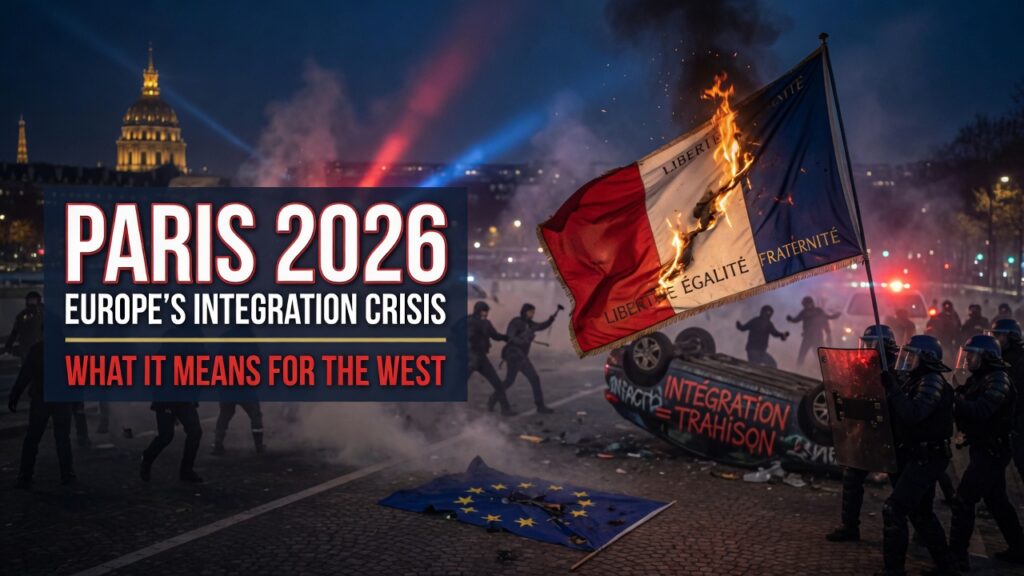
As post-match chaos engulfs French cities for the second consecutive year, a deeper and more urgent question is emerging — not about football, but about governance, accountability, and the cost of policies that millions of Europeans were never asked to vote on.
Burning cars. Riot police. 780 arrests in a single night.
The images streaming out of Paris on May 30–31, 2026 are not new — and that is precisely the problem. For the second straight year, celebrations following a Paris Saint-Germain Champions League victory descended into widespread violence, looting, and destruction across France. But while the trigger was a football match, the underlying conditions that make French cities so combustible have been building for decades — and no amount of teargas will extinguish them.
Support Independent Local Journalism
TheTownHall.News is a non-profit reader-supported journalism. Just $5 helps us hire local reporters, investigate important issues, and hold public officials accountable across Alameda County. If you believe our community deserves strong, independent journalism, please consider donating $5 today to support our work.What Actually Happened in Paris — And What the Headlines Missed
Let’s be precise, because precision matters here. According to confirmed reporting from Reuters, The Guardian, and Al Jazeera, the May 2026 unrest was primarily post-match rioting tied to PSG’s Champions League win over Arsenal. The verified facts: 780 detained, 57 officers injured, hundreds of vehicles torched, shops looted along the Champs-Élysées, and at least two deaths — one a road accident, one a separate incident elsewhere in France. France deployed 22,000 police officers in anticipation of trouble.
It is critical to note what is not verified: viral social media posts claiming the riots were explicitly driven by demands for Sharia Law or coordinated religious chanting are not supported by credible sourcing from Reuters, AP, BBC, or any established European outlet. Responsible journalism requires drawing that distinction clearly.
However, correcting a fabricated narrative does not mean dismissing the real and documented crisis France is facing.
Is This Really Just About Football?
No serious analyst believes 780 arrests and hundreds of burned vehicles are simply the collateral damage of sporting passion.

France has experienced a pattern of severe post-match civil unrest that has grown more destructive year over year. In 2025, PSG’s first Champions League win produced two deaths and nearly 200 injuries. In 2026, the same scenario unfolded with higher arrest numbers and broader geographic spread — incidents were recorded in approximately 15 cities across the country. This is not a coincidence. It is a repeating systemic failure.
When a society’s social fabric is strong, people celebrate in the streets. When it is fraying, they burn them.
The French government’s own interior minister acknowledged that the violence was concentrated in specific neighborhoods — areas that sociologists, urban planners, and French civic leaders have repeatedly identified as zones of chronic unemployment, generational poverty, and institutional neglect. These are not abstract policy talking points. They are the measurable outcomes of decisions made — and not made — over decades.
Who Is Actually Paying the Price for These Policies?
The honest answer: ordinary French citizens, small business owners, and the residents of the very communities that bore the brunt of the destruction.
The shops looted along the Champs-Élysées were not owned by government ministers. The cars torched in suburban arrondissements were not government vehicles. The officers injured — 57 of them — were working-class civil servants doing a dangerous job in predictable conditions that their leadership failed to address structurally.
Support Independent Local Journalism
TheTownHall.News is a non-profit reader-supported journalism. Just $5 helps us hire local reporters, investigate important issues, and hold public officials accountable across Alameda County. If you believe our community deserves strong, independent journalism, please consider donating $5 today to support our work.“When the same crisis repeats itself year after year with no structural solution, it stops being a crisis. It becomes a policy choice.”
France spends among the highest proportions of GDP on social welfare in the developed world [OECD data]. And yet, by virtually every measure — youth unemployment in disadvantaged suburbs, educational attainment gaps, civic participation rates — the return on that investment in specific communities has been deeply insufficient. The question that demands an answer from policymakers is not whether more money is needed. It is whether the current model of top-down, dependency-building welfare policy is structurally capable of producing the integration and upward mobility it promises.
What Do Supporters of Current Integration Policy Actually Believe?
This is a fair question worth answering honestly. Defenders of France’s immigration and integration framework make several substantive arguments.
They point out that the rioters represent a tiny fraction of France’s diverse communities, the vast majority of whom are law-abiding, taxpaying citizens who condemn the destruction. They argue that poverty, not culture or origin, is the root driver of unrest — and that the solution is more investment in education, job training, and social infrastructure, not less. They also note, correctly, that post-victory riots are not uniquely French: Vancouver, Philadelphia, and London have all experienced similar post-championship chaos.
These points deserve engagement, not dismissal.
But here is where the argument breaks down: France has been making these same investments, in the same framework, with the same institutional assumptions, for thirty years. At what point does a compassionate society demand that its compassion produce measurable results — rather than repeating the same cycle of crisis, spending, and silence? Personal responsibility must function at the institutional level as well as the individual. When a policy framework consistently fails the people it claims to serve, accountability is not cruelty. It is the minimum standard of competent governance.
22,000. The number of police officers France deployed for a single night of football celebrations. The question no one in the Élysée Palace wants to answer: how long can a democracy sustain itself on riot control instead of root cause reform?
Is There a Model That Actually Works?
The honest answer is yes — and the evidence points toward societies that prioritize civic integration over cultural isolation, employment pathways over permanent welfare dependency, and community accountability structures alongside government support.
Countries with the most successful integration outcomes share common characteristics: clear civic expectations communicated at the point of arrival, labor market access prioritized over bureaucratic resettlement, and strong local community governance rather than centralized state management. None of these are radical propositions. They are the practical conclusions of the research. [Migration Policy Institute, various studies 2018–2024]
The question is not whether France can afford to change course. It is whether French political leadership has the will to be honest with its citizens — and with itself — about what the evidence actually shows.
Are We Watching Europe’s Accountability Moment — Or Its Last Warning?
France is not alone. Similar patterns of post-event civil unrest, concentrated in specific suburban zones, have been documented in Germany, Sweden, and the United Kingdom over the past decade. What is happening in Paris is not a uniquely French failure — it is a preview of what happens when democratic governments prioritize short-term political comfort over long-term civic honesty.
The riots of May 2026 will be cleaned up. The broken glass will be swept. The politicians will give press conferences. The arrests will be processed. And then, in all likelihood, the cycle will begin again — because the structural conditions that produce these nights of chaos will remain unchanged.
That is the story no viral post, and no government press release, fully tells.
Key Questions This Article Raises
- At what point does a repeated policy failure become a deliberate policy choice — and who in government is accountable for that distinction?
- Is France’s model of centralized welfare and social investment structurally capable of delivering the civic integration it promises, or has it created the conditions it was designed to prevent?
- If the same level of destruction occurred in a wealthier, more politically connected neighborhood, would the policy response look different — and what does the answer tell us about whose security actually matters?
The Bottom Line
The Paris riots of 2026 are real. The destruction is documented. The pattern is undeniable. And the social media narratives that distort this crisis with fabricated religious conspiracies do something genuinely dangerous: they let the actual policymakers — the ones who designed these systems, who fund them, who defend them — completely off the hook.
The real accountability question isn’t whether a viral post was accurate. It’s whether the people in charge of France’s cities will ever be asked — seriously, publicly, and without deflection — why the same crisis keeps happening on their watch.
What do you think — is it too late for European governments to change course, or is the political will simply not there? Share this article and make your voice heard.
Still have questions? Stay informed — subscribe for daily coverage of European policy, civic affairs, and accountability journalism.
Think others need to hear this? Share the article with someone who’s been watching these stories unfold.
Want your voice to count? Contact your elected representative or MEP and ask them directly: what is the measurable integration outcome target for 2030, and who is accountable if it isn’t met?