El Paso City Council Candidate, Sean Austin Orr, Arrested for Child Sexual Assault — What Went Wrong?
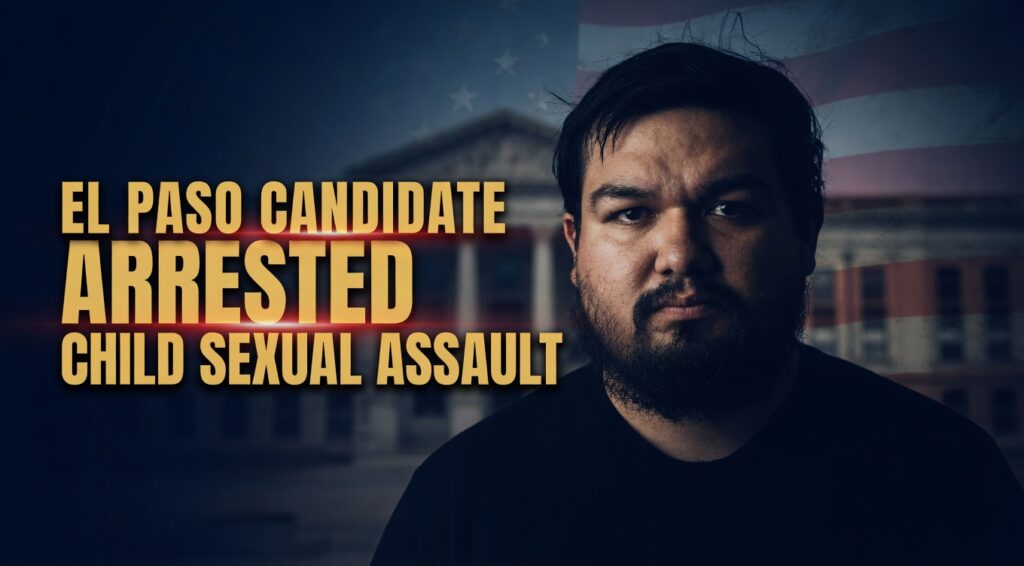
A former city council candidate was just charged with sexually assaulting a child. The real question isn’t just who he is — it’s how he got this far in the first place.
A man who wanted to represent your neighborhood just got arrested for allegedly raping a child. That sentence should stop every voter in America cold.
On May 29, 2026, Sean Austin Orr — a former candidate for El Paso City Council, District 5, who ran in the November 2024 special election and had previously served as a DNC State Delegate — was booked into an El Paso jail on charges including sexual assault of a child, indecency with a child, and three counts of possession with intent to promote child pornography. His bond was set at $1.1 million. The alleged crimes reportedly occurred between February and May 2023, while he was grooming his way into public life. He ran for public office while this was allegedly happening.
That is not a political statement. That is a timeline — and it demands a serious public conversation.
Support Independent Local Journalism
TheTownHall.News is a non-profit reader-supported journalism. Just $5 helps us hire local reporters, investigate important issues, and hold public officials accountable across Alameda County. If you believe our community deserves strong, independent journalism, please consider donating $5 today to support our work.What Exactly Did Investigators Uncover?
The details of the arrest affidavit, as reported by El Paso’s KVIA ABC 7 News, are deeply disturbing. According to investigators, Orr met the victim when she was just 13 years old through social media. He cultivated a relationship with her over time, and by the time she was 15 or 16, the abuse had begun. Homeland Security Investigations (HSI) agents, working alongside El Paso Police, traced child sexual abuse material (CSAM) uploaded to a Russian digital storage website back to Orr’s personal email address.
Here is the detail that should make every voter sit up straight: that same email address — the one tied to uploaded images of child sexual abuse — was the identical address Orr used when he applied to appear on the November 2024 city council ballot.
He was allegedly uploading criminal material and running for office at the same time.
$1.1 Million Bond. One Question Nobody Is Asking Loudly Enough.
$1,100,000 — the bond set for a man who asked voters to trust him with their community.

How does a person with this alleged conduct running in the background get on a ballot at all? The question isn’t rhetorical — it reflects a genuine structural gap in how American cities vet candidates for local office.
Unlike candidates for federal positions, school employees, or even volunteer youth coaches, city council candidates in most jurisdictions — including El Paso — are not required to submit to a criminal background check before their name appears on a ballot. The barrier to entry is primarily administrative: filing paperwork, paying a fee, gathering signatures. Character is assumed. History is unverified.
If a youth football coach requires a background check before standing on a sideline, why doesn’t a city council candidate require one before standing at a podium?
Is This a Systemic Failure — or Just One Bad Actor?
It would be tempting to dismiss Orr as an isolated case — one disturbed individual who slipped through the cracks. But that dismissal is precisely the kind of comfortable thinking that allows institutional failures to persist.
Child safety advocates and law enforcement professionals have long argued that predators are not random. They seek positions of trust, access, and authority. They become coaches, mentors, community figures — and yes, sometimes political candidates. The structure of local elections, with minimal vetting and maximum public-facing opportunity, is not an accident predators would fail to notice.
Support Independent Local Journalism
TheTownHall.News is a non-profit reader-supported journalism. Just $5 helps us hire local reporters, investigate important issues, and hold public officials accountable across Alameda County. If you believe our community deserves strong, independent journalism, please consider donating $5 today to support our work.“The question isn’t just who Sean Orr is — it’s what kind of system allowed him to campaign for the right to govern families while allegedly abusing one of their children.”
Across the country, there is no uniform federal or state standard requiring background checks for city or county candidates. Some municipalities have explored it; most have not acted. The result is a patchwork of honor-system assumptions in an era where digital forensics, as this very case demonstrates, can unravel a double life in extraordinary detail.
The system that caught Sean Orr worked. The system that let him run for office didn’t.
What Do Supporters of Open Ballot Access Actually Believe?
To be fair, the argument against mandatory background checks for candidates has legitimate grounding in democratic principles. Civil libertarians and election law scholars point out that adding screening requirements to candidacy could create barriers that disadvantage lower-income or minority candidates who lack resources to navigate a bureaucratic vetting process. There is also the constitutional concern: in America, the presumption of innocence is foundational, and pre-screening mechanisms could be weaponized by incumbent political establishments to exclude challengers.
These are real concerns, and they deserve honest engagement — not dismissal.
But there is a meaningful difference between a structural barrier to candidacy and a basic public safety check. Background screening for CSAM convictions or sex offender registry status is not a political litmus test. It is the same standard we apply to librarians, school bus drivers, and Little League coaches. A reasonable, narrowly scoped, non-partisan requirement — focused specifically on violent and sex-offense history — does not amount to a constitutional crisis. It amounts to common sense.
The burden of proof required for a criminal conviction is high and rightfully so. But the question of who appears on a public ballot — asking citizens for the privilege of governing them — is a separate matter entirely.
Are Parents and Voters Being Left Exposed?
This case lands in El Paso, but the vulnerability it reveals is national. Orr wasn’t a fringe figure operating in the dark. He was a DNC State Delegate who filled out candidate surveys, attended community meetings, and presented himself as an advocate for law and order — his own campaign platform explicitly cited “enhancing community policing” as a priority. He spoke at high schools. He volunteered as an elementary school track coach.
If a predator can campaign on a platform of public safety while allegedly victimizing a child, the system isn’t protecting families — it’s providing cover.
Federal investigators ultimately cracked this case through digital forensics — tracing an email to a Russian file-sharing server. That is not a reassuring origin story for accountability. It means justice here was largely a matter of luck and investigative resources, not systematic prevention. For every case that HSI agents have bandwidth to pursue, how many go uninvestigated at the local level?
What Happens Now — And Who Is Responsible for the Answer?
Orr lost his 2024 city council bid and is now facing six felony-level charges. The legal system is moving. HSI did its job. El Paso law enforcement did its job. That is worth acknowledging plainly.
But accountability cannot begin and end with arrest. The parents of this community — and communities across the country — deserve a policy conversation that extends beyond this individual case. State legislatures have the authority to mandate basic background screening for ballot candidates. City councils can adopt ethics ordinances requiring disclosure of sex-offender registry status as a condition of candidacy. Political parties — both of them — can implement internal vetting standards that go beyond the paperwork.
None of these measures would violate constitutional rights. All of them would serve the families whose children attend the schools, parks, and events where political candidates present themselves as community champions.
What do you think — should every candidate for local office be required to pass a basic background check before their name goes on a ballot? Share this article and make your voice heard.
Key Questions This Story Raises
- Why are city council candidates held to a lower safety standard than school volunteers? Most municipalities require background checks for anyone working with youth — but not for the people seeking to govern the communities those youth live in.
- What responsibility do political parties bear when a credentialed party operative is later charged with crimes against children? At what point does vetting become a shared obligation across institutions?
- How many similar cases go undetected because federal investigative resources aren’t available for local-level crimes? HSI cracked this case. But HSI is not omnipresent — and local departments often lack the digital forensics capacity to follow the same trail.
The Question Every Voter Should Walk Away With
This story is about one man, one victim, and one arrest. But it points toward a broader question that no elected official — at any level, in any party — has adequately answered: Who is watching the gate?
The legal system responded when investigators had evidence. But the candidate vetting system — the layer of protection that should have existed before the ballots were printed — offered nothing. In an era when we scan ID at the pharmacy and run credit checks to rent an apartment, the bar for public office at the local level remains functionally nonexistent.
Child safety is not a partisan issue. Law and order is not a talking point — it is a governing responsibility. And parental rights begin with the basic assurance that the people asking for power over your community have been minimally screened before they get it.
The real question isn’t whether this case is alarming. It’s whether we wait for the next one before demanding something changes.
Take Action
Still have questions? Stay informed — subscribe for daily coverage of local government accountability and civic news.
Think others need to hear this? Share this article with parents, neighbors, and local voters in your community.
Want to make your voice count? Contact your state representative and ask them directly: Does your state require background checks for city council candidates? Find your Texas state legislator at capitol.texas.gov.