India’s Fake Degree Bust: How Strong Is the U.S. Foreign Credential Verification System?
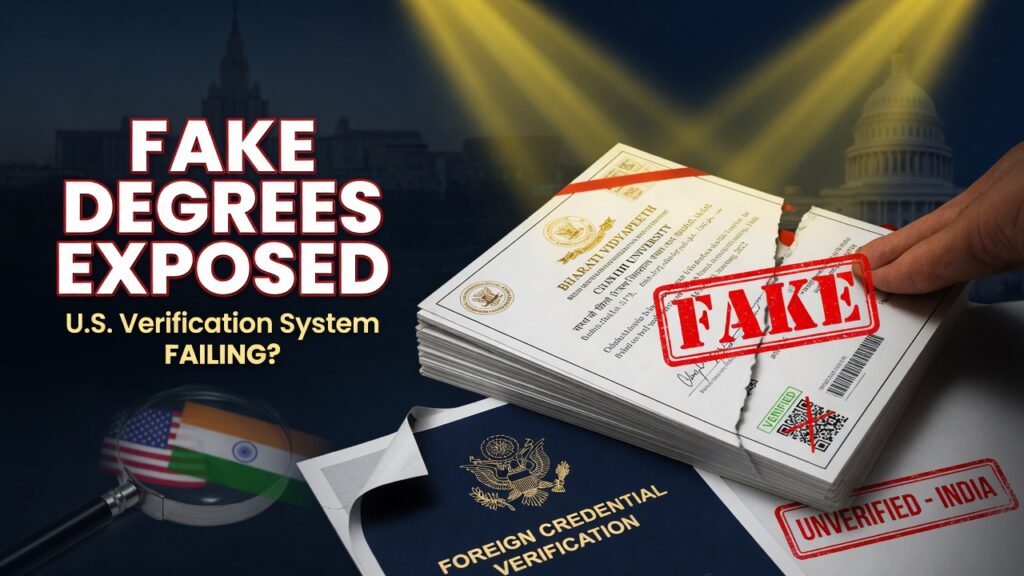
As one of the largest credential fraud operations in modern history unravels in India, a critical question demands an honest answer: are the systems protecting American jobs, hospitals, and infrastructure actually built to stop a forged piece of paper?
A bust this big doesn’t stay local for long. In December 2025, Kerala Police dismantled a pan-India criminal network that manufactured and distributed over 100,000 counterfeit university certificates — covering medicine, nursing, and engineering — linked to approximately 22 universities. Eleven suspects were arrested. Investigators believe the total output of fake credentials may exceed one million documents circulated over the years.
The scale is staggering. But the more uncomfortable question isn’t what happened in India. It’s what, if anything, slipped through on this side of the world — and whether the systems Americans rely on were ever designed to catch it.
Support Independent Local Journalism
TheTownHall.News is a non-profit reader-supported journalism. Just $5 helps us hire local reporters, investigate important issues, and hold public officials accountable across Alameda County. If you believe our community deserves strong, independent journalism, please consider donating $5 today to support our work.What Did Kerala Police Actually Uncover?
The operation was sophisticated, not sloppy. Authorities seized hundreds of printers and computers, forged university seals, stamps, holograms, and signature templates — an industrial-scale forgery infrastructure designed specifically to produce documents that pass casual inspection.
The alleged ringleader, identified as Dhaneesh (alias “Dany”), was a repeat offender. He had previously been arrested for similar crimes in 2013, served his sentence, and rebuilt the operation — this time with a wider distribution network spanning Tamil Nadu, Karnataka, Andhra Pradesh, Maharashtra, Goa, Delhi, and West Bengal. He was arrested in Kozhikode while reportedly attempting to flee the country with his family.
Certificates reportedly sold for ₹75,000 to ₹1.5 lakh — approximately $900 to $1,800 each. [Arab Times/Kerala Police announcement, December 2025] Investigators are now probing whether institutional insiders may have provided templates or authorized signature samples.
“When a document has been produced using insider knowledge of institutional formats, there may be nothing visibly wrong with it at all. At that point, the question is no longer does this look genuine? — it’s is this genuine?” — Qualification Check fraud analysis report, 2026
What Do the Numbers Actually Tell Us?
100,000+ forged certificates seized. An estimated 1 million potentially in circulation. The question no one wants to sit with: how many crossed an international border?

Investigators confirmed the network targeted domestic Indian employment markets as its primary customer base. Some certificates, however, were reportedly used to obtain work visas abroad, including to the United States and Australia. The Australian political response was immediate — Senator Malcolm Roberts publicly challenged Prime Minister Anthony Albanese to address the issue of fraudulent Indian applicants entering Australia’s visa system. [India Today, January 2026]
The U.S. has not yet announced a formal policy response to the Kerala bust specifically. That silence itself is worth examining.
How Does the U.S. Vet Foreign Medical Credentials — and Is It Enough?
For foreign-trained physicians entering the American healthcare system, the credentialing pathway is genuinely rigorous. The Educational Commission for Foreign Medical Graduates (ECFMG) has required primary-source verification since 1986 — meaning it contacts issuing medical schools directly to authenticate every diploma and transcript, cross-referencing against a decades-deep library of verified credential samples. Applicants must then pass multiple steps of the United States Medical Licensing Examination (USMLE), complete accredited residency programs, and clear state licensing boards.
This is not a rubber stamp. It is a multi-year gauntlet — and it matters, because approximately 59,000 Indian-origin physicians currently practice in the U.S., representing roughly 1 in 5 immigrant doctors and filling critical shortages in rural and underserved communities. [Times of India; AAMC 2025 Key Findings] The pathway these professionals navigated is among the most demanding in the world.
The genuine gap, however, lies elsewhere. Nursing, mid-level engineering roles, and other skilled professions that fall under H-1B and related visa categories face less standardized primary-source verification. The rigor depends heavily on the employer, the state, and whether a credentialing agency is involved. That inconsistency is where the real policy conversation needs to happen.
Support Independent Local Journalism
TheTownHall.News is a non-profit reader-supported journalism. Just $5 helps us hire local reporters, investigate important issues, and hold public officials accountable across Alameda County. If you believe our community deserves strong, independent journalism, please consider donating $5 today to support our work.What Do Supporters of the Current System Actually Believe?
Defenders of existing verification frameworks make a legitimate point: the ECFMG model proves that robust primary-source verification works. Thousands of competent, thoroughly vetted foreign-trained professionals contribute enormously to American healthcare and innovation every year. To suggest systemic failure based on one criminal operation in India — whose primary market was domestic — risks doing serious injustice to professionals who cleared every legitimate bar set before them.
They also argue that credential fraud is not an immigration-specific problem. Domestic degree fraud, diploma mills, and falsified resumes cost American employers billions annually and affect workers of every background.
Both points are fair. And neither one is a reason to avoid asking whether the current system is uniformly applied across all visa categories, all professions, and all credential types. Personal responsibility and institutional accountability are not competing values — they reinforce each other. A system that works for physicians but has gaps for nurses and engineers is not a finished system. It is a partially finished one.
Is This the Accountability Moment the System Has Been Waiting For?
If a criminal network can produce 100,000 convincing fake degrees, the burden of proof has shifted — verification cannot be optional, and “looks legitimate” can no longer be good enough.
The Kerala bust is not a reason for panic. It is a reason for precision. Credential verification experts responding to the scandal have been unambiguous: document inspection alone — even by trained eyes — cannot catch sophisticated forgeries produced with insider knowledge of institutional formats. Only primary-source verification, meaning direct confirmation from the issuing institution, closes the gap reliably.
What would responsible policy reform actually look like? Several concrete steps are defensible, proportionate, and grounded in existing best practices:
Mandatory primary-source verification for all regulated professional categories under employment-based visas — not just physicians — is an achievable standard. Targeted re-verification of credentials from institutions or networks flagged in criminal investigations is legally defensible and narrowly scoped. Real-time data sharing between U.S., Indian, Australian, and other allied regulatory bodies would help fraud patterns surface faster. And expanded employer accountability — requiring companies sponsoring H-1B workers to document the verification steps taken — shifts appropriate responsibility onto the institutions with the most direct knowledge.
None of these measures require inflammatory rhetoric. All of them require political will.
Are Our Leaders Even Listening — or Waiting for a Crisis That’s Already Here?
Australia moved quickly. Politicians there demanded answers within weeks of the Kerala bust becoming international news. The U.S. has been quieter.
That is worth noting — not because the systems are broken, but because systems that are never stress-tested against emerging threats tend to fail precisely when the stakes are highest. Fiscal accountability means not waiting until a scandal forces an emergency audit. Law and order means building enforcement capacity before the problem scales, not after.
The question isn’t whether every foreign-trained professional in America is suspect — they are not, and treating them as such would be both unjust and self-defeating. The question is whether we can honestly say every system designed to protect the public is operating at the standard we expect.
Key Questions This Story Raises
- Does the U.S. government have a comprehensive, uniform primary-source verification standard for all foreign credentials used in employment-based visa applications — or only for some professions?
- Has USCIS or any federal agency initiated a review of credentials from networks or institutions implicated in the Kerala investigation?
- What accountability mechanisms exist for employers who sponsor H-1B workers without conducting thorough independent credential verification?
The real question this story leaves every reader with is not about India. It is about institutional honesty. Every system that touches public safety — from hospital credentialing to visa adjudication — carries an implicit promise: we checked. After a bust of this scale, the reasonable demand of any citizen is simple: prove it.
The Kerala operation was exposed by Indian police doing their jobs. The follow-through — ensuring those credentials never passed through doors they weren’t supposed to open — is now someone else’s responsibility. The question is whether anyone in a position of authority is treating it that way.
What do you think — is a uniform federal credentialing standard long overdue, or does the existing system deserve more credit than it’s getting? Share this article and weigh in.
Still have questions about how foreign credentials are vetted in the U.S.? Subscribe for ongoing coverage of immigration policy, public safety, and government accountability.
Think this story deserves wider attention? Share it with your network.
Want to make your voice heard? Contact your Congressional representative and ask what standard of primary-source verification applies to employment-based visa categories beyond medicine. The answer — or the absence of one — is itself informative.