
United Flight 2005 Cockpit Breach: What the FAA Data Really Reveals?
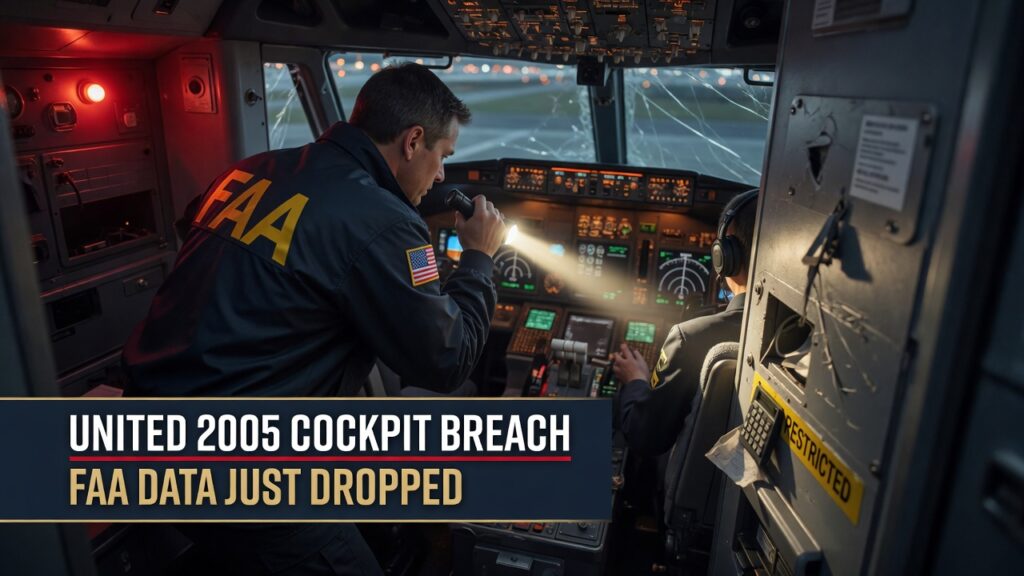
As a passenger allegedly made multiple attempts to storm the cockpit on a Chicago-to-Minneapolis flight, Americans are left asking a question no official seems eager to answer: who is actually keeping us safe at 35,000 feet — and why does it keep coming to this?
The breach failed. The plane landed. And then the government said almost nothing.
On the night of May 29, 2026, United Airlines Flight 2005 — a Boeing 737 carrying 147 passengers and six crew — was diverted from its Chicago-to-Minneapolis route and forced to land at Madison, Wisconsin’s Dane County Regional Airport after a passenger made what air traffic control audio, reviewed by CNN, described as “multiple attempts to breach the cockpit.” The threat was neutralized not by a federal security system, but by off-duty law enforcement officers who happened to be sitting in coach.
Support Independent Local Journalism
TheTownHall.News is a non-profit reader-supported journalism. Just $5 helps us hire local reporters, investigate important issues, and hold public officials accountable across Alameda County. If you believe our community deserves strong, independent journalism, please consider donating $5 today to support our work.That detail alone should give every American pause.
What Actually Happened on United Flight 2005?
The trouble reportedly started before the wheels left the runway. According to eyewitness Mike Rundle, who spoke to CNN, the passenger stood up during taxiing at O’Hare International Airport and had to be repeatedly told to sit down. Crew members were observed asking whether any passenger on board could speak Russian — suggesting a possible language barrier complicated the situation from the outset. The flight took off anyway.
Midair, the passenger moved to the front of the aircraft and made multiple attempts to breach the fortified cockpit door. Passengers described chaos near the front of the cabin. Off-duty law enforcement officers on board stepped in, physically restrained the man, and held him in his seat — flanked on both sides — until the aircraft touched down in Madison. Police boarded the plane, handcuffed the individual, and removed him from the aircraft. The remaining passengers then continued to Minneapolis.
The FBI’s Milwaukee Resident Agency confirmed it responded to the scene alongside the Dane County Sheriff’s Office. As of the time of publishing, the suspect’s identity remains undisclosed, and no formal charges have been announced.

Is the Government’s Silence After This Incident Acceptable?
Passengers deserve answers — and so far, they aren’t getting them. Federal authorities have confirmed a detention. They have confirmed an FBI response. What they have not confirmed is a charging decision, a motive, a name, or a timeline for accountability. In an era when the federal government tracks and publicizes minute details of passenger screening statistics, the silence following a cockpit breach attempt feels conspicuous.
640. That’s how many unruly passenger incidents airlines have already reported to the FAA in 2026 alone. The question no one in Washington seems willing to answer: why is the number still climbing? [Federal data, FAA]
The FAA has issued fines and opened investigations, but the agency’s own numbers reveal a troubling gap between enforcement rhetoric and results. Of 492 reports of unruly passengers filed through late April 2026 [federal data, FAA], only 24 resulted in actual enforcement actions, and total fines issued amounted to $600,000 — a figure that sounds significant until you realize it averages out to roughly $25,000 per enforcement action across an industry carrying tens of millions of passengers monthly.
A Disturbing Pattern That Demands More Than Press Releases
Flight 2005 is not an anomaly. It is a data point in a pattern that authorities have been slow to address with the urgency it demands.
Earlier in May 2026, United Airlines Flight 1837 — traveling from the Dominican Republic to Newark — declared a full in-flight emergency after a 48-year-old passenger allegedly attacked a flight attendant and attempted to force his way into the cockpit. He was detained by Port Authority Police and transported for psychiatric evaluation. The FAA opened an investigation. And the cycle repeated itself.
Support Independent Local Journalism
TheTownHall.News is a non-profit reader-supported journalism. Just $5 helps us hire local reporters, investigate important issues, and hold public officials accountable across Alameda County. If you believe our community deserves strong, independent journalism, please consider donating $5 today to support our work.“When a cockpit breach attempt happens once, it’s an incident. When it happens twice in the same month on the same airline — with federal investigators still processing paperwork — it’s a failure of institutional accountability.”
Both incidents share something significant: the immediate response came from people on the plane, not from any government-run security layer above the airport checkpoint. The crew held the line. Off-duty officers held the line. Regular passengers held the line. The system, as designed by Washington, was a secondary actor in both cases.
What Do Supporters of Current Aviation Security Policy Actually Believe?
To be fair, there is a credible case to be made for the existing framework. Supporters of current FAA and TSA protocol would rightly note that cockpit doors reinforced under post-9/11 aviation regulations have an exceptional track record — no successful breach has resulted in a catastrophic hijacking on a U.S. commercial flight since those measures were implemented. The multi-layered system, they argue, is working precisely as designed: the door held, the crew responded, and law enforcement contained the threat.
They would also point out that unruly passenger incidents, while still too frequent, have declined dramatically from the 2021 pandemic-era peak of nearly 6,000 annual reports [federal data, FAA]. Progress, they say, is real even if it isn’t perfect.
These are not frivolous arguments. But they raise a deeper question: if the system is working, why does it consistently rely on ordinary citizens and off-duty personnel to do the heavy lifting when federal security layers are either absent or ineffective mid-flight? Acknowledging incremental improvement is not the same as answering for structural gaps that leave passengers exposed.
Who Is Really Accountable When the Cockpit Door Becomes the Last Line of Defense?
Personal responsibility and civic courage — values that Americans across the political spectrum claim to champion — were on full display inside that Boeing 737. Off-duty officers acted without hesitation. Crew members managed a volatile, multilingual situation under pressure at altitude. Passengers stayed calm. These are the kinds of individuals the system depends on far more than official protocols like to admit.
If it weren’t for off-duty law enforcement already on that plane, the outcome of United Flight 2005 might look very different right now.
But dependence on luck — on the fortunate coincidence of having trained officers aboard — is not a security policy. It is a prayer. And prayers, while admirable, are not a substitute for accountable governance, fully staffed federal enforcement pipelines, and transparent post-incident reporting that tells the American public what happened, why, and what consequences followed.
We have every right to ask: if a man can stand up during taxiing, refuse to comply, and still board a commercial flight — what exactly is our security infrastructure screening for?
Is This the Accountability Moment the Flying Public Has Been Waiting For?
The FAA can propose fines of up to $43,658 per violation [federal data, FAA]. Federal law authorizes imprisonment of up to 20 years for assaulting or interfering with a flight crew. The legal architecture for consequence is robust. The follow-through, based on the public record of 2026, is not.
Law and order means nothing without enforcement. Fiscal accountability means nothing when fines are proposed but rarely collected in full. And free speech means nothing if passengers and crew members cannot demand transparency from the agencies funded by their tax dollars to keep them safe.
Key Questions This Story Raises:
- Why has the suspect’s identity not been disclosed, and when will charges — if any — be formally announced by federal prosecutors?
- If 640 unruly passenger incidents have been reported to the FAA in 2026 and only 24 resulted in enforcement actions, is the agency’s zero-tolerance policy anything more than a talking point?
- Should Congress hold public hearings on the structural gaps that repeatedly require ordinary passengers and off-duty personnel to serve as the de facto last line of cockpit defense?
The real question isn’t whether aviation security has room to improve. It’s whether anyone in authority will be forced to answer for it before the next flight diverts — or worse.
What do you think — is it time Congress demanded a full accounting of FAA enforcement failures? Share this article and tell us where you stand.
Still have questions about aviation safety and government accountability? Subscribe for daily coverage of the stories that affect your life and your rights.
Think others need to hear this? Share this article with someone who flies.
Want to make your voice count? Contact your congressional representative and demand a public hearing on FAA enforcement data and in-flight security gaps. You can find your representative at house.gov.