Wearable Cancer Patch Destroys 97% of Tumors: What You Need to Know
A graphene patch just destroyed 97% of melanoma tumors in mice — no surgery, no chemotherapy, no hospital stay. The science is real. So why does the path to your doctor’s office still look like a 20-year detour?
A patch smaller than a bandage may be quietly rewriting the future of cancer treatment. Published in ACS Nano in April 2026, new research from a Chinese team of scientists describes a flexible, laser-activated graphene patch that eliminated up to 97% of melanoma tumors in mice over just ten days — without a single incision.
This matters right now because melanoma is not a distant threat. Over six million people are diagnosed with skin cancer every year globally, and melanoma — the most aggressive subtype — accounts for roughly 80% of skin cancer-related deaths [ACS journal data, 2026]. The technology described in this study isn’t science fiction. It’s peer-reviewed, published science. What happens next, however, is where the questions get uncomfortable.
Support Independent Local Journalism
TheTownHall.News is a non-profit reader-supported journalism. Just $5 helps us hire local reporters, investigate important issues, and hold public officials accountable across Alameda County. If you believe our community deserves strong, independent journalism, please consider donating $5 today to support our work.How Does This Wearable Cancer Patch Actually Work?
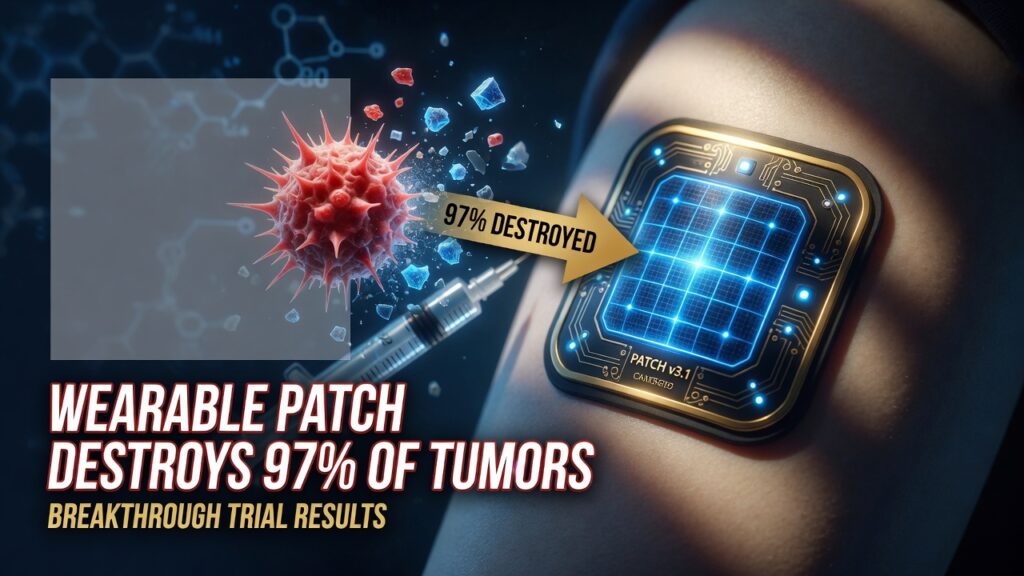
The patch itself is deceptively simple in concept. Researchers embedded copper oxide nanoparticles into laser-induced graphene — a porous carbon material — and suspended the structure in a flexible silicone polymer. The result is a breathable, transparent, stretchable patch that sits directly over a tumor site.
When activated by a low-power laser heated to just 42 degrees Celsius — barely above a warm bath — the patch releases copper ions into the tissue beneath it. Those ions trigger a cascade of cell death mechanisms: apoptosis, ferroptosis, and cuproptosis, a recently identified process where copper accumulation destroys cancer cells at the mitochondrial level. Healthy tissue surrounding the tumor was left largely undamaged in the study.
Two one-hour activation sessions — on Day 1 and Day 5 — produced a 97% reduction in melanoma lesions within ten days. No copper accumulated in the organs or blood of the treated mice. The patch is also reusable across multiple treatment cycles.
97% tumor reduction. Two one-hour sessions. No surgery. The question is simple: why isn’t this already in human trials?

What Do the Numbers Actually Tell Us About the Cost of the Status Quo?
The current standard of care for melanoma is surgical excision — often followed by immunotherapy or targeted drug regimens that can cost patients tens of thousands of dollars per treatment cycle. The American cancer drug market alone is projected to exceed $300 billion annually by 2030 [industry analyst estimates, IQVIA].
Wearable, externally activated therapies represent a structurally different economic model. They are potentially low-cost to manufacture, reusable, and non-invasive — which means fewer hospital visits, fewer anesthesia bills, and fewer post-operative complications. For patients carrying high-deductible health plans or navigating underinsured rural healthcare, that difference isn’t academic. It’s the difference between treatment and bankruptcy.
“The promise of wearable medicine isn’t just scientific. It’s a direct challenge to the economics of a system that has long profited from complexity.”
Personal responsibility has always included the freedom to make informed medical choices. But that freedom is meaningless when the only available options are expensive, invasive, and controlled by a narrow institutional pipeline that takes two decades to approve what a research team can demonstrate in ten days.
What Do Supporters of the Current Medical Approval System Actually Believe?
To be fair, the case for rigorous clinical oversight is not cynical — it is grounded in history. Thalidomide. Vioxx. The opioid crisis. Each represents a moment when treatments moved too fast and patients paid the price with their lives or their health. Regulatory frameworks like the FDA’s multi-phase trial system exist precisely because early animal studies — even dramatic ones — frequently fail to replicate in humans.
Supporters of the current pathway rightly argue that 97% efficacy in a mouse model is not 97% efficacy in a human. Copper ion toxicity in human tissue may behave differently. Long-term immune responses, systemic effects, and laser delivery logistics all require rigorous study.
Support Independent Local Journalism
TheTownHall.News is a non-profit reader-supported journalism. Just $5 helps us hire local reporters, investigate important issues, and hold public officials accountable across Alameda County. If you believe our community deserves strong, independent journalism, please consider donating $5 today to support our work.These are legitimate concerns, and they deserve serious engagement — not dismissal.
But here is the fact-based response: the problem is not the existence of safety trials. The problem is a regulatory and funding environment where novel, non-pharmaceutical technologies often wait years simply to enter those trials — not because the science is insufficient, but because the financial incentives to accelerate non-drug therapies are structurally weaker than those driving pharmaceutical pipelines. A patch you use twice is not as profitable as a biologic you infuse monthly. That economic reality shapes timelines in ways that have nothing to do with patient safety.
If a treatment works and doesn’t generate recurring revenue, does the system have a real incentive to rush it to your door?
Is This the Beginning of a New Era — or Another Promising Dead End?
The melanoma patch is not an isolated discovery. Parallel research published concurrently in ACS journals describes a 3D-printed microneedle patch combining graphene quantum dots with chemotherapy agents, a bioelectronic patch generating immune-stimulating compounds via electrocatalysis, and integrated “theranostic” systems capable of both detecting cancer biomarkers and triggering drug release automatically.
This is a scientific wave, not a single study. And the broader wearable medical device market is already validating the direction: valued at approximately $54 billion in 2026 and projected to reach $84.7 billion by 2034 [Coherent Market Insights, 2026], the sector is expanding rapidly. Remote patient monitoring is now officially categorized as a mainstream healthcare trend by the American Association of Nurse Practitioners.
The distance between monitoring wearables — already in your doctor’s toolkit — and therapeutic wearables that treat cancer is real, but it is closing.
Who Should Decide How Fast This Technology Reaches Patients?
This is the civic question that underlies all the science. When a technology is developed — often with significant public funding, as this study was supported by China’s National Natural Science Foundation and National Key R&D Program — who controls the timeline to patient access?
Parental rights advocates and patient liberty groups have long argued that individuals, in consultation with their physicians, should have more direct access to experimental treatments when terminal or high-risk diagnoses leave conventional options limited. The FDA’s expanded access (“compassionate use”) pathway exists for exactly this reason — but it remains underutilized and poorly understood by most patients.
The government that funds science with your tax dollars should be accountable for explaining why it takes 20 years to turn a proven concept into an available treatment.
Fiscal conservatives should also be paying attention. Every year of delayed access to cheaper, non-invasive therapies is a year the healthcare system absorbs the full cost of surgical and pharmaceutical alternatives — costs that flow directly into insurance premiums, Medicare expenditures, and out-of-pocket patient burden.
Global melanoma cases are projected to approach 500,000 annually by 2040.
The question no one in the oncology establishment wants to answer plainly: how many of those patients could benefit from therapies that already exist in laboratories today?
The Real Question Isn’t Whether This Will Affect You
Wearable medicine is not a futuristic abstraction. It is a present-tense scientific reality moving toward clinical application across monitoring, drug delivery, and now — credibly — targeted cancer therapy. The melanoma patch published in ACS Nano this spring is one data point in an accelerating trend.
The researchers themselves are careful and honest: this is not a ready treatment. Clinical trials are required, and the science demands respect. But the principle is now demonstrated. A wearable device can target cancer tissue, kill it with precision, spare healthy cells, and leave no systemic toxicity — in a living biological system.
What happens next is not purely a scientific question. It is a question of priorities, incentives, funding, regulation, and ultimately, political will. It is a question of whether the institutions trusted to steward medical progress are genuinely accountable to patients — or to the financial architecture that surrounds them.
The real question isn’t whether wearable cancer treatment will one day reach your medicine cabinet. It’s whether the system will let it get there before it’s too late for the people who need it now.
What do you think — is the medical establishment moving fast enough on breakthrough technologies? Share this article and tell us where you stand.
Key Questions This Article Raises:
- Who controls the timeline between a proven laboratory result and an approved human treatment — and are those decision-makers accountable to patients or to profits?
- Should patients with terminal diagnoses have faster access to experimental wearable therapies under expanded consent frameworks?
- Is the regulatory pathway for non-pharmaceutical medical devices adequately funded and incentivized to move at the speed the science demands?
Still have questions? Subscribe for daily coverage of the science and policy stories that actually affect your life. Think others need to hear this? Share the article — and start the conversation. Want to make your voice count? Contact your Congressional representative’s health subcommittee office and ask specifically what their position is on FDA expanded access reform for novel medical devices.