
Minnesota Autism Fraud Bust: $442 Million Medicaid Scheme Charged in Historic DOJ Takedown
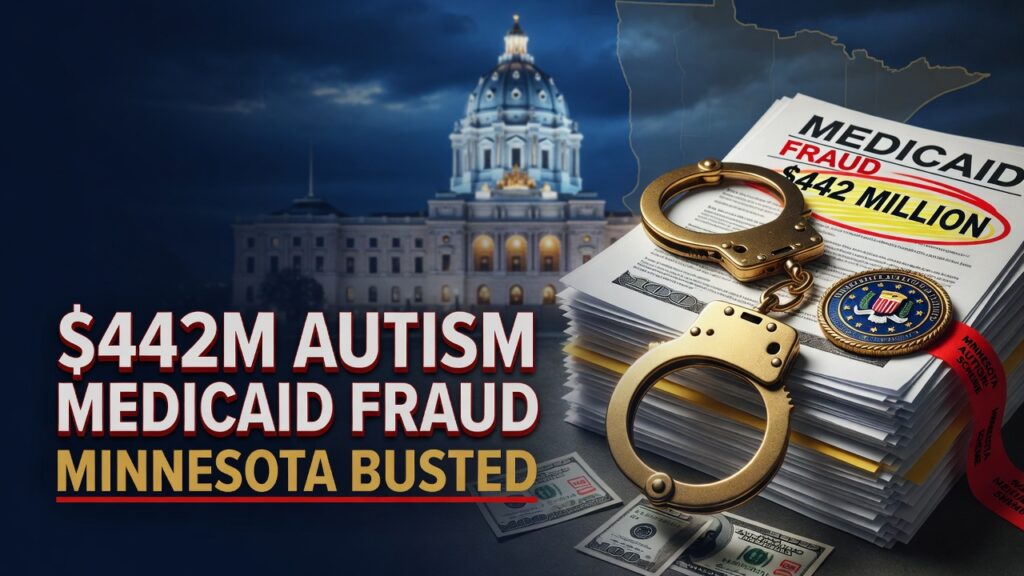
As the largest autism fraud bust in American history lands in a Minneapolis courtroom, millions of taxpayers and parents are demanding the same answer: how did $38 million quietly become $442 million — and why did it take this long for anyone to act?
Fifteen people have been charged. One suspect jumped from a fourth-floor balcony to escape investigators. And the bill handed to American taxpayers? Over $90 million in confirmed fraud losses — with potentially hundreds of millions more never recovered.
On May 21, 2026, the U.S. Department of Justice announced the Minnesota Health Care Fraud Takedown, a coordinated enforcement action that officials from the DOJ, HHS, FBI, and CMS called the most significant autism fraud prosecution in the nation’s history. This wasn’t a bureaucratic accounting error. According to federal prosecutors, it was a calculated, organized criminal operation — one that exploited the most vulnerable children in America while draining a Medicaid program that was supposed to protect them.
Support Independent Local Journalism
TheTownHall.News is a non-profit reader-supported journalism. Just $5 helps us hire local reporters, investigate important issues, and hold public officials accountable across Alameda County. If you believe our community deserves strong, independent journalism, please consider donating $5 today to support our work.What Do the Numbers Actually Tell Us?
The scale of the fraud is almost impossible to comprehend — until you see it laid out plainly.
In 2018, Minnesota’s Early Intensive Developmental and Behavioral Intervention (EIDBI) program — which funds medically necessary services for children under 21 with autism spectrum disorder — paid out just over $600,000 in total claims [federal data, DOJ press release, May 2026]. By 2025, that number had exploded to over $400 million annually. Not because Minnesota suddenly had more children with autism. Because, according to federal prosecutors, criminals had discovered a program with insufficient oversight and turned it into a personal ATM.
“This was not a paperwork error; it was not a technical violation. This was organized theft that exploited the most vulnerable children in America.” — HHS Secretary Robert F. Kennedy Jr., May 21, 2026
$600,000 to $400 million in just seven years. The question every Minnesota taxpayer — and every American parent — deserves answered: who was watching?
How Did Fraudsters Turn Children Into Billing Opportunities?
The alleged scheme was brazen in its simplicity and devastating in its impact.

According to DOJ charging documents, two lead defendants ran a network of fraudulent autism centers that paid kickbacks to parents in exchange for bringing their children in. Children were then diagnosed with autism regardless of medical necessity — fabricated diagnoses used solely to generate billing codes. Services were billed to Medicaid that were never provided. Real children with real needs were either misdiagnosed, underserved, or crowded out entirely by phantom patients generating phantom claims.
These were not victimless crimes. Real children with autism lost access to legitimate care because fraudsters were flooding the system with fake claims.
HHS Secretary Kennedy was unambiguous at the Minneapolis press conference: the defendants “deceived families, stole taxpayer dollars meant to help children with autism access legitimate care, and treated children as billing opportunities.” Acting Attorney General Todd Blanche called it organized theft carried out “while providing substandard care for children.”
Is the Autism Fraud Just the Beginning of a Much Larger Problem?
The EIDBI autism scheme was the headline — but it was far from the whole story.
The same May 21 takedown charged defendants across four additional Minnesota Medicaid programs, each telling a nearly identical tale of explosive growth followed by systemic exploitation. The Individualized Home Supports (IHS) program grew from $100 million in 2018 to over $700 million in 2025 [federal data, DOJ]. Two defendants allegedly acquired more than 20 properties, housed vulnerable disabled Medicaid recipients in those properties, and billed for services never rendered — spending proceeds on luxury automobiles and jewelry.
Support Independent Local Journalism
TheTownHall.News is a non-profit reader-supported journalism. Just $5 helps us hire local reporters, investigate important issues, and hold public officials accountable across Alameda County. If you believe our community deserves strong, independent journalism, please consider donating $5 today to support our work.The Housing Stabilization Services (HSS) program, designed to help people with disabilities find and maintain housing, was so thoroughly compromised that Minnesota was forced to shut it down entirely on October 31, 2025. The program had been projected to cost $2.6 million annually. It paid out over $104 million in 2024 alone [federal data, DOJ]. Eight defendants in Thursday’s charges included out-of-state residents from Pennsylvania who engaged in what prosecutors described as “fraud tourism” — literally traveling to Minnesota because of how easy it was to steal.
In one particularly chilling case involving the Integrated Community Supports program, a Medicaid recipient requiring 24-hour care was found deceased the day after a provider billed for services he never received.
What Do Supporters of This Policy Actually Believe?
It would be unfair — and inaccurate — to suggest that Minnesota’s expanded Medicaid programs were designed with malicious intent.
Defenders of these programs, and of Governor Tim Walz’s administration, argue that rapidly expanding access to disability services and autism care reflects a genuine and compassionate policy priority. They contend that the fraud was the work of bad actors exploiting any accessible system, and that the existence of fraud doesn’t negate the real need these programs were built to address. Civil liberties and advocacy groups have also raised concerns about the use of fraud cases to justify broader immigration enforcement operations, like the Trump administration’s “Operation Metro Surge” in Minnesota, which resulted in significant civil rights scrutiny.
These are fair points — and they deserve serious engagement.
But fiscal accountability and compassionate governance are not mutually exclusive. A program that grows from $600,000 to $400 million in seven years without triggering automatic audits, program reviews, or enrollment safeguards is not a well-managed program — regardless of its intentions. The question is not whether vulnerable children deserve support. They absolutely do. The question is whether the systems built to deliver that support were designed with any meaningful accountability at all.
Strong oversight protects both taxpayers and the legitimate beneficiaries those programs exist to serve. Fraud at this scale doesn’t just cost money — it actively crowds out real children with real needs.
Is This the Accountability Moment We’ve Been Waiting For?
The DOJ isn’t stopping here. As part of the May 21 announcement, the Justice Department confirmed it is hiring 15 new federal prosecutors dedicated exclusively to Medicaid fraud, and is expanding its Health Care Fraud Strike Force into Minnesota. U.S. Attorney Daniel Rosen made the stakes clear: “We have more fraud prosecutors and law enforcement officers on the task than ever before. Stay tuned.”
CMS Administrator Dr. Mehmet Oz put it in blunter terms: “The gravy train is over. We will cut you off, shut you down, and lock you up.”
If it took this long to catch $90 million in charged fraud — with hundreds of millions more in unexplained program growth — how many other states are running the same playbook right now?
The Trump administration has already moved to temporarily halt some Medicaid funding for Minnesota and freeze Medicare enrollments for certain home health agencies. Critics call it political. Supporters call it overdue.
Either way, the 15 defendants charged in Minneapolis aren’t abstractions. They are, allegedly, people who looked at programs built for children with autism, adults with disabilities, and seniors in need of housing — and saw a personal profit center.
Key Questions This Story Raises:
- Why did it take a $400 million annual expenditure — up from $600,000 — before federal prosecutors triggered a formal takedown of Minnesota’s EIDBI program?
- Are similar Medicaid fraud explosions occurring in other states, and what data-monitoring systems exist at the federal level to catch them before they reach this scale?
- What accountability, if any, will state-level officials face for the oversight failures that allowed these programs to become so easily exploited?
The real question this case forces every American to confront isn’t whether fraud happens in government programs — it always has. The question is whether we have built systems serious enough to stop it before vulnerable children lose the care they were promised.
Because if $38 million quietly became $442 million without a single alarm going off, the problem isn’t just the 15 people charged in Minneapolis.
The real question isn’t whether this kind of fraud will happen again — it’s whether we’ll finally build the accountability structures to stop it.
What do you think — is it too late to reverse course on Medicaid oversight? Share this article and tell us where you stand.
Still have questions? Subscribe for daily coverage of government accountability and policy news.
Think others need to hear this? Share the article — this story affects every taxpayer.
Want to make your voice count? Contact your U.S. Representative and ask them directly: what oversight mechanisms are in place to prevent Medicaid program costs from multiplying tenfold without triggering a federal review? Find your representative at house.gov/representatives/find-your-representative.