Oregon Removes Reading and Math Graduation Requirements: What Parents Need to Know
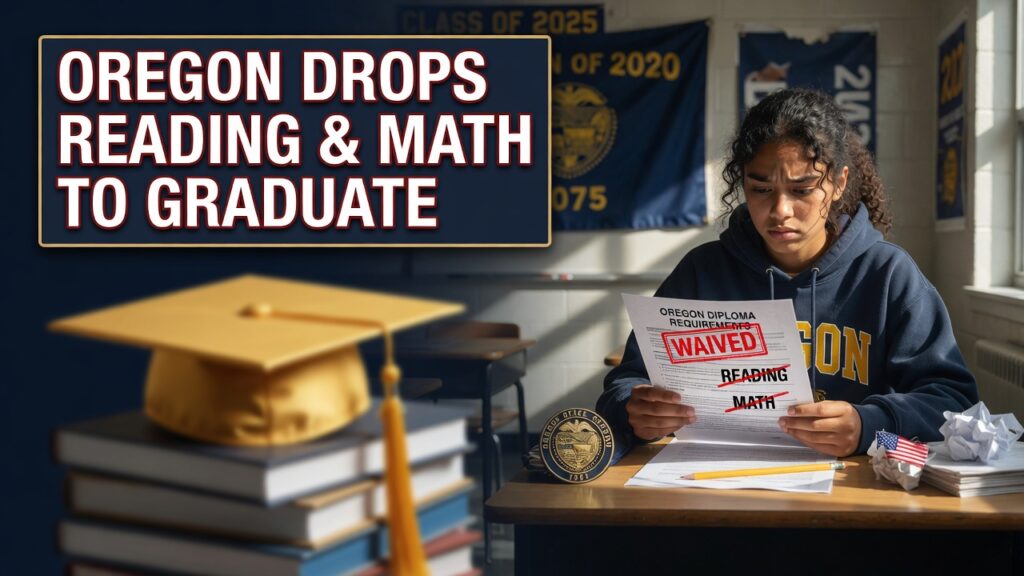
Oregon is handing out record numbers of high school diplomas — but only one in five students can demonstrate basic math proficiency. Someone needs to answer for that.
A diploma used to mean something. In Oregon, that may no longer be true.
Since 2021, Oregon has systematically suspended the requirement that high school students demonstrate proficiency in reading, writing, and math before graduating. The policy, originally framed as a temporary equity measure, has now been extended so many times that students won’t face any academic proficiency test until at least the 2028–29 school year — if ever. And while graduation rates have climbed to record highs, the underlying data tells a story that Oregon’s Department of Education would rather not headline.
Support Independent Local Journalism
TheTownHall.News is a non-profit reader-supported journalism. Just $5 helps us hire local reporters, investigate important issues, and hold public officials accountable across Alameda County. If you believe our community deserves strong, independent journalism, please consider donating $5 today to support our work.What the Numbers Actually Reveal About Oregon’s Diplomas
20%. That is the percentage of Oregon juniors who demonstrated math proficiency in the 2023–24 school year — yet over 83% of that same cohort graduated. The question that demands an answer: what exactly does an Oregon diploma certify?
According to Oregon Department of Education data, only 45.2% of the class of 2025 demonstrated proficiency in English when tested as juniors. [Oregon Department of Education statewide assessment data, 2024.] Math performance was even more alarming, with just one in five students reaching the proficiency bar. Yet the state celebrated an 83% graduation rate for the class of 2025 — its highest ever recorded.
Portland Public Schools’ own internal analysis sharpened the contradiction. While PPS posted an 84% graduation rate for the class of 2024, just 69.1% of those same students met the district’s post-secondary readiness benchmarks. [Portland Public Schools district data, 2026.] Graduates are leaving Oregon classrooms without the foundational skills that their diplomas imply they possess. That is not equity. That is a systemic failure dressed up as progress.
The Policy That Started It All — And Why It Has Never Ended
Oregon’s Senate Bill 744, signed in 2021, suspended the Assessment of Essential Skills graduation requirement for the classes of 2022, 2023, and 2024. The stated rationale was that standardized proficiency testing disproportionately harmed students of color, English language learners, and students with disabilities. The legislature framed the pause as a moment to “review” graduation standards and design something better.

That review never produced a replacement. Instead, in October 2023, the Oregon State Board of Education voted to extend the suspension through the entire 2027–28 academic year — pushing any possible reinstatement of skills testing to 2029 at the earliest. What was sold as a temporary, compassionate policy correction has become a permanent lowering of the bar.
“Oregon is graduating students at record rates while fewer than half can demonstrate proficiency in the subjects their diploma claims they’ve mastered. That is not a success story — it is a credibility crisis.”
No new proficiency framework has been introduced to replace the suspended one. The state has added half-credit requirements in personal financial education and career path skills beginning in 2027, but neither addresses the core academic gap in reading, writing, or mathematics. The goalposts weren’t moved. They were quietly removed.
Who Is Really Paying for This Policy?
The students are. Specifically, the very students Oregon claimed it was protecting.
When a diploma no longer signals academic readiness, employers and colleges adjust their expectations accordingly. Oregon students — disproportionately those from lower-income and minority households who do not have the private tutoring safety nets available to wealthier peers — enter a labor market or university system that quickly discovers what their transcript conceals. Lowering the standard doesn’t eliminate the gap; it just ensures no one measures it until it’s too late.
The ripple effects extend to taxpayers and communities as well. Businesses operating in Oregon depend on a workforce pipeline from state high schools. When graduates arrive without demonstrable literacy and numeracy skills, employers either absorb remediation costs internally or bypass Oregon’s local talent pool entirely. This is a fiscal accountability issue as much as an educational one. Parents who pay property taxes and school levies deserve to know whether their investment is producing actual student outcomes — or merely inflating a headline statistic.
Support Independent Local Journalism
TheTownHall.News is a non-profit reader-supported journalism. Just $5 helps us hire local reporters, investigate important issues, and hold public officials accountable across Alameda County. If you believe our community deserves strong, independent journalism, please consider donating $5 today to support our work.If a diploma no longer guarantees that a student can read, write, or calculate — what are Oregon parents actually paying for?
What Do Supporters of This Policy Actually Believe?
Defenders of the suspension make arguments that deserve honest engagement.
Their central claim is that standardized proficiency tests are structurally biased, penalizing students who face systemic disadvantages rather than measuring their true capabilities. They point to research suggesting that grade-point average is a more reliable post-secondary predictor than a single high-stakes assessment. Oregon’s ODE Director Dr. Charlene Williams has cited national studies ranking Oregon among states with the highest credit-hour requirements for graduation, arguing that course completion itself represents a meaningful standard.
These are not frivolous points. Poorly designed tests can embed cultural and socioeconomic bias. Rigid high-stakes exit exams have, in some cases, pushed vulnerable students out of schools entirely without improving their prospects.
But here is where the counterargument fails on its own terms. Oregon did not replace the Essential Skills assessment with a more equitable alternative — it replaced it with nothing. If the old test was flawed, the responsible answer was to build a better one, not to eliminate accountability altogether. Suspending a measurement does not solve the underlying problem; it simply ensures the problem goes undetected until it becomes catastrophic. A student who cannot read at a functional level is not helped by receiving a diploma that says otherwise. They are set up to fail in silence.
Is Oregon Finally Ready to Course-Correct?
There is a narrow opening for optimism. In January 2026, ODE Director Williams stated publicly that the department “does not anticipate continued extension” of the essential skills suspension beyond the 2027–28 window. [Willamette Week, January 29, 2026.] That is the first signal from state leadership in years that the proficiency requirement may actually return.
But intent and action are different things. Oregon officials have made similar noises before, and the political pressure to extend the suspension — particularly from equity-focused advocacy groups — has consistently prevailed. Parents, civic organizations, and legislators who believe in rigorous and honest education standards will need to hold the ODE publicly accountable to that January commitment.
Oregon’s graduation rate hit 83% — but only 20% of those graduates could do basic math. If that doesn’t demand accountability, what does?
The clock is now running toward a 2028–29 decision point. That is not far away. And if history is any guide, the default answer — absent sustained public pressure — will be another extension.
📌 Key Questions
- 1. If Oregon reinstates proficiency requirements in 2029, will students who graduated under the suspended standard be disadvantaged compared to peers in states that maintained academic benchmarks throughout?
- 2. Who in Oregon’s legislature or Department of Education is specifically accountable for designing the replacement framework that was promised in 2021 and never delivered?
- 3. Are Oregon’s rising graduation rates being used to justify future education funding levels — and if so, are taxpayers funding a system whose core metric has been deliberately decoupled from academic reality?
The real question isn’t whether Oregon’s diploma crisis will affect future students. It already has — for four graduating classes and counting. The question is whether parents, legislators, and civic leaders will demand honest accountability before yet another extension makes the damage permanent.
Standards don’t oppress students. The absence of them does.
What do you think — is it too late for Oregon to restore the value of its high school diploma? Share this article and let us know in the comments.
Take Action
Still have questions? Stay informed on education policy, parental rights, and civic accountability — subscribe for daily coverage.
Think others need to hear this? Share this article with every parent, teacher, and taxpayer in your network.
Want to make your voice count? Contact the Oregon Department of Education directly at oregon.gov/ode or reach your state legislator through oregonlegislature.gov to demand a concrete plan — not another extension — before 2028.