Israel Got the War They Wanted by Not Honoring the Cease-Fire. Iran Is All In on War — No Peace With the US or Israel
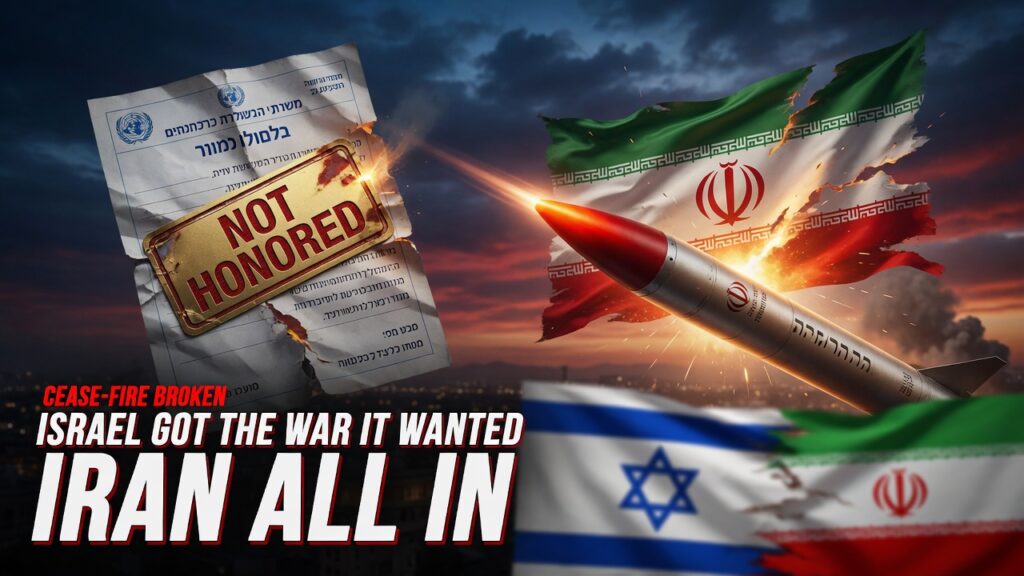
The Cease-Fire That Never Really Was:
For months, the world watched as diplomats scrambled to pull the Middle East back from the edge. A fragile ceasefire between the United States and Iran, brokered through Pakistani mediation on April 8, 2026, offered a rare and narrow window of hope. The Strait of Hormuz, which Iran had closed to strangle global oil markets, was to be reopened. A 60-day extension of the ceasefire was tentatively agreed upon as recently as May 24, 2026. Nuclear talks were on the table. A deal appeared, for one brief moment, genuinely within reach.
That window has now slammed shut — and the fingerprints on it belong to Israel.
Support Independent Local Journalism
TheTownHall.News is a non-profit reader-supported journalism. Just $5 helps us hire local reporters, investigate important issues, and hold public officials accountable across Alameda County. If you believe our community deserves strong, independent journalism, please consider donating $5 today to support our work.While American and Iranian diplomats worked painstakingly toward an agreement, Israel was doing something else entirely: escalating its military campaign in Lebanon with relentless force. Netanyahu’s government ordered deeper strikes pushing toward Beirut, targeted southern Lebanese towns — killing civilians and paramedics alike — and explicitly declared, in the words of Netanyahu’s own office, that the US–Iran ceasefire “does not include Lebanon.” Iran said it does. The Pakistani mediator said it does. The original ceasefire framework said it does. Israel said it doesn’t — and then kept bombing anyway.
The result? On June 1, 2026, Iran officially suspended ceasefire negotiations with the United States. The deal is gone. The diplomacy is in ruins. And the region is once again staring down the barrel of full-scale war.
Iran Draws Its Line — And Means It:
Iran’s position has never been ambiguous. Iranian Foreign Minister Abbas Araghchi stated it plainly and publicly: “The ceasefire between Iran and the US is unequivocally a ceasefire on all fronts, including in Lebanon.” Iran’s Foreign Ministry spokesman Esmaeil Baghaei was equally direct: “We insist that a ceasefire in Lebanon is an essential condition for any deal aimed at ending the war.”

This was not a new demand issued at the last minute to blow up talks. It was a consistent, documented, non-negotiable condition that Tehran had been pressing throughout the entire negotiation process. Iran has long viewed Hezbollah in Lebanon not merely as a proxy force but as a frontline buffer and strategic partner. An American deal that left Lebanon as an open battlefield for Israeli bombardment was never going to be acceptable to Tehran — and Tehran made that crystal clear from the start.
When Israel refused to stop, and when the United States failed to force Israel to stop, Iran concluded that Washington either could not or would not honor the spirit of the agreement. Either conclusion leads to the same outcome: Iran walking away from the table and back toward war.

Israel’s Strategy — Wreck the Deal, Keep the War:
What has unfolded is not a diplomatic accident. Analysts and reporting from outlets including The Conversation, BBC News, and Al Jazeera have increasingly pointed to the same uncomfortable conclusion: Israel deliberately escalated in Lebanon precisely because a US–Iran deal was getting close. The logic is strategic and cold. A comprehensive peace agreement between Washington and Tehran would almost certainly constrain Israel’s freedom to strike Iranian assets, Hezbollah forces, and Lebanese territory at will. A deal would mean Iran’s survival as a regional power — something the Netanyahu government has spent decades trying to prevent.
By continuing to pound Lebanon, by threatening to strike Beirut’s southern suburbs, and by publicly insisting that no ceasefire applies to its Lebanon campaign, Israel made it functionally impossible for Iran to sign any agreement without looking like it had abandoned its allies and its own stated red lines. As The Conversation reported: “Unable to defeat Iran, Israel shifts its focus to Lebanon, fearing US negotiations with Tehran could limit operations against Hezbollah.”
Support Independent Local Journalism
TheTownHall.News is a non-profit reader-supported journalism. Just $5 helps us hire local reporters, investigate important issues, and hold public officials accountable across Alameda County. If you believe our community deserves strong, independent journalism, please consider donating $5 today to support our work.In short, Israel saw a peace deal forming and chose to detonate it.
The United States Blinked — And Paid the Price:
The most damaging element of this crisis for American credibility is not what Iran did. It is what the United States allowed Israel to do. According to reporting from Axios, the US–Iran deal was expected to include a Lebanon ceasefire component — and that component was effectively hollowed out under pressure from the Israeli government. DW News confirmed the split openly, reporting: “The US said Lebanon is not part of the ceasefire deal. Iran says it is.”
That contradiction — between what Washington agreed to and what Tel Aviv demanded — proved fatal to the negotiations. Iran’s negotiating team halted communications with the US, accusing Washington of breaking the terms of what had been agreed. Iran’s parliament speaker went further, accusing the US of actively breaking Iran’s trust. Whether the Americans removed Lebanon from the deal at Netanyahu’s direct request or simply failed to enforce the terms against Israeli objections, the result is the same: the United States subordinated its own strategic interests — ending a war, reopening critical shipping lanes, securing a nuclear agreement — to the military objectives of its ally.
And now America is paying the price in broken diplomacy, ongoing military operations, and a war that was tantalizingly close to pausing.
Trump Caught in the Middle — Publicly:
Even within the Trump administration, the tension has become impossible to ignore. Bloomberg Television reported on June 2, 2026 that Trump and Netanyahu have openly diverged on Lebanon strategy in a direct phone call. Trump has reportedly tried to stop Israel’s Lebanon push, with the president stating publicly that he persuaded Israel and Hezbollah to halt hostilities on June 1 — yet Netanyahu simultaneously vowed to maintain and deepen the Lebanon offensive, calling the military operation a “dramatic shift” in the campaign. Trump told CNBC on June 1: “I don’t care” if Iran negotiations are over — a statement that reads less like confidence and more like a man cornered by his own ally’s choices.
The BBC posed the question that is now on the lips of every serious foreign policy observer: “Is Israel collapsing a US–Iran deal over Lebanon?” The answer, based on everything that has happened in the past 72 hours, is yes.
Iran Is Now All In — No Peace, No Deal, No Retreat:
With the ceasefire talks suspended and Iranian officials describing the situation as a fundamental breach of trust, Tehran is no longer in a diplomatic posture. Iran has reportedly resumed activity at its ballistic missile and drone reconstitution programs during the ceasefire period, according to the Institute for the Study of War’s June 1 special report. The Strait of Hormuz, which was to be reopened under any deal, remains a pressure point Iran can activate at will. Iranian officials have warned of “many more surprises” if the conflict resumes. An Iranian military officer stated on June 2 that renewed war with the US “seems unavoidable.”
This is not rhetorical bluster from a weakened adversary. Iran entered this war absorbing massive American and Israeli strikes on February 28, 2026, and has continued fighting for over three months. It has struck US military bases, including in Kuwait. It has closed the world’s most critical oil chokepoint. And now, with the peace deal in tatters, Iran has concluded that there is nothing left to negotiate — because the only offer on the table was one in which Israel got to keep killing Lebanese civilians and Hezbollah fighters while Iran was expected to stand down completely.
That was never going to be a deal. It was always a surrender.
Conclusion: The War Israel Wanted, the Peace America Lost:
History will record that in the spring and summer of 2026, the United States came closer than it had in decades to a transformative diplomatic agreement with Iran — one that could have ended an active shooting war, secured nuclear non-proliferation commitments, and stabilized the Middle East. And history will record that it was Israel’s unrelenting military campaign in Lebanon, conducted in open defiance of ceasefire terms, that tore that agreement apart.
Netanyahu got the war he wanted. He now has a Lebanon campaign unconstrained by any peace deal. He has an Iran that is all in on war and has nothing left to lose at the negotiating table. And he has an American president who, whatever his frustrations in private, has so far been unable or unwilling to impose the one condition — stop bombing Lebanon — that could have saved everything.
Iran is done talking. The cease-fires have been dishonored. The deal is dead. And the Middle East is once again on the brink — not because diplomacy failed, but because one party to the agreement decided, from the very beginning, that they never wanted peace at all.
Sources: Al Jazeera, The New York Times, BBC News, Reuters, AP News, DW News, Asharq Al-Awsat, Times of Israel, Arab News, PBS NewsHour, Bloomberg Television, The Conversation, Institute for the Study of War, Wikipedia — 2026 Iran War, 2026 Lebanon War.