TrialGPT Explained: How NIH’s AI Tool Is Fixing Clinical Trial Matching
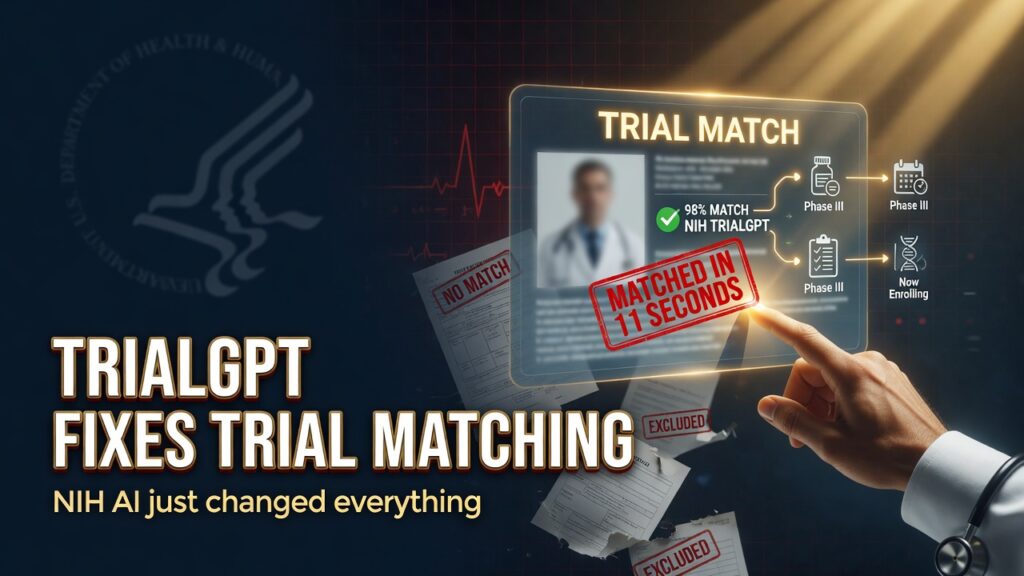
The NIH has quietly built an AI called TrialGPT that can match dying patients to life-saving clinical trials in seconds — so why has bureaucratic inertia kept this technology from reaching the people who need it most?
Every day, terminal patients run out of time. Not because cures don’t exist. Because no one told them where to look.
That calculation may be changing. The National Institutes of Health has developed an AI algorithm called TrialGPT — a peer-reviewed, clinically tested tool that matches patients to relevant experimental drug trials in a fraction of the time it used to take human clinicians. Published in Nature Communications in October 2024 and already being adapted at hospitals across the country, TrialGPT represents one of the most tangible, patient-centered advances in medical AI in recent memory. The question now isn’t whether the technology works. The question is whether the system built around it will allow it to reach the Americans who need it most.
Support Independent Local Journalism
TheTownHall.News is a non-profit reader-supported journalism. Just $5 helps us hire local reporters, investigate important issues, and hold public officials accountable across Alameda County. If you believe our community deserves strong, independent journalism, please consider donating $5 today to support our work.What Exactly Is TrialGPT — and Why Does It Matter Right Now?
The answer is both simple and staggering. TrialGPT is an AI framework developed by researchers at NIH’s National Library of Medicine (NLM) and the National Cancer Institute. It processes a patient’s clinical summary — their medical history, demographics, diagnoses — and cross-references it against the thousands of experimental trials listed on ClinicalTrials.gov. The system then delivers a ranked, annotated list of trials the patient may qualify for, complete with plain-language explanations a doctor can actually use.
The results published in Nature Communications were striking: 87.3% accuracy in matching patients to correct trial eligibility criteria [peer-reviewed, Nature Communications, 2024], nearly identical to expert human performance. More importantly, clinicians using TrialGPT reduced patient screening time by 40–42.6% without any loss in accuracy [NIH press release, November 2024]. That is not a rounding error. That is nearly half the time — freed up, returned to doctors, and given back to patients.
87.3% accuracy. 42.6% less screening time. The question worth asking: how many patients died waiting while this technology sat in a research paper?
Why Has It Taken This Long?
This is the uncomfortable question that should follow every breakthrough announcement. TrialGPT did not emerge from nowhere. Large language model research has been publicly accelerating since at least 2022. The underlying data — ClinicalTrials.gov — has existed since 2000. Yet the systematic, AI-driven connection between desperate patients and available trials is only now being operationalized at scale.

The bottleneck has never been science. It has been the slow-moving apparatus of institutional medicine: procurement cycles, hospital IT integration requirements, liability caution, and the simple organizational inertia that governs large federal agencies. Personal responsibility is a cornerstone of conservative values — but personal responsibility requires access to information. When the system withholds that access through sheer inefficiency, it is not the patient who failed. It is the institution.
“The real barrier between a terminal patient and a life-saving trial has never been science — it’s been the bureaucracy standing between them.”
What Do the Numbers Actually Tell Us?
Consider the scale of the problem TrialGPT is trying to solve. ClinicalTrials.gov lists well over 400,000 registered studies as of 2024 [ClinicalTrials.gov public database]. No human clinician, no matter how diligent, can meaningfully scan that database for every patient on their caseload. The result is a systemic failure of information — one that disproportionately harms patients who lack access to elite academic medical centers with dedicated research coordinators.
One independent study found that TrialGPT outperformed traditional matching methods by 46%, with patients qualifying for an average of seven out of the top ten recommended trials [PMC/NCBI, 2025]. In a separate institutional deployment at UT Health San Antonio, the framework was adapted for real-world clinical eligibility screening, demonstrating that the model can function outside of controlled laboratory conditions.
400,000+ registered clinical trials. If your doctor can’t search them all — who is searching for you?
Is the Medical Establishment Ready to Let Patients Benefit?
The NIH has taken meaningful steps. The TrialGPT team was awarded the NIH Director’s Challenge Innovation Award to develop TrialGPT 2.0, specifically focused on testing the model’s fairness and performance across diverse and underrepresented populations. Lead investigator Dr. Zhiyong Lu received the 2024 NLM Regents Award for his work on the project. The paper itself ranked in the Top 25 most-downloaded health science papers of 2024 in Nature Communications.
Support Independent Local Journalism
TheTownHall.News is a non-profit reader-supported journalism. Just $5 helps us hire local reporters, investigate important issues, and hold public officials accountable across Alameda County. If you believe our community deserves strong, independent journalism, please consider donating $5 today to support our work.These are not the hallmarks of a project being buried. But recognition and deployment are not the same thing. Hospitals are large, complex institutions with competing priorities. Insurance billing structures, legal liability frameworks, and physician workflow systems were not designed with AI integration in mind. Without deliberate policy pressure — from legislators, hospital administrators, and informed patients — even the most promising tools risk stalling at the pilot stage.
If a breakthrough AI tool exists and patients don’t know about it, does the breakthrough actually matter?
What Do Supporters of This Technology Actually Believe?
To be fair, many within the medical establishment are genuinely enthusiastic. Proponents argue that TrialGPT is being rolled out responsibly — tested rigorously before broad deployment, with appropriate attention to bias and fairness across demographic groups. They point out that patient safety demands caution and that rushing AI into clinical environments without proper validation has caused real harm in other contexts. The NIH’s Director’s Challenge award is, in their view, evidence of institutional commitment, not stagnation.
That argument deserves respect — and it is partially correct. Responsible deployment matters. Accuracy across racial, gender, and socioeconomic groups is not a bureaucratic concern; it is a moral one. An AI that works brilliantly for white male patients and fails for Black women or rural elderly patients is not a solution — it is a new inequity dressed in code.
But caution and urgency are not mutually exclusive. The NIH has had the core TrialGPT framework validated. The data is strong. The case for accelerated, monitored deployment — starting with terminal patients who have the fewest alternatives and the least time — is both clinically and ethically sound. The burden of proof no longer sits entirely with the innovators. It sits with those who would delay.
What Happens If No One Pushes for Faster Access?
The answer is already visible in the status quo. Clinical trial enrollment in the United States is chronically underperforming — studies routinely fail to meet recruitment targets, extending timelines by years and increasing costs by hundreds of millions of dollars [FDA/industry data, various reports]. Meanwhile, patients — particularly those in rural areas, lower-income brackets, and minority communities — remain systematically unaware of trials for which they qualify.
TrialGPT is not a cure. It does not develop new drugs or guarantee outcomes. But it removes one of the most persistent and solvable barriers in medicine: the information gap between a patient who needs options and a database full of them.
Fiscal conservatives should take note: failed clinical trials cost the healthcare system billions. A tool that improves enrollment efficiency and reduces screening waste is not just a medical victory — it’s a financial one.
🔑 Key Questions This Story Raises
- Why are hospitals not required to inform patients about AI-assisted trial matching tools that are publicly funded and already validated?
- Who is monitoring whether TrialGPT 2.0’s rollout reaches underserved communities — or whether it stalls at well-funded academic centers?
- At what point does “responsible caution” in deploying a proven, life-saving tool become institutional negligence?
The Question That Should Keep Us All Up at Night
TrialGPT works. The NIH built it, tested it, published it, and awarded it. The science is not the obstacle. The system is.
A tool that reduces clinical trial screening time by 40%, matches patients with 87% accuracy, and has been independently validated at real hospitals across the country should not be a niche topic for biomedical informatics conferences. It should be a front-page demand from every patient advocacy group in America.
The values that built this country — personal responsibility, civic accountability, the belief that individuals deserve access to information that affects their own lives — demand that we ask the harder question.
The real question isn’t whether TrialGPT can save lives. It’s whether the institutions holding the keys will open the door before it’s too late.
What do you think — should patients have a right to demand AI-assisted trial matching from their doctors? Share this article and let us know in the comments.
Still have questions about how AI is changing healthcare access? Subscribe for daily coverage of the stories that affect your health, your rights, and your wallet.
Think someone you know deserves this information? Share the article — it could make a difference.
Want to make your voice count? Contact your congressional representative and ask what they are doing to accelerate access to publicly funded medical AI tools. You can find your representative at congress.gov/members.