eVTOL Air Taxis in 26 States: Real Aviation Breakthrough or Costly Federal Experiment?
As the FAA launches its most ambitious aviation pilot program in decades, Americans deserve to ask: who chose the winners, who bears the risk — and what happens if this doesn’t fly?
The future of American aviation is being decided right now — and most taxpayers have no idea it’s happening.
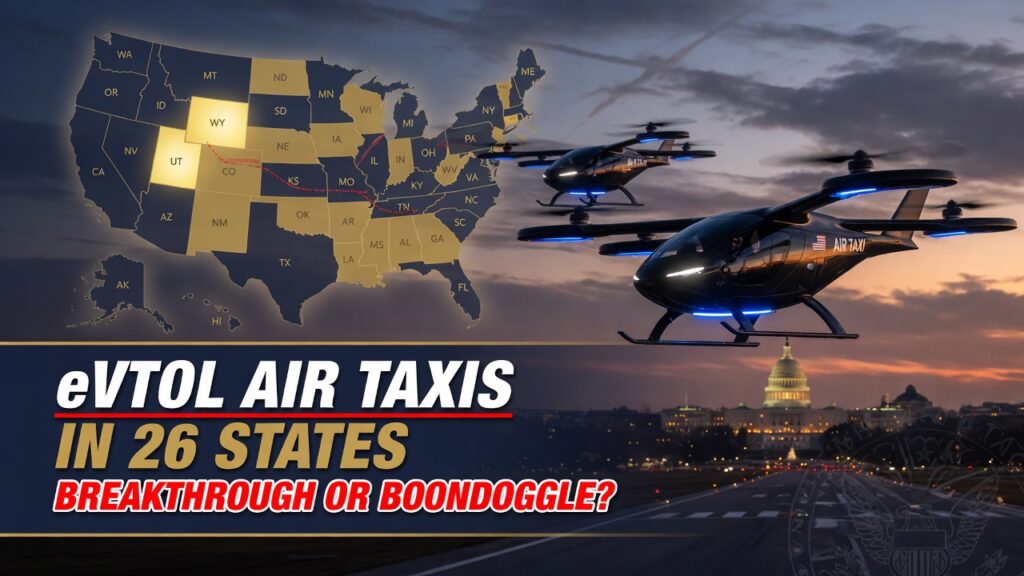
In March 2026, U.S. Transportation Secretary Sean Duffy stood before cameras, announced eight federally selected pilot programs spanning 26 states, and declared the eVTOL era officially open. Electric vertical takeoff and landing aircraft — the futuristic “air taxis” that promise to connect cities, deliver emergency care, and revolutionize regional travel — are no longer a concept. They are being funded, deployed, and regulated in your skies, in your state, on Washington’s timeline. The question worth asking is not whether this technology is exciting. It clearly is. The question is whether the federal government is the right entity to be driving it — and whether American taxpayers are being told the full story.
Support Independent Local Journalism
TheTownHall.News is a non-profit reader-supported journalism. Just $5 helps us hire local reporters, investigate important issues, and hold public officials accountable across Alameda County. If you believe our community deserves strong, independent journalism, please consider donating $5 today to support our work.What Exactly Did the Government Just Announce?
The FAA’s eVTOL Integration Pilot Program (eIPP) is the centerpiece of President Trump’s “Unleashing Drone Dominance” Executive Order, signed in June 2025. Eight project consortiums were selected from more than 30 proposals, involving state transportation departments from Texas, Florida, Utah, Pennsylvania, North Carolina, and Louisiana, as well as New York’s Port Authority and the City of Albuquerque. Partners include private firms like Joby Aviation, Archer Aviation, and BETA Technologies.
The stated goals are ambitious and, on their face, genuinely compelling: urban air taxis, emergency medical transport, regional connectivity for underserved communities, and cargo logistics. Operations are expected to begin by summer 2026. Secretary Duffy became the first U.S. Transportation Secretary to fly in an eVTOL — a symbolic and savvy PR moment that generated enormous media traction.
But symbolism is not policy. And excitement is not accountability.
Who Is Really Paying for This Revolution?
The federal government does not create innovation — it funds it, regulates it, and picks winners. That distinction matters enormously when public money is on the line.

The eIPP is framed as a public-private partnership, and the involvement of private capital from companies like Toyota (which has invested nearly $900 million in Joby Aviation alone [investor disclosures]) is genuinely encouraging. Private sector skin in the game is exactly the kind of market discipline that keeps speculative ventures honest.
But federal pilot programs are rarely cost-free. The DOT and FAA are committing significant institutional resources — staff time, regulatory bandwidth, airspace infrastructure — to shepherd eight simultaneous large-scale aviation experiments. History offers cautionary lessons. The federal government’s track record of picking technological winners — from Solyndra to Amtrak’s perpetual subsidies — should prompt at minimum a healthy skepticism about centralized enthusiasm.
$894 million. That’s Toyota’s total investment in just one eVTOL startup. The real question: if this technology is as transformative as advertised, why does it still need the government to run the pilot program?
The answer may be simpler than critics want to admit — regulatory complexity. The FAA’s certification process is so demanding that no private consortium can navigate it without federal partnership. That is either a feature of responsible aviation safety culture or a symptom of bureaucratic gatekeeping. Probably both.
Is the FAA Moving Fast Enough — or Has Regulatory Drag Already Cost America the Lead?
Speed matters in technology races. China is not asking these questions — it is building. And while Washington was navigating its approval processes, competitors abroad were running flight demonstrations, signing bilateral agreements, and locking up manufacturing supply chains.
Support Independent Local Journalism
TheTownHall.News is a non-profit reader-supported journalism. Just $5 helps us hire local reporters, investigate important issues, and hold public officials accountable across Alameda County. If you believe our community deserves strong, independent journalism, please consider donating $5 today to support our work.Joby Aviation completed Stage 4 of FAA Type Certification in March 2026 — a significant milestone that took years to reach. Archer Aviation became the first eVTOL company to close Phase 3 of the FAA’s four-phase certification process as of Q1 2026 [company earnings disclosures]. These are real achievements. But they also reveal the underlying friction: full commercial certification for most aircraft remains months to years away, even as the government announces public operations for “summer 2026.”
New legislation introduced in February 2026 aims to expedite FAA Type Certification for eVTOLs. That legislation exists precisely because the existing process was too slow. Congress acknowledging the problem is not the same as solving it.
“If America is serious about winning the next generation of aviation, it cannot afford a regulatory framework designed for the last one.”
What Do Supporters of This Policy Actually Believe?
To be fair, the case for federal involvement here is not without merit. Aviation is uniquely subject to federal jurisdiction — you cannot have fifty states writing fifty sets of airspace rules. The FAA’s certification process, however slow, exists because aviation failures are catastrophic and irreversible. No one wants an air taxi to fall on a school.
Proponents argue that the eIPP is not a subsidy program but a regulatory sandbox — a controlled environment to generate the safety data that will eventually enable a fully private, competitive market. Archer CEO Adam Goldstein has said the program “marks the next step in moving from development to deployment.” Joby’s leadership has praised it as pragmatic federal-private collaboration.
These are legitimate points. The technology does require airspace integration that only the FAA can provide. And the diversity of use cases selected — from Gulf of America energy logistics to rural North Carolina medical transport — suggests the program was designed with genuine public benefit in mind, not just urban elite air taxis.
But good intentions do not guarantee good outcomes. The question is whether the program has clear performance benchmarks, sunset provisions, and mechanisms for public accountability — or whether it will quietly expand and entrench regardless of results.
Are the Right Communities Actually Being Served?
This question deserves more attention than it is receiving. Twelve rural hospitals have closed in North Carolina since 2002, according to the state’s own DOT proposal. Emergency medical eVTOL flights could genuinely change — and save — lives in communities that traditional aviation infrastructure has abandoned. That is not a talking point. That is a real and urgent need.
If eVTOL technology can deliver emergency care to rural Americans who currently wait hours for medical transport, that is not a government overreach — that is government doing exactly what it should.
But the bulk of the commercial energy in this space is concentrated around Manhattan heliports, LA Olympic venues, FIFA World Cup partnerships, and Miami luxury travel corridors. Archer is the official air taxi of the 2026 FIFA World Cup in Los Angeles. It is the official air taxi of the 2028 Olympics. These are high-visibility, high-revenue opportunities — not rural healthcare missions.
The federal pilot program includes both. The market will eventually prioritize one. Americans should watch carefully which one wins when the subsidies thin out and the profit motive takes over.
What Happens If No One Asks the Hard Questions Now?
We are at an inflection point. Once regulatory frameworks are built, markets are established, and federal dependencies are created, reversing course becomes exponentially harder — and exponentially more expensive.
The eVTOL revolution may be genuine. The technology is impressive. The private investment is substantial. The bipartisan political support is real. But transformative technology and responsible governance are not the same thing, and one does not automatically produce the other.
Personal responsibility and fiscal accountability are not obstacles to innovation — they are its most durable foundations. The Americans funding this program through their tax dollars and their airspace deserve clear answers about costs, milestones, and consequences for failure.
Key Questions This Story Raises:
- What are the specific performance benchmarks for each of the 8 eIPP pilot programs — and what happens if they are not met?
- How much total federal funding, direct and indirect, is committed to the eVTOL Integration Pilot Program, and who oversees it?
- When commercial operations launch, what consumer protections, pricing oversight, and safety disclosure requirements will apply to passengers?
The real question isn’t whether eVTOL aircraft will transform American transportation — it’s whether the American public will demand accountability before the bills come due.
Innovation built on private risk and public trust can reshape a nation. Innovation built on unchecked federal enthusiasm and borrowed momentum has a far more complicated history. This story is just beginning. Whether it ends as a triumph of American ingenuity or an expensive lesson in managed hype depends entirely on the questions citizens are willing to ask — and the answers their representatives are willing to give.
What do you think — is the government the right engine for this revolution, or should the market be driving? Share this article and make your voice heard.
Think someone needs to hear this? Share the article — the conversation starts when you do.
Want to make your voice count? Contact your state’s Department of Transportation and ask what role your state is playing in the eIPP — and what accountability measures are in place. You can find your state DOT contact at transportation.gov.