Israel Kills Lebanese Army Brigadier General, Wissam Sabra, What Happened and Why It Matters?
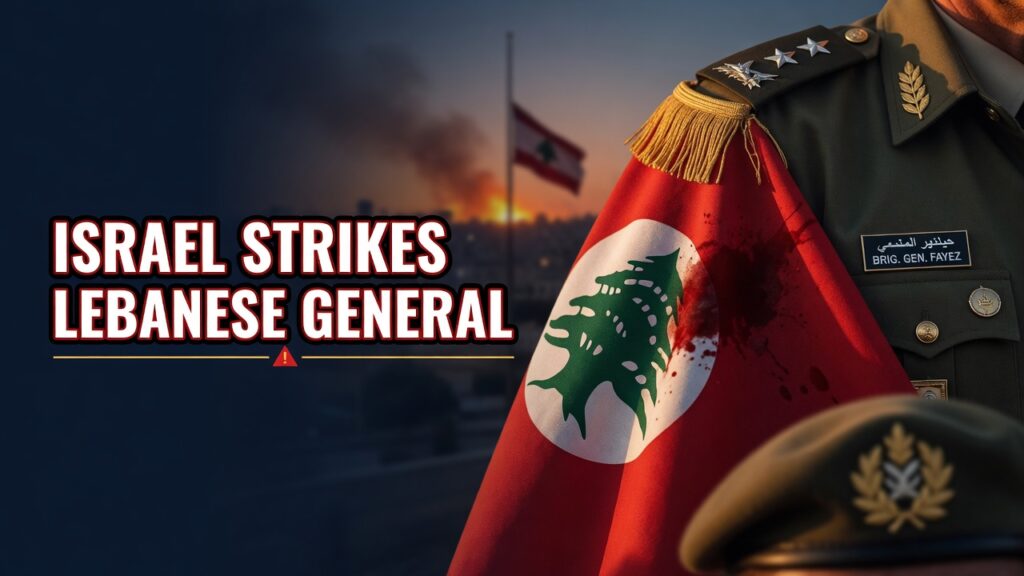
A US-brokered ceasefire was signed just days before Israel struck a Lebanese military vehicle, killing a Brigadier General, a Captain, and a soldier who had no connection to Hezbollah. As the smoke clears in Nabatieh, the world is asking: who is actually in charge of this conflict — and who is going to answer for it?
Three Lebanese soldiers drove down a road between Kfar Tebnit and Khardali on June 6, 2026. They never made it home.
The soldiers — Brigadier General Wissam Sabra, Captain Elie Khoury, and Private Hussein Ghazal — were members of the Lebanese Armed Forces (LAF), a state institution that has painstakingly stayed neutral in the war between Israel and Hezbollah. They were Christian, Sunni, and Shia respectively — a cross-section of Lebanon itself. An Israeli strike killed all three. The incident happened just days after a fresh US-brokered ceasefire agreement was announced between the governments of Lebanon and Israel. The timing could not be more damning.
Support Independent Local Journalism
TheTownHall.News is a non-profit reader-supported journalism. Just $5 helps us hire local reporters, investigate important issues, and hold public officials accountable across Alameda County. If you believe our community deserves strong, independent journalism, please consider donating $5 today to support our work.What Actually Happened on That Road in Southern Lebanon?
The facts, as confirmed by both Lebanese officials and the Israeli Defense Forces (IDF), are not seriously in dispute. An Israeli strike targeted a military vehicle traveling on the Kfar Tebnit–Khardali road in the Nabatieh district of southern Lebanon. The Lebanese Army, in its official statement, identified the victims and declared the attack “continued, deliberate, and repeated Israeli aggression against Lebanon, its people and its army.” [Lebanese Armed Forces official statement, June 6, 2026]
The IDF acknowledged the strike but offered a justification that has struck many observers as inadequate: the vehicle was “moving suspiciously” in an active combat zone where movement requires prior coordination with Israeli forces, and troops were on heightened alert due to intelligence suggesting Hezbollah could fire on Israeli soldiers from the area. An initial inquiry was launched. The IDF simultaneously insisted it “operates against Hezbollah and not against the Lebanese army.” Yet three Lebanese Army officers are dead. The contradiction is not a minor one.
Three Lebanese soldiers — Christian, Sunni, and Shia — with zero ties to Hezbollah were killed in a single strike. If that doesn’t demand accountability, what does?
Is “Moving Suspiciously” Enough Justification to Kill Allied Soldiers?
The IDF’s explanation rests on a dangerously thin premise. The Lebanese Army is not a combatant in this war. It is a multi-confessional, US-supported institution that Lebanon’s own government has actively tried to strengthen as an alternative to Hezbollah’s armed wing. The Lebanese state, through President Joseph Aoun — himself a former army general — has publicly condemned Hezbollah for dragging the country into conflict and has called for the group to disarm. These are not the actions of an adversary. They are the actions of a fragile government trying to hold its country together.

President Aoun called the strike “a flagrant violation of Lebanon’s sovereignty and international law,” and convened emergency discussions in response. [Lebanese Presidency statement, June 6, 2026] The Lebanese Army, for its part, said the attacks aim to “thwart all efforts to reach a solution that would restore stability.” These are not the talking points of a proxy militia. They are the words of a sovereign state demanding to be treated as one.
“The continued, deliberate, and repeated Israeli aggression against Lebanon, its people and its army only strengthens our resolve, faith and determination.” — Lebanese Armed Forces official statement, June 6, 2026
The Numbers Behind the Crisis
More than 3,500 people have been killed in Lebanon since the current war began on March 2, 2026. Over 1.2 million Lebanese — more than 20% of the country’s population — have been displaced. Roughly three dozen members of Lebanon’s own security forces have been killed since the conflict erupted [Armed Conflict Location and Event Data]. 3,500 deaths. 1.2 million displaced. Now, a Brigadier General killed days after a ceasefire was signed. The question no one in Washington wants to answer: at what point does oversight begin?
What Do Supporters of This Policy Actually Believe?
It is worth engaging seriously with the Israeli position — because dismissing it wholesale serves no one’s interest in truth or accountability.
Israel argues, not without reason, that Hezbollah routinely exploits civilian infrastructure, mixed civilian-military zones, and ambiguous scenarios to launch attacks on Israeli troops. The IDF states it received “concrete indications” of an imminent Hezbollah attack from the vicinity where the Lebanese Army vehicle was traveling. In a genuine war zone, with drone threats active and ceasefire violations occurring daily on both sides, the fog of war is real. Mistakes happen, and militaries operating under fire do not always have the luxury of perfect identification.
Hezbollah, it must be noted, has continued launching drones into northern Israel even after the latest ceasefire announcement and has flatly rejected the US-brokered deal signed by the Lebanese government. That makes coordination and trust across the battlefield extraordinarily difficult. Supporters of Israel’s military posture argue that the Lebanese Army’s failure to coordinate its vehicle’s movement — as required in an active combat zone — created a tragic but foreseeable outcome.
Support Independent Local Journalism
TheTownHall.News is a non-profit reader-supported journalism. Just $5 helps us hire local reporters, investigate important issues, and hold public officials accountable across Alameda County. If you believe our community deserves strong, independent journalism, please consider donating $5 today to support our work.These are legitimate points. They deserve engagement. But they do not resolve the central problem: the Lebanese Army is a recognized, US-supported national institution with zero involvement in hostilities. Killing its officers — especially a Brigadier General, the most senior LAF officer to die in this conflict — and labeling the vehicle “suspicious” after the fact does not meet the standard of proportionality, distinction, or accountability that international law demands. A review that was still “ongoing” hours after the strike is not a substitute for answers.
Has the Ceasefire Already Collapsed Before It Could Begin?
The timing of this strike is what transforms it from a military incident into a political crisis. The US-brokered ceasefire between Israel and Lebanon’s government was announced on June 3–4, 2026, just two days before the June 6 strike. The agreement was designed to create “pilot security zones” and lay a framework for de-escalation. It was already fragile: Hezbollah refused to endorse it, and Israel’s military had already issued fresh evacuation orders to five southern Lebanese towns the same day as the strike.
If a ceasefire cannot protect the uniformed soldiers of a neutral, US-allied army two days after being signed, it is not a ceasefire — it is a pause with paperwork.
This matters for every American taxpayer who funds diplomatic efforts in the region. It matters for every citizen who believes that international agreements should mean something. And it matters for the Lebanese people — a nation that has lost its infrastructure, a fifth of its territory, and now its highest-ranking officer, all while its government was sitting at a negotiating table trying to end the war.
Why Should American Citizens Be Paying Attention to This?
Because the United States is the central broker of both the military relationship with Israel and the diplomatic effort to end this conflict. American diplomatic credibility is on the line every time a deal is struck and then violated within days. American taxpayers fund security assistance programs that are supposed to strengthen institutions like the Lebanese Armed Forces — the very institution whose general was just killed. And American values — law and order, respect for sovereign institutions, accountability for state actors — are precisely what is being tested here.
The Lebanese Army is not Hezbollah. It is a constitutionally governed force answerable to a civilian government that has, remarkably, tried to assert state authority over an armed group that openly defies it. Striking its officers, then offering a bureaucratic review as a response, is not the conduct of an ally that takes accountability seriously.
Key Questions This Story Raises
- Will the IDF’s internal review result in any meaningful accountability, or will it quietly close without consequence?
- If a US-brokered ceasefire cannot protect the uniformed soldiers of a neutral sovereign army, what is the point of US-mediated diplomacy in the region?
- At what point do American lawmakers ask whether security assistance is being used in ways consistent with US law, US values, and the safety of non-combatant state institutions?
What Comes Next — and Whether Anyone Will Answer for It
The diplomatic fallout is already escalating. Lebanon’s president has condemned the strike. Iran’s foreign minister has traded barbs with Aoun over who bears responsibility for Lebanon’s suffering. Hezbollah continues to reject the ceasefire. And the IDF continues issuing evacuation orders to new villages in the south, signaling that military operations are far from over.
The three men killed on that road in Nabatieh were not militants. They were soldiers of a state that is trying, against enormous odds, to survive as a functioning country. Brigadier General Wissam Sabra, Captain Elie Khoury, and Private Hussein Ghazal deserve to be remembered as what they were: officers of the Lebanese Republic, killed in uniform, on a road in their own country.
Accountability is not an abstraction. It is the principle that distinguishes law from force, governance from chaos, and allies from occupiers.
The real question isn’t whether this strike was a mistake — it’s whether anyone in a position of power will have the courage to say so, and act accordingly.
What do you think — should the US be demanding a full independent investigation before any further ceasefire negotiations proceed? Share this article and weigh in.
Still have questions? Stay informed — subscribe for daily coverage of the Lebanon conflict and US foreign policy. Think others need to hear this? Share the article — this story deserves a wider audience. Want to make your voice count? Contact your Congressional representative and ask what oversight mechanisms exist for US security assistance to parties in active conflict zones. Find your representative at house.gov or senate.gov.