Is Election Fraud in Los Angeles Finally Being Exposed — Or Just the Tip of the Iceberg?
A woman caught on hidden camera paying homeless residents to register to vote has pleaded guilty to federal charges. Now the DOJ says multiple investigations are underway — and millions of Americans are asking: how deep does this go?
A woman was caught on camera paying homeless people cash to sign voter registration forms. That’s not a conspiracy theory — that’s a federal guilty plea.
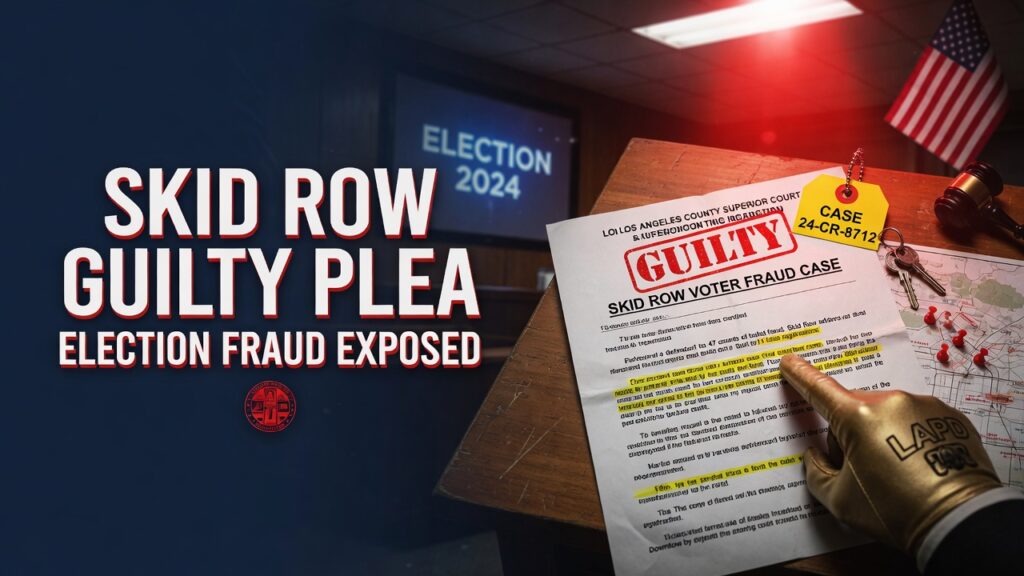
On May 18, 2026, the U.S. Department of Justice announced that Brenda Lee Brown Armstrong, 64, of Marina del Rey, California — a two-decade veteran petition circulator known on the streets as “Anika” — had agreed to plead guilty to one federal felony count of paying individuals, including homeless residents of Los Angeles’ notorious Skid Row, to register to vote. The charge carries a statutory maximum of five years in federal prison. And according to federal prosecutors, this case isn’t an isolated incident. It’s the opening of a much larger door.
Support Independent Local Journalism
TheTownHall.News is a non-profit reader-supported journalism. Just $5 helps us hire local reporters, investigate important issues, and hold public officials accountable across Alameda County. If you believe our community deserves strong, independent journalism, please consider donating $5 today to support our work.What Actually Happened on Skid Row?
The facts of this case are not in dispute — Armstrong herself admitted to them in her plea agreement. For approximately 20 years, Armstrong worked as a petition circulator, collecting voter signatures for ballot initiatives and earning per-signature payments from political coordinators. Beginning no later than 2025, her scheme escalated. She began visiting Skid Row carrying stacks of blank voter registration forms collected from the Los Angeles County Registrar of Voters, paying individuals $2 to $3 in cash — not just to sign petitions, but to fill out those forms and become registered voters.
The operation was caught on undercover hidden camera video by independent journalist James O’Keefe and the O’Keefe Media Group. Federal officials later credited that footage as instrumental in triggering the FBI investigation and subsequent charges.
The scheme had a particularly alarming dimension: many Skid Row residents have no permanent address. On multiple occasions, Armstrong provided her own former Los Angeles address for homeless individuals to list on their registration forms. Because California automatically mails a ballot to every registered voter, this meant live ballots — in other people’s names — could potentially land at an address Armstrong controlled.
The specific criminal act cited in the indictment occurred on January 30, 2026, when Armstrong knowingly paid another person to register to vote in a federal election.

Is This One Bad Actor — or a Broken System?
One person committing fraud does not make a system corrupt. That’s a fair starting point. But the Armstrong case has done more than put one woman in legal jeopardy — it has cracked open a broader federal investigation that prosecutors themselves say goes well beyond a single circulator.
On June 5, 2026, First Assistant U.S. Attorney Bill Essayli — overseeing the Central District of California — publicly announced that his office has “multiple election fraud investigations” underway in coordination with the FBI across Los Angeles. Essayli directly cited the Armstrong case as proof of concept, writing on social media: “Yes. There is evidence of election fraud in California. Here’s a case we charged just last month. More investigations are underway.”
That same day, a federal prosecutor from Essayli’s office physically appeared at an L.A. County ballot processing center to observe the vote-counting process — a move confirmed by L.A. County registrar’s spokesperson Michael Sanchez.
“False registrations undermine Americans’ faith in elections — even more so when payoffs are involved.” — Assistant Attorney General Harmeet K. Dhillon, DOJ Civil Rights Division
What Do Supporters of This System Actually Believe?
Critics of the investigation — and there are credible ones — argue that isolated fraud cases like Armstrong’s, while real, do not constitute evidence of systemic or election-altering fraud. California Secretary of State Shirley Weber stated that the state has “built a strong system that expands access, empowers voters, and ensures more Californians can fully participate in our democracy.” Senator Adam Schiff called federal scrutiny of the count “a blatant attempt to cast doubt in our election results.” Election researchers broadly note that proven fraud cases are rare and have not historically been shown to change election outcomes.
These are legitimate points. Institutional overcorrection — treating one guilty plea as proof of a stolen election — does real damage to public trust in both directions.
Support Independent Local Journalism
TheTownHall.News is a non-profit reader-supported journalism. Just $5 helps us hire local reporters, investigate important issues, and hold public officials accountable across Alameda County. If you believe our community deserves strong, independent journalism, please consider donating $5 today to support our work.But here’s what those arguments don’t answer: if Armstrong’s scheme went undetected for months or years, and was only exposed because a journalist sent someone in with a hidden camera, how confident can we actually be that no other such schemes exist? The DOJ’s own announcement of multiple investigations suggests federal law enforcement has reason to keep looking. Dismissing that as political theater before the investigations conclude is itself a leap of faith — one that asks voters to simply trust a system that just produced a federal guilty plea.
$2 to $3 Per Signature. Paid with Cash. At Scale.
$2 to $3 per voter registration. Over twenty years of petition work, across one of the most densely populated cities in America. The question no one in Sacramento wants to answer: how many registrations were filed this way, and are any of those names still on the rolls?
The DOJ and Assistant Attorney General Harmeet Dhillon’s office are already working to conduct what they describe as a “comprehensive audit of California’s voter rolls.” The federal government previously sued the state for access to those rolls — a lawsuit a federal judge dismissed as “unprecedented and illegal.” That case is now before the U.S. 9th Circuit Court of Appeals.
If the voter rolls are clean, transparency costs nothing. So why has California fought so hard to keep federal auditors out?
Who Is Really Protecting the Integrity of Your Vote?
This is, at its core, a question about personal accountability and civic trust. Armstrong operated for roughly two decades in a system that paid her per valid signature — a structure that created a direct financial incentive to cut corners. She responded to that incentive by allegedly falsifying voter registration forms for people who may never have known their names were being enrolled in the electorate.
Every fraudulent registration is a direct assault on every legitimate voter’s voice. That isn’t hyperbole — it’s the mathematical reality of how ballots cancel each other out.
The O’Keefe investigation didn’t manufacture this story. It documented something that was happening. A federal grand jury reviewed the evidence and approved the charges. Armstrong herself agreed to plead guilty. At every institutional checkpoint — journalism, law enforcement, federal prosecution — the system is moving in one direction: toward accountability.
The question is whether California’s political leadership will move with it, or continue to treat federal scrutiny as an attack rather than a service.
Is This the Accountability Moment We’ve Been Waiting For?
The Armstrong case is significant not because it proves a stolen election — it doesn’t — but because it proves the system can be gamed, has been gamed, and was only caught because someone decided to look. That should disturb every voter regardless of party.
If a petition circulator with a stack of registration forms and a pocket full of cash can operate undetected for months on the streets of Los Angeles, what does that say about the safeguards protecting your vote?
Civic integrity isn’t a partisan issue. It’s the foundation on which every other political debate rests. Law and order means nothing if the mechanism for choosing lawmakers is vulnerable to manipulation. Fiscal accountability is meaningless if the people setting the budget were elected through compromised rolls.
🔑 Key Questions This Story Raises
- How many fraudulent voter registrations from Armstrong’s scheme remain active on California’s voter rolls — and will the state cooperate with a federal audit to find out?
- Who hired Armstrong’s “coordinators,” and are those individuals or organizations under investigation as part of the DOJ’s multiple ongoing fraud cases?
- If the hidden camera footage hadn’t surfaced, would this case ever have been prosecuted — and what does that say about the transparency of California’s election oversight?
The Question Every Californian Should Be Asking
The real issue isn’t whether Brenda Lee Brown Armstrong goes to prison. She almost certainly will. The real issue is what her plea agreement reveals about structural vulnerabilities in a state that automatically mails ballots to every registered voter, resists federal audits of its rolls, and relies on a signature-collection industry with built-in financial incentives to cheat.
Armstrong isn’t the story. She’s the evidence.
The real question isn’t whether this type of fraud can happen in California — it just did. The question is whether anyone in Sacramento has the courage to find out how often.
Still have questions? Subscribe for daily coverage of election integrity, legal accountability, and civic issues that affect your vote.
Think others need to hear this? Share the article and ask your network: should California open its voter rolls to a federal audit?
Want to make your voice count? Contact your U.S. Representative or state legislator and ask them where they stand on voter roll transparency and federal election oversight.