California Mail Ballot Rules Under SCOTUS Scrutiny — What Voters Need to Know
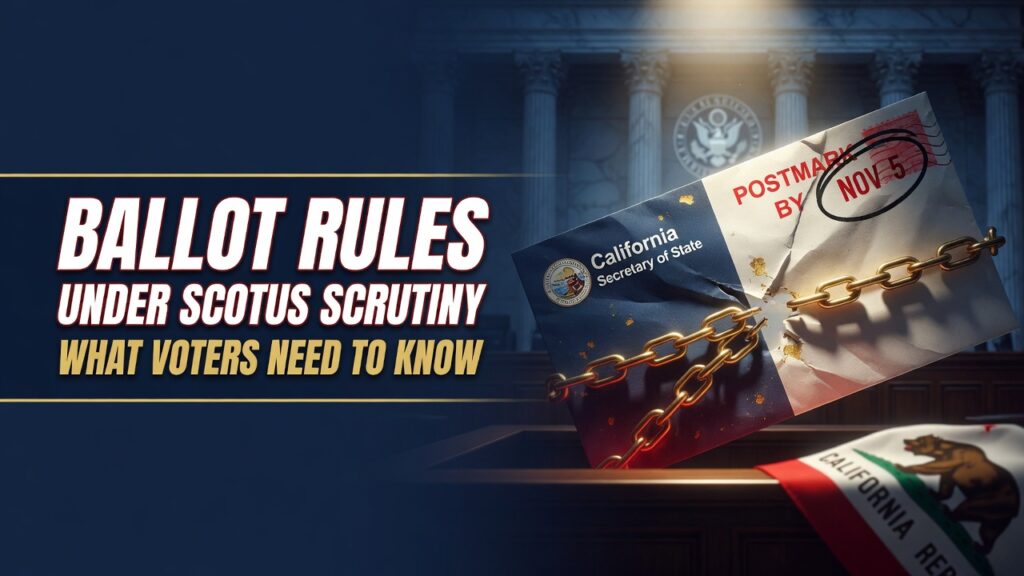
Days after polls closed, millions of ballots remain uncounted and a Supreme Court case is poised to upend the rules — while a sitting president is alleging fraud without evidence. Here is what is actually happening, and why it matters to every American voter.
Election results should not be a weeks-long guessing game. Yet here we are, more than 48 hours after California’s June 2 primary, and the race for governor of the nation’s most populous state is still unresolved — with only 56% of ballots counted and no definitive winner in sight.
This is not an anomaly. It is a pattern. And right now, it is colliding with a Supreme Court case that could fundamentally rewrite the rules for mail-in voting across 14 states before November’s midterms. For voters who believe elections should be transparent, timely, and decisively administered, the events unfolding in California this week demand serious attention.
Support Independent Local Journalism
TheTownHall.News is a non-profit reader-supported journalism. Just $5 helps us hire local reporters, investigate important issues, and hold public officials accountable across Alameda County. If you believe our community deserves strong, independent journalism, please consider donating $5 today to support our work.What Is Actually Happening in California Right Now?
The numbers are striking. As of June 4, 2026, Steve Hilton — the Trump-endorsed Republican — leads Democrat Xavier Becerra 27.6% to 25.6% in the governor’s race, with an estimated 56% of ballots counted. [California Secretary of State data] The Los Angeles mayoral contest is similarly unresolved.
California’s “jungle primary” system sends the top two vote-getters, regardless of party, to the November general election. With margins this thin and this many ballots outstanding, the outcome of one of the most consequential gubernatorial races in the country remains genuinely unknown.
56% of the vote counted — more than 48 hours after polls closed. In the governor’s race of America’s largest state. Is that an acceptable standard for a democracy that values accountability?
State law allows mail ballots postmarked by Election Day to be received and counted up to seven days later — meaning California’s official deadline for receiving ballots is June 9, 2026. Officials began processing mail ballots as early as May 5, a full month before Election Day, and over 4.2 million mail-in ballots had already been returned and accepted before polls even opened. [California Secretary of State]

Is a Slow Count the Same as a Suspicious One?
Here is where intellectual honesty matters. California’s extended counting timeline is a structural reality of its universal vote-by-mail system — not automatically evidence of manipulation. Every registered voter receives a ballot automatically. That means millions of ballots must be individually received, sorted, signature-verified, and processed. It takes time. It has always taken time.
In 2024, control of the United States House of Representatives was not determined until roughly a week after Election Day — in large part because California was still counting. The state’s final certified results did not arrive until nearly a month after the election. [AP/CalMatters reporting]
The question reasonable voters should be asking is not whether fraud is definitively occurring — there is no verified evidence that it is. The question is whether a system this sprawling, this slow, and this dependent on post-Election-Day processing adequately serves the democratic value of timely, transparent results.
“A process that takes weeks to deliver a winner is not just an inconvenience — it is an open invitation for public distrust, regardless of whether that distrust is ultimately warranted.”
What Do Supporters of This Policy Actually Believe?
Defenders of California’s mail ballot system make substantive arguments that deserve a fair hearing. The Federal Election Assistance Commission data indicates that allowing Election Day postmarks has significantly cut California’s ballot rejection rates — meaning more valid votes are counted, not fewer. [Federal Election Assistance Commission data] Supporters also point out that late-arriving ballots represent a relatively small share of the total: approximately 406,000 of California’s ballots arrived after Election Day in the 2024 general election, roughly 2.5% of the state’s total. [VoteBeat/nonprofit reporting]
Military service members, overseas voters, and residents in remote communities, advocates argue, are the voters most likely to be disenfranchised if strict Election Day receipt deadlines are imposed. California Secretary of State Shirley Weber has stated plainly that restricting late ballot counting would “disenfranchise millions of voters” and undermine states’ constitutional authority to administer their own elections.
Support Independent Local Journalism
TheTownHall.News is a non-profit reader-supported journalism. Just $5 helps us hire local reporters, investigate important issues, and hold public officials accountable across Alameda County. If you believe our community deserves strong, independent journalism, please consider donating $5 today to support our work.These are legitimate concerns — and any policy response must grapple with them seriously. But acknowledging those arguments does not require accepting that the status quo is beyond scrutiny. A system can simultaneously protect legitimate voters and generate legitimate questions about transparency and timeliness. Both things can be true.
The Supreme Court Case That Could Change Everything
The more significant story unfolding this week has nothing to do with Trump’s Truth Social posts. It is a case called Watson v. Republican National Committee (Case No. 24-1260), currently before the United States Supreme Court — and a ruling is expected within weeks.
The case originated in Mississippi, where the Republican-led legislature passed a 2020 law allowing mail ballots postmarked by Election Day to be counted up to five days after. The Fifth Circuit Court of Appeals struck it down in 2025, ruling that federal law — which designates a single national Election Day — preempts state laws permitting post-deadline ballot receipt. SCOTUS agreed to hear the case and heard oral arguments on March 23, 2026.
If the Supreme Court sides with the challengers, laws allowing post-Election-Day ballot receipt in 14 states and three U.S. territories could be invalidated — potentially before November 2026.
Election officials across the country are already preparing contingency plans. California’s Secretary of State faces the most exposure of any state, having built its entire modern election infrastructure around the assumption that late-arriving, postmark-compliant ballots will be counted. A ruling against that practice would require rapid legislative and logistical adjustments under serious time pressure.
What Do the Numbers Actually Tell Us?
Nationwide, approximately 750,000 ballots arrived after Election Day during the 2024 general election. California alone accounted for 406,000 of those. [VoteBeat, nonprofit election research]
750,000 ballots resolved after Election Day. The question every voter deserves an answer to: does a system built around that volume of late-arriving ballots serve democratic confidence — or quietly undermine it?
A separate federal lawsuit, Issa v. Weber, filed by Republican Congressman Darrell Issa directly against California’s Secretary of State, seeks to shorten the state’s mail ballot receipt deadline and block counting of any ballot arriving after Election Day. That case’s outcome is likely to be shaped significantly by whatever SCOTUS decides in Watson v. RNC.
Is This the Accountability Moment Voters Have Been Waiting For?
The Supreme Court does not step into election law lightly — and when it does, the consequences are national and lasting. Whatever one’s party affiliation, the Watson v. RNC decision represents exactly the kind of institutional check that voters who believe in limited government and rule of law should want to see function properly.
The answer is not to dismiss all criticism of California’s system as partisan bad faith. Nor is it to accept every allegation of fraud without evidence — and it is worth stating clearly that President Trump’s specific claims of “cheating” and an ongoing federal investigation, made on June 4, 2026, were unsubstantiated at the time of publication. No evidence of coordinated fraud has been produced, and election experts have consistently rated fraudulent mail-in voting as rare. [Brennan Center; Heritage Foundation election fraud database]
What is substantiated is this: a system that cannot deliver a winner in the nation’s largest state for days or weeks after Election Day is a system that has a transparency problem — whatever its legal merits. Citizens who value personal responsibility in civic life have every right to demand that their election infrastructure reflect the same standard.
🔑 Key Questions
These are the questions this article raises that voters, journalists, and lawmakers should be demanding answers to:
- If the Supreme Court rules against post-Election-Day ballot receipt, will California be able to restructure its entire mail voting system before the November 2026 midterms — and at what cost to voters?
- Should federal law establish a uniform national deadline for ballot receipt, or does election administration legitimately belong to the states — even when state practices create weeks of uncertainty?
- At what point does a counting process so extended that it delays national legislative outcomes cross from “thorough” into “structurally incompatible with public trust”?
The Question Every Voter Should Be Asking
The events of this week — an unresolved California governor’s race, a president making unsubstantiated fraud claims, and a Supreme Court poised to rewrite mail-ballot rules for 14 states — are not happening in isolation. They are happening simultaneously, and that convergence matters.
If the people designing election systems cannot deliver timely, transparent results — and courts have to step in to define what “Election Day” actually means — something fundamental has gone wrong.
Civic trust is not rebuilt by dismissing legitimate structural questions, and it is not protected by amplifying unverified allegations. It is rebuilt when institutions operate with speed, clarity, and accountability — the same standards we expect of every other institution that serves the public.
The real question is not whether California’s ballot system is intentionally corrupt. The real question is whether a democracy that values personal responsibility and institutional accountability can afford to keep treating election transparency as optional.
What do you think — is the Supreme Court’s intervention long overdue, or does mail voting flexibility protect more voters than it risks? Share this article and tell us where you stand.
Still have questions? Stay informed on the Watson v. RNC ruling and California’s election law developments — subscribe for daily coverage of the stories that matter.
Think others need to hear this? Share the article with someone who follows election law or civic policy.
Want to make your voice count? Contact your U.S. Representative’s office and ask where they stand on a federal uniform ballot receipt deadline. You can find your representative at house.gov/representatives/find-your-representative.