Anktiva Cancer Treatment Approved in 33 Countries: What Patients and Policymakers Need to Know
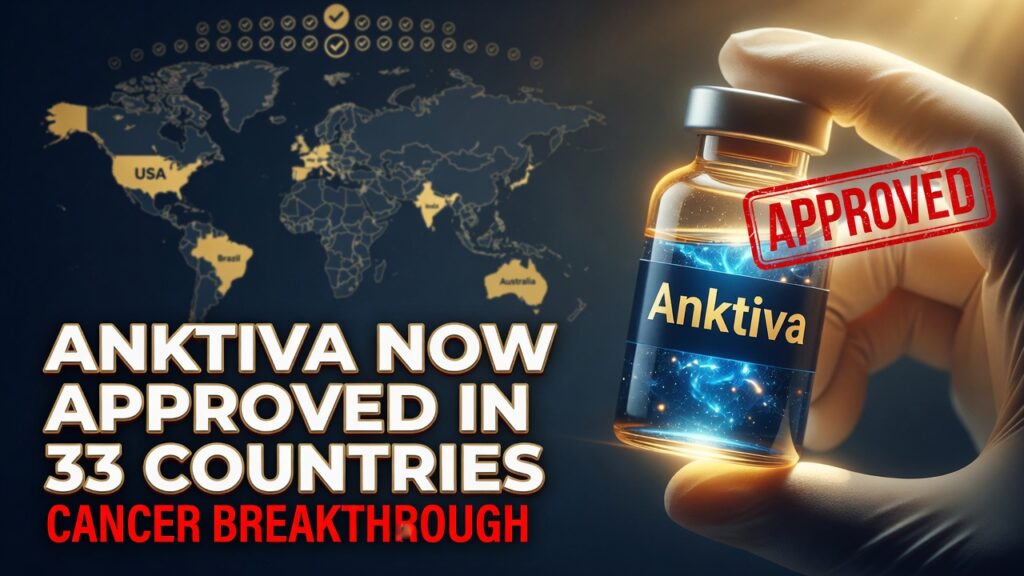
A privately funded immunotherapy built on American ingenuity is now saving bladder cancer patients in 33 countries. The real question: why did it take government this long to get out of the way?
A single scientist’s conviction is quietly rewriting cancer medicine. Dr. Patrick Soon-Shiong, founder of ImmunityBio, did not wait for a federal grant committee to validate his vision. He built it. And now Anktiva — his first-in-class immunotherapy drug also known as N-803 — has been approved across four major global regulatory jurisdictions in under two years, generating $113 million in revenue in 2025 alone, a staggering 700% year-over-year increase.
This matters right now because cancer patients don’t have time to wait. Every year, more than 200,000 new bladder cancer cases are diagnosed across Europe alone, and until Anktiva arrived, patients whose cancer stopped responding to standard BCG therapy had no authorized treatment. Their only option was radical bladder removal. That is no longer the only answer — and American private enterprise deserves significant credit for why.
Support Independent Local Journalism
TheTownHall.News is a non-profit reader-supported journalism. Just $5 helps us hire local reporters, investigate important issues, and hold public officials accountable across Alameda County. If you believe our community deserves strong, independent journalism, please consider donating $5 today to support our work.What Exactly Is Anktiva and Why Does It Work?
Anktiva, generically known as nogapendekin alfa inbakicept, is a first-in-class interleukin-15 (IL-15) receptor superagonist. In plain English: it does not attack cancer directly the way chemotherapy does, burning through healthy cells alongside malignant ones. Instead, it empowers the body’s own immune system to do what it was designed to do — identify and destroy threats.
The drug activates natural killer (NK) cells, cytotoxic T cells, and memory T cells simultaneously. Clinical trial results from the pivotal QUILT-3.032 study showed a 71% complete response rate in bladder cancer patients, with over 80% of treated patients preserving their bladder through three years of follow-up. Those numbers are not incremental progress. They represent a genuine paradigm shift.
71% complete response. 80% bladder preservation at three years. These are not statistics from a government research committee — they came from a privately driven clinical program. (Tweetable)
Is This the Accountability Moment American Innovation Deserves?
Here is what the mainstream medical establishment and many in Washington have been slow to acknowledge: this breakthrough did not emerge from a billion-dollar federal research bureaucracy. It was built by a team operating under enormous financial pressure, navigating one of the most demanding regulatory environments in the world.

ImmunityBio received FDA approval for Anktiva in April 2024. By February 2026 — less than 24 months later — the drug was authorized in the United States, the United Kingdom, the European Union, and Saudi Arabia. That is 33 countries. The company described it as “the most rapid international expansion for an immunotherapy in this indication.”
That kind of execution demands recognition. And it raises a pointed question every taxpayer should be asking: if private capital and personal accountability can produce this result, why do we continue to funnel hundreds of billions into government health bureaucracies that deliver innovation at a fraction of the speed?
“In under two years from initial FDA approval, ImmunityBio has built a global commercial footprint spanning 33 countries — powered not by federal committees, but by a founder’s conviction and market accountability.”
Who Is Really Benefiting — And Who Could Be Left Out?
The Saudi Food and Drug Authority made history in January 2026 by becoming the first regulatory body in the world to approve Anktiva for lung cancer — specifically for metastatic non-small cell lung cancer in combination with checkpoint inhibitors. The European Commission followed weeks later with conditional marketing authorization for bladder cancer across all 27 EU member states.
Meanwhile, the U.S. FDA’s own supplemental review of Anktiva for an expanded bladder cancer indication — covering patients with papillary disease — carries a target action date of January 6, 2027. That means American patients with this specific cancer subtype could wait nearly a full additional year while patients in Saudi Arabia and Europe already have access.
$113 million in Anktiva revenue in 2025. The question every American cancer patient deserves answered: why is a foreign government approving this drug’s new uses before ours does? (Tweetable)
Support Independent Local Journalism
TheTownHall.News is a non-profit reader-supported journalism. Just $5 helps us hire local reporters, investigate important issues, and hold public officials accountable across Alameda County. If you believe our community deserves strong, independent journalism, please consider donating $5 today to support our work.This is not a partisan issue. It is a patient rights issue. It is a question of whether the regulatory infrastructure designed to protect Americans is, in practice, also slowing their access to life-saving medicine.
What Do Supporters of Government-Led Drug Oversight Actually Believe?
To be fair, the argument for rigorous FDA review is not without merit. Advocates for the current system correctly point out that accelerated approvals carry real risks — drugs approved on limited single-arm trial data have sometimes failed to demonstrate long-term benefit or revealed safety profiles that only emerge in broader populations. The FDA’s caution on expanding Anktiva’s papillary disease label stems, in part, from a request for additional data — a standard safeguard designed to protect patients.
The Saudi and European approvals are explicitly conditional — meaning they come with requirements for further data submissions and annual renewal. This is not full, unconditional market clearance. Supporters of careful oversight argue that American patients benefit from a higher evidentiary bar.
That argument deserves respect. But it also requires a response: Anktiva’s pivotal trial showed a 99% bladder cancer-specific survival rate at 24 months and a safety profile where no Grade 4 or 5 treatment-related adverse events were reported. At some point, demanding more data while patients lose organs — or their lives — is not caution. It is a failure of proportionality.
How Far Can This Treatment Actually Reach?
The pipeline behind Anktiva is where this story gets even more significant. ImmunityBio is currently running or planning over 30 active clinical trials across 10 tumor types. The company’s “Cancer BioShield” strategy is built on a simple but powerful concept: use Anktiva to restore and amplify the immune systems of patients weakened by chemotherapy, radiation, or disease itself — regardless of cancer type.
The FDA has already authorized an Expanded Access Program for Anktiva to treat treatment-induced lymphopenia in solid tumor patients who have failed first-line therapy. If successful, this approach could eventually place Anktiva in the treatment protocol for cancers of the pancreas, brain, breast, liver, colon, and lung. Randomized trials are either enrolling or in design for glioblastoma, triple-negative breast cancer, colorectal cancer, and first-line non-small cell lung cancer.
If Anktiva’s immune-restoring mechanism proves durable across tumor types, we may be witnessing the early chapters of the most consequential shift in oncology in a generation. (Tweetable — rhetorical resonance)
What Happens If Market Forces Are Constrained?
ImmunityBio holds patents on Anktiva’s combinations with checkpoint inhibitors through beyond 2035. That exclusivity window is what makes continued investment in the program financially rational. Critics of pharmaceutical patent protection often argue that these protections drive up prices and limit access. It is a fair concern — and one that demands a fact-based answer.
Without that patent protection, no private investor would have funded the hundreds of millions spent developing, trialing, and manufacturing this drug. The alternative — relying on government to conduct and fund all oncology innovation — is a model that produced far fewer breakthroughs per dollar than the American private sector model. Fiscal accountability, in this context, means understanding that short-term cost controls can produce long-term medical stagnation.
📋 Key Questions This Article Raises
- Should the FDA accelerate its review of Anktiva’s expanded indication, given that 33 countries have already approved it with strong safety data?
- Are American cancer patients paying the price of regulatory lag while foreign governments offer faster access to proven treatments?
- If private enterprise can deliver a 700% revenue-growth immunotherapy in under two years, what does that tell us about the efficiency of government-led medical research?
The Question That Should Follow Every Cancer Patient Home
American innovation built this drug. American patients funded the regulatory infrastructure meant to deliver it to them. The story of Anktiva is, at its core, a story about what happens when individual conviction, market accountability, and scientific rigor align — and what happens when bureaucratic timelines fail to keep pace.
The real question is not whether Anktiva works. The clinical data has answered that. The question is whether the systems Americans have built — and continue to pay for — are actually organized around the needs of patients, or around the comfort of institutions.
The real question isn’t whether this breakthrough will change cancer care — it’s whether American patients will be first in line to receive it, or last.
Still have questions? Stay informed — subscribe for daily coverage of the health and policy issues that actually affect your life.
Think others need to hear this? Share this article and tell us: should the FDA fast-track Anktiva for American cancer patients?
Want to make your voice count? Contact your congressional representative and ask what they are doing to reduce regulatory lag for life-saving treatments already approved in dozens of other countries. The Capitol Switchboard can be reached at 1-202-224-3121.