California Voter Rolls Audit Blocked: Is the State Hiding What’s Really on Them?
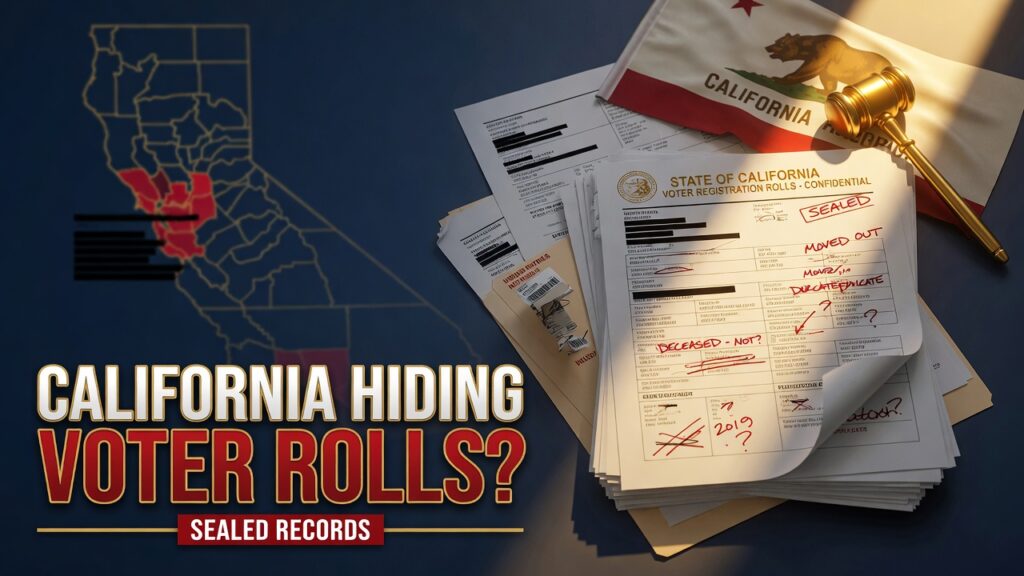
873,092. That is the number of inactive voter registrations that a new federal lawsuit alleges remain illegally on California’s rolls — some dating back a decade or more. The question no one in Sacramento wants to answer: how did this happen, and who let it go on for so long?
The lawsuit, filed by Orange County Supervisor and secretary of state candidate Don Wagner alongside Judicial Watch and the American Independent Party, was submitted in the U.S. District Court for the Central District of California. It alleges that California Secretary of State Shirley Weber is in violation of the National Voter Registration Act, which requires states to remove inactive registrations following two consecutive general federal elections without voter activity. According to the complaint, over 151,000 of those flagged registrations have been inactive through at least four consecutive elections.
This is not the first time Judicial Watch has forced California’s hand on this issue. In 2019, the organization settled a similar lawsuit with the state and Los Angeles County, resulting in the removal of more than 1.2 million names from voter rolls. Critics argue that California’s failure to maintain clean rolls since that settlement raises serious questions about institutional commitment to basic election hygiene — regardless of whether any single inactive registration ever results in a fraudulent vote.
Support Independent Local Journalism
TheTownHall.News is a non-profit reader-supported journalism. Just $5 helps us hire local reporters, investigate important issues, and hold public officials accountable across Alameda County. If you believe our community deserves strong, independent journalism, please consider donating $5 today to support our work.What Do Supporters of California’s Position Actually Believe?
This is a question worth taking seriously, because the opposing argument is not frivolous. California election officials and civil liberties organizations — including the League of Women Voters, the ACLU, and the Electronic Privacy Information Center — argue that the DOJ’s demand for unredacted voter files poses genuine risks to voter privacy. They contend that handing over sensitive personal data, including partial Social Security numbers, to federal authorities creates potential for misuse, voter intimidation, and chilling effects on registration, particularly among minority and immigrant communities.
They also argue that California’s election system already includes robust safeguards: signature verification on mail-in ballots, ballot tracking, post-election audits, and provisional ballot processes for voters whose eligibility requires confirmation. These are real protections, and dismissing them entirely would be intellectually dishonest.
The problem, however, is that privacy arguments and existing safeguards do not answer the core question the federal government is asking: are the rolls accurate? Transparency is not the enemy of privacy — it is the precondition for trust. And when a state fights this hard to keep its voter files away from federal oversight, it is reasonable for citizens to ask what, precisely, is being protected.
“When a government entity fights this hard to keep its own records away from lawful review, the burden of proof shifts. You no longer have to prove something is wrong — you have to ask why they’re so determined to prevent anyone from checking.”
Why Did Newsom Just Sign a Law Making Audits Harder?
Five days before the June 2 primary, Governor Gavin Newsom signed Senate Bill 73 into law. The legislation prohibits unauthorized access to voter rolls, voter lists, and certified voting technology by law enforcement — including federal agents — without a court order or an active investigation into specific California election law violations. It also makes it a felony, punishable by up to three years in prison, for anyone to seize voted ballots from election officials.

If California’s elections are as secure as its officials insist, why did the governor rush to sign a law specifically blocking federal access to voting systems just days before an election?
Supporters frame SB 73 as a shield against politically motivated intimidation. Critics see something harder to dismiss: a state legislature and a governor who, facing active federal litigation and multiple announced fraud investigations, chose to erect new legal barriers rather than open the books. The timing alone invites scrutiny that no press release can fully deflect.
What About California’s Voter ID Rules?
The post that sparked this article raised the issue of California allowing gym membership cards and prescription drug labels as voter ID. The reality, as always, is layered but still troubling to many Americans. Under the federal Help America Vote Act — a law that applies nationwide — voters who cannot be matched to a Social Security number or driver’s license during registration must present some form of ID before casting a regular ballot. California’s HAVA-compliant regulations permit an unusually broad list of qualifying documents, including health club membership cards, employer IDs, credit cards, insurance cards, and prescription drug labels issued by a government provider.
This applies only to a specific subset of first-time voters, not the general voting population. Voters without qualifying ID may still cast a provisional ballot subject to verification. But the breadth of acceptable documents raises a legitimate civic question: in an era when you need a photo ID to board a plane, open a bank account, or pick up a prescription, is it unreasonable to apply a consistent standard to the act of voting — arguably the most consequential civic act a citizen performs?
Key Questions This Story Raises
- If California’s voter rolls and election systems are as secure and clean as state officials claim, why has the state spent months in court fighting to prevent a federal audit of those same records?
- With 873,092 inactive registrations allegedly sitting on California’s rolls in violation of federal law, what concrete steps is the Secretary of State taking — right now — to remove them before November’s midterm election?
- Should every American voter — regardless of party — expect a uniform, photo-based ID standard as the minimum threshold for casting a ballot in a federal election?
Is This the Accountability Moment California’s Voters Deserve?
Two lawsuits. A brand-new state law designed to block federal access. A governor who signed that law days before polls opened. A federal case before the Ninth Circuit with no ruling yet. None of this proves fraud occurred. But all of it proves something important: the systems designed to guarantee election integrity in the nation’s most populous state are under serious, documented legal challenge — and the state’s response has been to fight transparency rather than embrace it.
Support Independent Local Journalism
TheTownHall.News is a non-profit reader-supported journalism. Just $5 helps us hire local reporters, investigate important issues, and hold public officials accountable across Alameda County. If you believe our community deserves strong, independent journalism, please consider donating $5 today to support our work.Election integrity is not a partisan issue — it is the foundation every other political right rests on. When that foundation cracks, every American loses, regardless of which party benefits.
Citizens who believe in law and order, civic accountability, and the equal value of every legitimate vote should be paying close attention to what happens next in the Ninth Circuit. Because the outcome of United States v. Weber will not just determine what California has to disclose — it will set a national precedent for how much transparency states owe the federal government, and by extension, the voters they serve.
The real question is not whether California’s voter rolls have problems. Multiple federal lawsuits, a prior 1.2-million-name purge, and 873,000 flagged registrations suggest they do. The real question is whether anyone with the power to act will do so before November — or whether accountability, once again, will arrive too late.
What do you think — is California doing enough to protect election integrity, or is transparency the real casualty here? Share this article and let us know in the comments.
Still have questions? Subscribe for daily coverage of election integrity, federal policy, and civic accountability. Think others need to hear this? Share the article on social media and start the conversation. Want to make your voice count? Contact your state and federal representatives and ask them where they stand on federal voter roll audits — the contact tool at Congress.gov takes less than two minutes.