Palisades Fire Trial 2026: What You Need to Know About the Case Against Rinderknecht
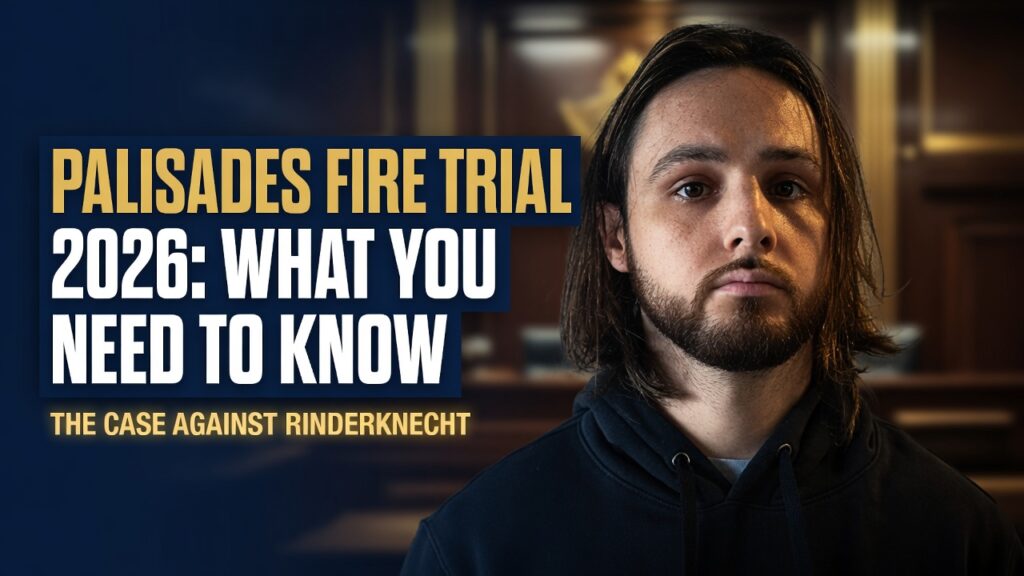
One man sits in the defendant’s chair today. But the evidence suggests the story of who failed Los Angeles on January 7, 2025 is far more complicated — and far more damning — than prosecutors are being allowed to tell.
Twelve people are dead. Seven thousand structures are gone. The most destructive fire in Los Angeles history erupted on a single night — and as of this morning, June 8, 2026, a federal jury is being selected to decide whether one man bears the weight of all of it. The courtroom may be ready for Jonathan Rinderknecht. The harder question is whether Los Angeles is ready for the full truth.
Rinderknecht, a 29-year-old occasional Uber driver from Melbourne, Florida, stands accused of igniting the so-called Lachman Fire near Pacific Palisades in the early hours of New Year’s Day 2025. Prosecutors allege the blaze smoldered underground for six days before Santa Ana winds drove it into the catastrophic Palisades Fire on January 7. He has pleaded not guilty to three federal felony counts and faces between five and 45 years in prison if convicted. What the trial will not fully examine — by judicial order — is what the Los Angeles Fire Department did, or failed to do, in the hours and days in between.
Support Independent Local Journalism
TheTownHall.News is a non-profit reader-supported journalism. Just $5 helps us hire local reporters, investigate important issues, and hold public officials accountable across Alameda County. If you believe our community deserves strong, independent journalism, please consider donating $5 today to support our work.The Evidence Prosecutors Will — and Won’t — Be Allowed to Use
Judge Anne Hwang, appointed to the federal bench by President Biden in 2024, has issued pre-trial rulings that significantly reshape what the jury will hear. Prosecutors cannot introduce the AI-generated ChatGPT images Rinderknecht allegedly prompted months before the fire — dystopian scenes of burning cities and fleeing crowds — on the grounds they are too prejudicial. Those images had been front and center at his October 2025 arrest press conference.
The defense, meanwhile, has been blocked from presenting testimony gathered in a separate civil lawsuit against the city — including sworn statements from a firefighter, a fire captain, and a state park ranger who alleged the Lachman Fire was still visibly smoldering when crews were ordered to leave the burn area. That testimony will not reach the jury. The Los Angeles Times reported in October 2025 that firefighters had raised internal concerns about being ordered to abandon the smoldering site, and a follow-up investigation in December 2025 found that the LAFD’s own after-action report was significantly watered down across seven drafts before publication.
$18 to $20 billion. That is the estimated damage from a fire that the Los Angeles Fire Department declared extinguished on January 2, 2025. The question no one in city government wants to answer: what happened in the hours after they left?
What Do Prosecutors Say Actually Happened?
The government’s case is built on a mosaic of circumstantial and digital evidence. According to the trial memorandum filed in April 2026, Rinderknecht was working as an Uber driver on New Year’s Eve and had grown increasingly agitated over a failed relationship and an inability to find companionship for the holiday. Multiple passengers told investigators he was driving erratically and appeared “angry, intense, and ranting about being pissed off at the world.” He made online searches in the weeks prior that included phrases like “lets take down all the billionaires” and expressed a fixation on Luigi Mangione, the man charged with the assassination of UnitedHealthcare CEO Brian Thompson.

Surveillance footage allegedly shows Rinderknecht hiking up a Palisades trail after his final Uber drop-off. Prosecutors say he lit the fire at approximately 12:12 a.m. on January 1, called 911 multiple times, and left before crews arrived — only to return and film the response. The case against him rests on witness statements, cellphone data, surveillance video, and fire dynamics analysis conducted by ATF investigators. Prosecutors will argue the January 7 Palisades blaze was a “holdover” or “zombie fire” — a direct continuation of the Lachman Fire burning underground.
Is a Single Defendant Enough to Explain a $20 Billion Catastrophe?
This is the question that hangs over the entire proceedings. Rinderknecht’s attorney, Steven Haney, argues his client is being “scapegoated” by an institution — the LAFD — desperate to deflect accountability for its own operational failures. The defense has noted that when investigators first conducted warrant searches on Palisades Fire suspects, none had ties to Rinderknecht. A connection was only formally claimed eight months later. Haney has also pointed to fireworks reported in the area that same night as a potential alternative ignition source.
If a fire department declares a blaze extinguished and leaves a smoldering site unattended, who bears responsibility when it reignites and kills a dozen people?
The judge herself acknowledged in pre-trial hearings that jurors might find Rinderknecht guilty of lighting the Lachman Fire but stop short of holding him legally responsible for the Palisades catastrophe — precisely because of the intervening decisions made by others. That is not a loophole. That is a legitimate question of legal causation — and one the city of Los Angeles has spent over a year avoiding.
What Do Supporters of the Government’s Case Actually Believe?
Defenders of the prosecution argue, not unreasonably, that personal responsibility must anchor any civilized legal system. If Rinderknecht lit a fire in a tinder-dry hillside community during historically dangerous fire conditions, he cannot escape liability by pointing to what came after. Criminal law does not require that a defendant’s act be the sole cause of harm — only that it be a substantial contributing cause. Prosecutors will argue that anyone who ignites a wildfire in Los Angeles in January, during Santa Ana wind season, should foresee catastrophic consequences.
Support Independent Local Journalism
TheTownHall.News is a non-profit reader-supported journalism. Just $5 helps us hire local reporters, investigate important issues, and hold public officials accountable across Alameda County. If you believe our community deserves strong, independent journalism, please consider donating $5 today to support our work.That argument deserves to be heard. But it does not answer the separate and equally urgent question of institutional accountability. Holding Rinderknecht responsible and holding the LAFD accountable are not mutually exclusive positions. A functioning system of civic accountability demands both. The fact that evidence of departmental conduct has been largely walled off from this trial does not mean the public should accept the same silence.
“One man sits in the federal dock today. But the Los Angeles Fire Department’s decisions in the hours after January 1 have been quietly erased from the official narrative — and that erasure has a cost.”
A Mayor Running for Reelection While Her City Burned
The political dimension of this story cannot be separated from the legal one. Mayor Karen Bass was in Ghana on a taxpayer-funded presidential delegation when the fires erupted. She returned to a city in crisis and has spent the months since defending the city’s response and managing her political exposure. The fire now dominates the June 2026 mayoral primary, in which Bass leads with approximately 35 percent of the vote [based on early returns as of June 8, 2026], while challengers Spencer Pratt and Nithya Raman battle for the second slot in a November runoff.
If a mayor is abroad while her city burns — and her fire department leaves a smoldering blaze unattended the week before — is the election an accountability moment, or just a formality?
Voters are evidently still deciding. But the closeness of the race — in a city where incumbents historically dominate — suggests that civic patience is not unlimited. Residents who spent over a year navigating debris removal, insurance disputes, and a shuttered post office are not interested in political spin. They want answers.
The Accountability Moment No One Is Scheduling
Federal prosecutors will spend the coming weeks arguing that Jonathan Rinderknecht is responsible for the deaths of twelve people and the destruction of a city. They may well be right. But the courtroom will remain deliberately silent on what the LAFD knew, when it knew it, and why an internal after-action report was altered across seven successive drafts. It will not examine who gave the order to leave. It will not ask why the city’s leadership was absent.
Personal responsibility is a foundational value — but it must apply to institutions as well as individuals. A civilization that holds its citizens to account while shielding its bureaucracies from scrutiny is not a government of laws. It is a government of convenience.
The families of twelve victims, the thousands who lost homes, and the taxpayers absorbing billions in costs deserve more than a single defendant. They deserve a full accounting — one this trial, by design, will not deliver.
Key Questions This Story Raises:
- If the LAFD left a visibly smoldering fire unattended and was subsequently ordered to suppress that fact in its own report, who authorized that cover-up — and will they ever face consequences?
- At what point does a city government’s failure to prepare for, respond to, and honestly account for a disaster become its own form of criminal negligence?
- Is the Los Angeles mayoral race the only remaining mechanism through which voters can demand institutional accountability for the Palisades catastrophe?
The real question this trial raises is not whether one angry young man set a fire in the hills. It may be whether the people and institutions paid to prevent exactly this kind of catastrophe will ever be asked to explain themselves — before the next fire season begins.
Think others need to hear this? Share this article and add your voice to the conversation. Want to stay informed on the trial and LA’s accountability crisis? Subscribe for daily coverage. You can also contact your local representative or the Los Angeles City Council directly at lacity.org to demand a full, independent review of LAFD’s conduct before and after January 1, 2025.