Journalists Killed in Gaza: The Press Freedom Crisis the World Cannot Ignore
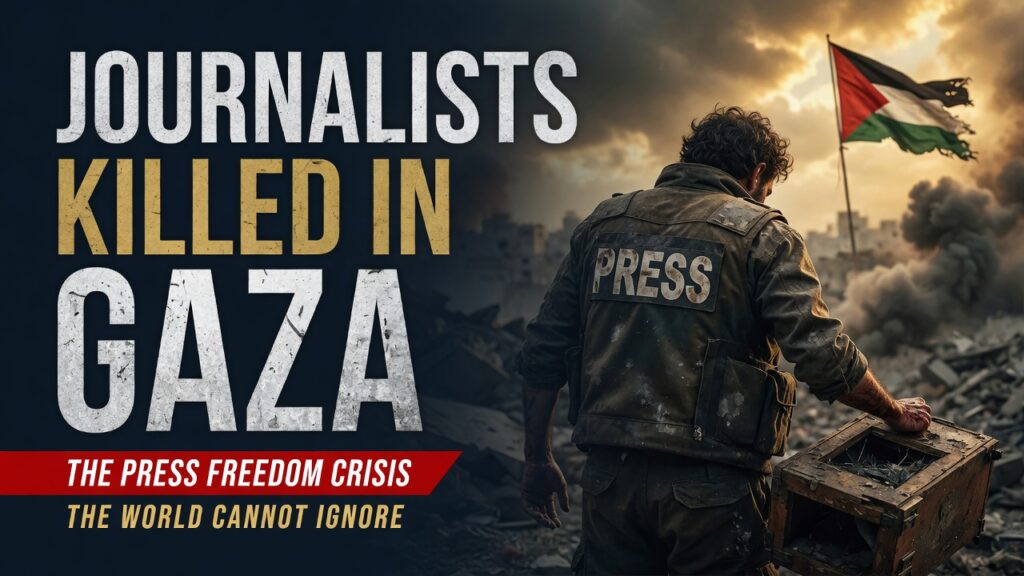
Are Journalists Paying With Their Lives While the World Looks the Other Way?
Since October 7, 2023, more journalists have been killed than in any conflict in recorded history — and not a single perpetrator has faced justice.
The numbers are not a statistic. They are a graveyard.
As of June 11, 2026, at least 263 journalists and media workers have been confirmed killed since the Israel-Gaza war began — surpassing every prior conflict on record, according to the Committee to Protect Journalists (CPJ). This is not a distant abstraction debated in academic journals. It is happening in real time, on camera, in press vests, and the silence from the institutions designed to prevent exactly this kind of impunity is deafening.
Support Independent Local Journalism
TheTownHall.News is a non-profit reader-supported journalism. Just $5 helps us hire local reporters, investigate important issues, and hold public officials accountable across Alameda County. If you believe our community deserves strong, independent journalism, please consider donating $5 today to support our work.What Do the Numbers Actually Tell Us?
The figures are staggering, and they deserve to be read slowly. The CPJ, which has tracked journalist killings since 1992, has never — in over three decades of documentation — recorded a single government responsible for more journalist deaths than Israel has accumulated since October 7, 2023. Of the 263 confirmed killed, 259 were killed by Israeli forces, including 207 Palestinians in Gaza, 31 Yemenis, 7 Lebanese during the Gaza war, and additional deaths in Lebanon and Iran. A further 174 journalists have been injured, 108 arrested, and 2 remain missing [CPJ, updated June 11, 2026].
Then came 2025. The Committee to Protect Journalists confirmed it as the deadliest year for journalists ever recorded — 129 press workers killed worldwide in a single calendar year, with Israel responsible for two-thirds of those deaths. The International Federation of Journalists independently confirmed 128 killed in 2025. These are not rival estimates. They are a consensus.
263 journalists confirmed killed since October 7, 2023. The question every press freedom organization is now asking: when does impunity become policy?
How Did We Get Here? The Shireen Abu Akleh Precedent
To understand how the world arrived at this moment, you have to go back to May 11, 2022 — the day Palestinian-American journalist Shireen Abu Akleh was shot and killed by Israeli forces while reporting for Al Jazeera in the Jenin refugee camp. She was wearing a vest clearly marked PRESS. She was among a group of journalists in an open area. Multiple independent investigations — conducted by the Associated Press, CNN, The New York Times, The Washington Post, Forensic Architecture, and Bellingcat — concluded she was killed by an IDF bullet. Several found evidence she was intentionally targeted.

The IDF eventually acknowledged a “high possibility” that its fire was responsible. It refused to prosecute anyone. The U.S. State Department called the killing “likely” caused by Israeli fire, then closed the matter in three paragraphs. The FBI opened an investigation in November 2022 and has released no public updates since. Abu Akleh was an American citizen. Four years later, on the anniversary of her death in May 2026, the International Press Institute stated plainly: no progress toward accountability has been made.
“The failure of the international community to hold Israel accountable has opened the door yet wider for emboldened attacks on journalists, and is further fuelling a global crisis of impunity for crimes against the press.” — IPI Executive Director Scott Griffen, May 2026
This is the precedent that mattered. When a U.S. citizen journalist is killed, investigations are opened, anniversaries are observed, and nothing changes — what signal does that send to every other government watching?
Is This Deliberate Targeting — Or Unavoidable Collateral Damage?
This question sits at the center of every legal and moral debate surrounding this crisis, and the evidence increasingly points in one direction. CPJ has confirmed that at least 75 journalists were deliberately and directly targeted by Israeli forces — killed in reprisal for their journalism, meeting CPJ’s rigorous legal threshold for classification as “murder.” In 2025 alone, 47 journalists were confirmed murdered for their work globally, and 81% of those killings were attributed to Israel [CPJ, February 2026].
The primary weapon in these targeted killings has been the armed drone. Since October 7, 2023, Israeli drone strikes have killed at least 49 Palestinian journalists and media workers — 1 in 2023, 17 in 2024, 28 in 2025, and 3 more in January 2026 alone. These are precision weapons operated by one of the world’s most technologically advanced militaries — a military that, as CPJ Regional Director Sara Qudah stated, possesses surveillance and targeting capabilities that make claims of mistaken identity implausible.
If a government uses precision drone technology to kill dozens of journalists wearing press vests, at what point does “unintended” become an excuse the evidence no longer supports?
Support Independent Local Journalism
TheTownHall.News is a non-profit reader-supported journalism. Just $5 helps us hire local reporters, investigate important issues, and hold public officials accountable across Alameda County. If you believe our community deserves strong, independent journalism, please consider donating $5 today to support our work.Israeli officials have consistently denied deliberately targeting journalists and have told media outlets the IDF cannot guarantee journalist safety in active combat zones. Those statements have been repeated even as the body count climbs past 250.
What Do Supporters of This Position Actually Believe?
It is worth engaging honestly with the argument made by those who defend Israel’s military conduct. Supporters contend that Hamas and other armed groups embed themselves within civilian and media infrastructure, making it genuinely difficult to distinguish journalists from combatants. They point to documented cases of individuals falsely identified as journalists, and note that CPJ itself has removed names from its database after subsequent investigations revealed some individuals had participated in combat. Israel’s defenders argue that holding the IDF to a standard no other military operating in urban asymmetric warfare faces is a form of selective accountability.
These are not frivolous arguments, and intellectual honesty demands they be taken seriously. CPJ’s own methodology accounts for exactly this complexity — it removes names when evidence of combatant status emerges, and it distinguishes between confirmed targeted murders and deaths that remain under investigation. The concern about misidentification is legitimate. But it does not explain 75 confirmed targeted murders. It does not explain the pattern of journalists killed in groups, in clearly marked press vehicles, or at their homes alongside their families. It does not explain four years of zero prosecutions — not one — across two decades of documented journalist killings by the same military.
Accountability is not anti-Israel. It is what the rule of law requires of every government, everywhere.
What Happens When Press Freedom Dies in Plain Sight?
The consequences of this impunity extend far beyond Gaza. Reporters Without Borders reported in 2026 that press freedom has fallen to its lowest level in 25 years globally. A 2024 UNESCO report found that the impunity rate for journalist killings worldwide stands at 85% — a figure that has not meaningfully changed in over a decade [UNESCO, 2024]. When journalists are killed without consequence, the information that reaches the public about wars, famines, and atrocities is not just incomplete — it is controlled.
Gaza has been under a near-total ban on foreign press access imposed by Israel since the war began. The journalists documenting conditions on the ground — the starvation, the hospital strikes, the displacement of 90% of a civilian population — are almost exclusively local Palestinian reporters. They are the only witnesses. And they are being killed at a rate history has never seen.
When the last journalist in a war zone is silenced, the only version of events that remains is the one the most powerful party wants you to hear.
Is This the Accountability Moment We Have Been Waiting For?
On World Press Freedom Day, May 3, 2026, Palestinian journalist Rewaa Abu Muamar broadcast a message from Gaza that was carried by the United Nations: “Stop targeting journalists.” That same month, journalists reporting from Gaza were awarded the 2026 Golden Pen of Freedom — the world’s most prestigious press freedom honor — for what the awarding body called courage under conditions designed to eliminate them.
The international legal framework is clear. Under international humanitarian law, journalists are civilians. The deliberate targeting of civilians is a war crime. Under Article 79 of Additional Protocol I to the Geneva Conventions, journalists in conflict zones are entitled to protection provided they take no action adversely affecting their civilian status. CPJ has called on international authorities to treat targeted journalist killings as war crimes and to investigate the chain of command, from individual soldiers to the highest levels of military leadership.
The mechanisms exist. The evidence is documented. The names are known. The question is whether the political will to act will ever match the scale of what has been lost.
Key Questions This Article Raises:
- Why has no government, court, or international body initiated formal war crimes proceedings specifically for the targeted killing of journalists in Gaza, despite over three decades of CPJ documentation and clear international legal frameworks?
- What accountability mechanisms remain available to the families of killed journalists — particularly those who were citizens of countries with the legal standing and political obligation to act?
- If the global impunity rate for journalist killings has remained at 85% for over a decade, what structural reforms to international press protection law are necessary — and who has the authority to implement them?
The Question That Cannot Be Unanswered
Press freedom is not a liberal value or a conservative value. It is the infrastructure of every other freedom. When governments can kill journalists without consequence, they can also conduct wars without witnesses, implement policies without scrutiny, and consolidate power without opposition. The killing of Shireen Abu Akleh was not the beginning of this story. The more than 260 deaths since October 7, 2023, are not its end.
The real question is not whether this crisis is unprecedented — it is. The real question is not whether the evidence is sufficient to demand accountability — it is. The question that remains, the one that every press freedom organization, every government with legal standing, and every citizen who depends on a free press must answer, is this: how many journalists have to die before the institutions we built to prevent exactly this finally decide to act?
What do you think — is the international community capable of holding anyone accountable for this, or has impunity become permanent? Share this article and tell us where you stand.
Still have questions about press freedom and journalist safety worldwide? Subscribe for ongoing coverage of this story as it develops. Think this needs wider attention? Share this article — the journalists still working in Gaza are depending on the world knowing their names. Want to make your voice count? Contact your elected representative and ask them directly: what is our government doing to investigate the killing of journalists who hold our citizenship?