Operation Firewall: 341 Arrested, 40 Children Rescued in SoCal Child Exploitation Crackdown
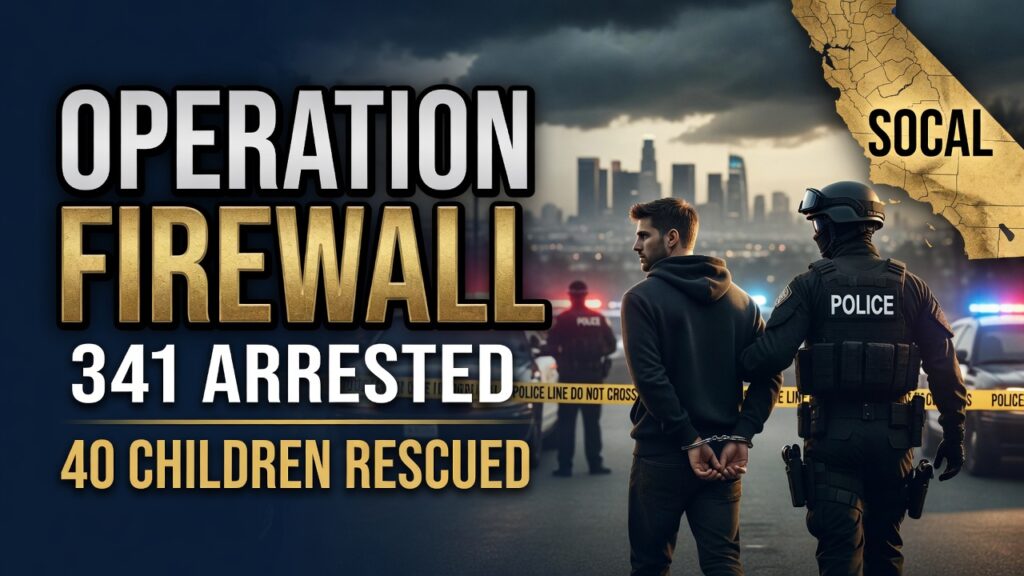
As Operation Firewall nets 341 arrests and rescues 40 children across Southern California, law enforcement is sending an unmistakable message — but the harder question is one only parents can answer.
The Arrests Were Massive. The Problem Is Bigger.
Three hundred and forty-one predators. Forty children rescued. Victims as young as one year old. When authorities announced the results of “Operation Firewall” on May 21, 2026, the numbers alone were enough to silence a room. But behind every statistic is a child whose life was shattered — and a digital pathway that no one shut down in time.
The announcement came from LAPD headquarters, where representatives of 112 law enforcement agencies gathered to present findings from a two-week operation spanning five Southern California counties: Los Angeles, Orange, San Bernardino, Santa Barbara, and Ventura. Led by the Los Angeles Regional Internet Crimes Against Children (ICAC) Task Force, Operation Firewall was not a routine sting. It was a coordinated, technology-driven campaign that used undercover investigations across social media platforms, executed residential and arrest warrants, and drew in every available tool at law enforcement’s disposal. The results were historic — and the warning embedded in them is urgent.
Support Independent Local Journalism
TheTownHall.News is a non-profit reader-supported journalism. Just $5 helps us hire local reporters, investigate important issues, and hold public officials accountable across Alameda County. If you believe our community deserves strong, independent journalism, please consider donating $5 today to support our work.What Did Operation Firewall Actually Uncover?
The operation ran from April 19 to May 3, 2026, and it revealed something that should concern every parent, educator, and community leader in America. The suspects were not lurking in back alleys. They were inside smartphones, gaming consoles, and social media platforms — in the digital rooms where millions of children spend hours each day, largely unsupervised.
Charges against the 341 arrested suspects included production, possession, and distribution of child sexual abuse material; lewd acts with a child; human trafficking; contacting or attempting to meet a minor for lewd purposes; and failure to register as a convicted sex offender. In Long Beach alone, one suspect was found in possession of more than 150,000 illicit images. In Orange County, 10 sting operations involved undercover investigators posing as 13-year-old girls — and men showed up anyway.
341 predators arrested in two weeks across five counties. The question that demands an answer: how many are still out there right now?
One case illustrated the transnational reach of these crimes. A man posing as a high school football player convinced a young girl to cross into Mexico for a meeting. Task force investigators alerted Mexican authorities in time to rescue her. Another suspect, Daniel Navarro, received a 45-year federal prison sentence after grooming two girls on Instagram and trafficking one across the border.

Is Technology the Problem — Or the Solution?
LAPD Chief Jim McDonnell confirmed that the task force deployed “every kind of technology available” to identify and apprehend suspects. Undercover digital operations, platform-based surveillance, inter-agency intelligence sharing, and coordinated warrant execution across five counties — Operation Firewall was a masterclass in modern law enforcement collaboration.
But that same technology is the predator’s weapon of choice. First Assistant U.S. Attorney Bill Essayli did not mince words at the press conference. “Get your kids off the internet,” he said. “Nothing good comes from it. Most of the exploitation we’re seeing today — they are not meeting these people out in the park or on the street. They are meeting your kids and they are grooming them online.”
“If you were a parent, you would never walk your child physically into a room and leave them alone with a predator. Yet every day, parents hand their kids an electronic device that gives them digital access into online gaming platforms and chat rooms.” — Orange County Sheriff Don Barnes
Authorities also issued a stark warning about a growing extremist online network known as “764” — a nihilistic group that targets vulnerable youth through chat rooms and social media, coercing them into producing child sexual abuse material and images of self-harm. This is not a fringe concern. It is an organized digital threat operating in plain sight.
Who Is Responsible When the System Fails a Child?
This is where the conversation must go beyond the arrests. Law enforcement did its job — spectacularly. But Operation Firewall is not a permanent solution. It is a snapshot of a crisis that rebuilds itself the moment headlines fade.
If 112 agencies working in perfect coordination for two weeks can only intercept a fraction of the predatory activity happening online, what does that say about the scale of the problem?
Support Independent Local Journalism
TheTownHall.News is a non-profit reader-supported journalism. Just $5 helps us hire local reporters, investigate important issues, and hold public officials accountable across Alameda County. If you believe our community deserves strong, independent journalism, please consider donating $5 today to support our work.The answer points directly to a hard truth: government alone cannot protect children in the digital age. The ICAC task force’s own statement acknowledged that “there are victims who are unnoticed” even after an operation of this magnitude. Parents, guardians, educators, and community members are not optional participants in child safety — they are the primary defense.
Personal responsibility is not a slogan here. It is the mechanism by which children survive digital spaces that no federal agency can fully patrol. Orange County Sheriff Don Barnes made the constitutional argument plainly: “My message to parents — the Fourth Amendment does not apply to you. Get in your kids’ stuff.”
What Do Supporters of a Hands-Off Approach Actually Believe?
Some advocates and digital rights groups argue that aggressive online monitoring — whether by government or by parents — raises legitimate civil liberties concerns. They contend that blanket surveillance of minors’ online activity can erode trust between parents and children, and that the focus should be on platform-level accountability rather than household-level restriction.
These are not frivolous arguments. There is genuine merit in holding Big Tech platforms legally accountable for the environments they create and profit from. Children should be able to use the internet safely, and the burden should not fall entirely on individual families while corporations absorb billions in advertising revenue generated partly by underaged users.
But accountability at the platform level and responsibility at the family level are not mutually exclusive. They are both necessary — and right now, one of them is absent. Waiting for federal legislation to rein in social media companies while leaving children unmonitored is not a strategy. It is a gamble with irreversible consequences.
Are We Doing Enough to Prevent the Next Victim?
Operation Firewall rescued 40 children. That number should be celebrated. It should also be haunting — because it represents only the victims authorities were able to find.
150,000. That is the number of illicit images found on a single suspect’s device in Long Beach. The question that follows is one no one wants to sit with: how many children does that number represent?
LA County District Attorney Nathan Hochman delivered the clearest warning of the press conference: “If you are out there creating and taking advantage of these children — if you are distributing or even consuming this child sexual abuse material — we will hunt you down. We will arrest you. We will prosecute you and we will punish you.”
Law enforcement made 341 arrests in two weeks. The real question is what every parent, school, and community leader does in the weeks that follow.
The tools exist. Families can visit MissingKids.org/NetSmartz for age-appropriate internet safety education. Suspicious material can be reported and removed at TakeItDown.ncmec.org. Community organizations can request an “iGuardian” safety presentation through Know2Protect.gov. These resources are free, accessible, and underused.
Key Questions This Story Raises:
- If 112 agencies working at full capacity rescued 40 children in two weeks, how many children remain unidentified in active exploitation situations right now?
- What legal obligations, if any, should social media and gaming platforms bear when their products are used to groom and traffic minors?
- Are parents in your community having the direct, specific conversations with their children that law enforcement says are the single most effective form of prevention?
The Responsibility No One Can Outsource
Operation Firewall is a law enforcement triumph — and a community indictment. The 341 arrests confirm that authorities are doing their part with skill, technology, and interagency coordination that is genuinely impressive. The 40 rescued children confirm the stakes are real and immediate.
But Chief McDonnell said it himself: those who prey on children “do not stop at city limits or county lines.” They do not stop between operations, either. The digital infrastructure that enabled hundreds of predators to access children across five counties remains active, evolving, and largely ungoverned at the scale required.
The responsibility that cannot be delegated, legislated away, or assigned to a task force is the one that begins at home — with a parent, a conversation, and a willingness to inspect the digital rooms where children spend their time. Law enforcement will keep hunting. The question is whether families will stop waiting to be asked.
The real question is not whether another operation will be launched. It is whether your child is protected before the next one is necessary.
What do you think — are social media platforms doing enough to protect minors, or is it time to demand real accountability? Share this article and tell us where you stand.
Think others need to hear this? Share this piece with every parent you know.
Want to stay informed on issues that affect your family and community? Subscribe for daily coverage that cuts through the noise.
Ready to make your voice count? Contact your congressional representative and ask them where they stand on the Kids Online Safety Act and platform accountability legislation. Find your representative at congress.gov.