Germany’s Avilus Defense Drones Just Hit Four Milestones in Four Weeks — NATO Is Watching
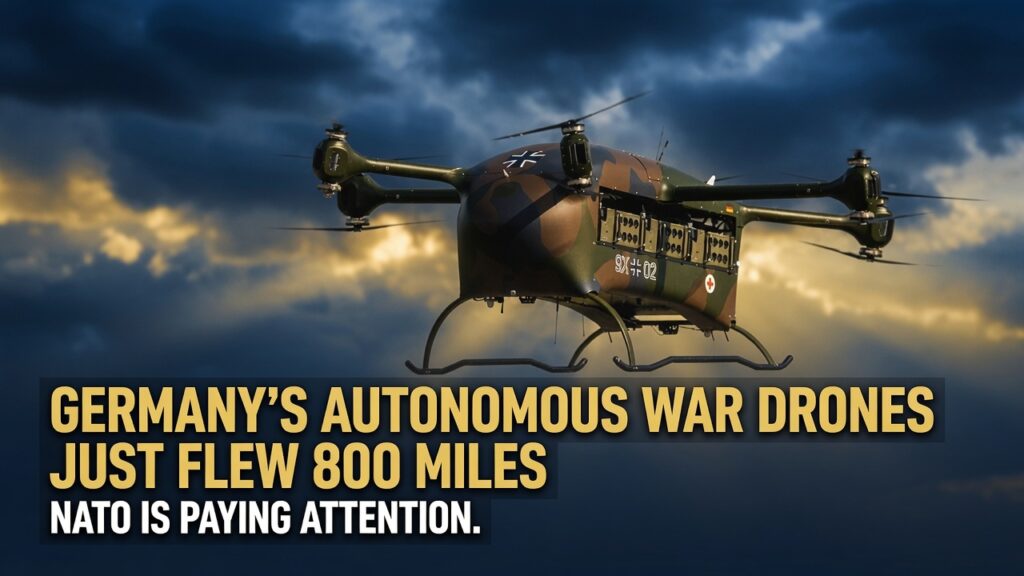
A small Bavarian startup has quietly built what may become the backbone of European battlefield medicine and autonomous logistics — and 2026 is the year the world finds out.
While Washington debates drone policy and Silicon Valley argues about AI ethics, a company called Avilus operating out of Ismaning, Bavaria, has been doing something simpler and far more consequential: building autonomous drones that fly themselves into active conflict zones, extract the wounded, and return — no pilot required.
In the span of just a few weeks this June, Avilus completed the maiden flight of its fourth-generation medevac drone, flew a separate aircraft 800 kilometers by remote control without incident, debuted a brand-new helicopter UAV, and demonstrated its autonomous casualty evacuation system live at NATO’s largest military medical exercise in years. If you missed all of that, you weren’t alone. This story has been hiding in defense procurement newsletters and German-language aerospace press. It shouldn’t be.
Support Independent Local Journalism
TheTownHall.News is a non-profit reader-supported journalism. Just $5 helps us hire local reporters, investigate important issues, and hold public officials accountable across Alameda County. If you believe our community deserves strong, independent journalism, please consider donating $5 today to support our work.What Avilus is building is nothing less than the autonomous logistical spine of the future European military — and it just crossed into production.
What Is Avilus, and Why Does It Matter Now?
Avilus was born from a very specific problem. Before the war in Ukraine had even begun, the German Bundeswehr looked at its battlefield medical evacuation chain and concluded it was dangerously inadequate. There were not enough armored medical vehicles. There would never be enough. And there was no good answer to the core tactical problem: how do you get a gravely wounded soldier off a hot battlefield when helicopters are high-value targets and ground vehicles can’t reach the front?
The answer the German Army gave Avilus’ founders was blunt: “We need a flying stretcher.”
That flying stretcher became the Grille — the German word for cricket — a heavy-lift multirotor UAV designed to land near a casualty, load a single patient into a pressurized medical cabin, and autonomously fly them back through active airspace to a field hospital. The system requires no pilot. A dispatcher and a safety operator can manage multiple concurrent missions simultaneously from a ground control station the size of a ruggedized equipment case.

The Grille is not a prototype. As of this week, Avilus has entered pre-series manufacturing of five production-ready units for Bundeswehr trial service in 2026.
Four Milestones in Four Weeks: What Just Happened
Grille X4 Flies for the First Time on June 2
The fourth-generation Grille — designated X4 — completed its maiden flight on June 2, 2026, at Avilus’ Ismaning facility near Munich. This was not a test article. It was the first aircraft from a pre-series production run of five units destined for the German armed forces.
The X4 improves on its predecessors with a redesigned distributed parachute system, a lighter and more robust monocoque structure, and refined manufacturing processes that allow for greater scalability. The platform weighs 750 kilograms, carries a 135-kilogram payload — enough for one patient and full life-support equipment — cruises at 86 kilometers per hour, reaches a ceiling of 2,100 meters, and has an operational range of 51 kilometers. It can be assembled tool-free in 15 minutes and deployed from vehicles, containers, tents, or naval platforms.
Its navigation is fully autonomous and jamming-resistant, using an inertial reference unit that functions in GNSS-denied environments — the exact electronic warfare conditions Ukrainian and Russian forces have been using against each other’s drone fleets since 2022.
Wespe Helicopter UAV Makes Its First Flight on May 28
Four days before the Grille X4 flew, a completely different aircraft made its own debut. The Wespe — German for “wasp” — is Avilus’ tactical helicopter UAV, built for missions the Grille was never designed for: rapid resupply, heavier payload transport, and close air support.
Support Independent Local Journalism
TheTownHall.News is a non-profit reader-supported journalism. Just $5 helps us hire local reporters, investigate important issues, and hold public officials accountable across Alameda County. If you believe our community deserves strong, independent journalism, please consider donating $5 today to support our work.Chief Engineer Carlos Hünteler described the maiden flight with characteristic German restraint: “The crew and the aircraft were ready, and the flight confirmed that confidence.”
The numbers are less restrained. The Wespe is available in piston and turbine-powered variants, with payload capacities of up to 200 kilograms and 350 kilograms respectively. It features autorotation capabilities for emergency landings and jamming-resistant autonomous navigation. For context: 350 kilograms of payload capacity puts the Wespe in a category that, until now, only manned helicopters could fill.
Bussard Flies Itself 800 Kilometers Away — Controlled from Munich
Also this month, Avilus publicly demonstrated something that almost no drone company in the world has done at scale: remote flight operations over 800 kilometers. The Bussard — a fixed-wing ISR platform — was operated from a ground control station near Munich while the aircraft flew in North Sea airspace. No relay aircraft. No crew near the drone.
The Bussard has a 2,500-kilometer range, up to 14 hours of endurance, and is equipped with synthetic aperture radar for 360-degree, all-weather surveillance — day or night.
It can be launched from short grass strips or improvised runways. It needs a minimal logistical footprint. For a NATO military that has spent the better part of three years watching long-range ISR capability become the decisive factor in the Ukraine war, that profile is not academic. It is urgent.
iMEDCAP Goes Live at NATO’s Vigorous Warrior 2026 in Estonia
The most strategically significant event of Avilus’ June came not from Bavaria, but from Estonia. NATO’s Vigorous Warrior 2026 exercise — one of the alliance’s largest military medical drills, involving approximately 2,000 participants from 32 allied and partner nations — concluded this month after hosting a live demonstration of the iMEDCAP consortium’s autonomous tactical medical evacuation system.
Avilus is a core member of iMEDCAP, a European Defence Fund-backed program that aims to fully automate the detect-extract-treat-evacuate chain for gravely injured or potentially contagious battlefield casualties. The live demonstration in Estonia was not a concept pitch. It was a working autonomous medevac system performing in front of allied military leadership in a realistic exercise environment.
This is the moment a technology moves from “interesting startup” to “NATO procurement conversation.”
The Architecture Behind It All: RasCore
Every Avilus aircraft — Grille, Wespe, Bussard — runs on the same proprietary avionics stack called RasCore Air. This is not a software wrapper on top of commercial drone hardware. It is a purpose-built, fully redundant flight control architecture with primary and secondary flight control implemented on dissimilar hardware, dual independent monitoring systems, military-grade inertial sensing, multi-constellation GNSS, LiDAR and secondary radar for precision landings in confined spaces or on naval vessels, and multiple line-of-sight and beyond-line-of-sight communication links with optional SATCOM.
The system is EASA Specific Category-compliant, NATO battle management system-interoperable, and fully ITAR-free — the last point being particularly significant for European allies who have spent years trying to reduce dependence on American export-controlled defense technology.
The Strategic Picture: Why Europe Needed This
The war in Ukraine rewrote drone doctrine in real time. Cheap FPV drones became the dominant anti-personnel weapon of the conflict. Long-range ISR drones became indispensable for targeting. And the absence of reliable autonomous medevac capability meant that casualty rates among wounded soldiers who could have been saved continued to climb, because the cost and risk of extracting them was too high.
Avilus was built to solve exactly those three problems — not as a future concept, but as a deployable system.
The company’s ambition is explicit: Avilus CEO Ernst Rittinghaus has said he wants the Grille to become not just the German rescue drone but the European one — standard kit for any NATO nation where the lives of professional soldiers are worth protecting with more than infantry training and a stretcher-bearer.
The business case is reinforcing itself. In May 2026, the European Defence Agency selected Avilus for the RASCAP consortium, pooling European defense, medical, and research institutions to advance autonomous rescue and medical support systems. In April, UI Helicopter of South Korea entered a strategic partnership with Avilus to co-develop autonomous medevac systems, opening the program to a market outside Europe. And HENSOLDT, one of Germany’s largest defense electronics companies, has integrated its sensor suite directly into Avilus platforms.
The Counterargument: Is This Too Good to Be True?
A fair challenge. Defense technology is littered with startups that demonstrated impressive hardware and then failed to deliver at scale, on budget, or within regulatory frameworks.
Avilus has answered some of those concerns more credibly than most. The company is one of only three operators in Germany to hold a Light UAS Operator Certificate from the Luftfahrt-Bundesamt — the German federal aviation authority — which grants self-authorization privileges for drone flights. That certification is not a marketing badge. It requires documented operational maturity, safety management systems, and regulatory accountability that a startup with vaporware cannot fake.
The harder question is whether autonomous medevac will actually function in a contested electronic warfare environment at scale. The 51-kilometer range of the Grille and the reliance on RF communications represent real operational constraints. Avilus has addressed the jamming problem architecturally — the inertial reference unit allows mission completion in GNSS-denied conditions — but the full tactical validation won’t come from an exercise in Estonia. It will come from actual operational use.
The Bundeswehr trial service beginning in 2026 will be the first real test.
Key Questions
- Will the Bundeswehr formally procure the Grille X4 following the 2026 trial service, and at what scale?
- Which other NATO nations will move first on the Grille — and does Avilus have the production capacity to meet demand?
- How does the 51-kilometer operational range of the Grille hold up in a peer adversary environment with active electronic warfare?
- Does the UI Helicopter partnership signal a Pacific defense market expansion, and how does that complicate European export frameworks?
- When does iMEDCAP move from exercise demonstration to operational doctrine?
The Bottom Line
Germany has built a flying stretcher that doesn’t need a pilot. It passed a live NATO test this month. It’s going into production. And the same company has simultaneously developed a helicopter UAV that can carry 350 kilograms, a fixed-wing surveillance drone with a 2,500-kilometer range, and an avionics platform designed to work when the enemy is actively trying to jam it.
Avilus is not a drone company. It is the early version of what autonomous European defense logistics looks like — and 2026 is the year it stopped being theoretical.