Ukraine Just Ran Russia Off a Strategic Strip of Land That Controlled the Black Sea — and Raised Its Flag
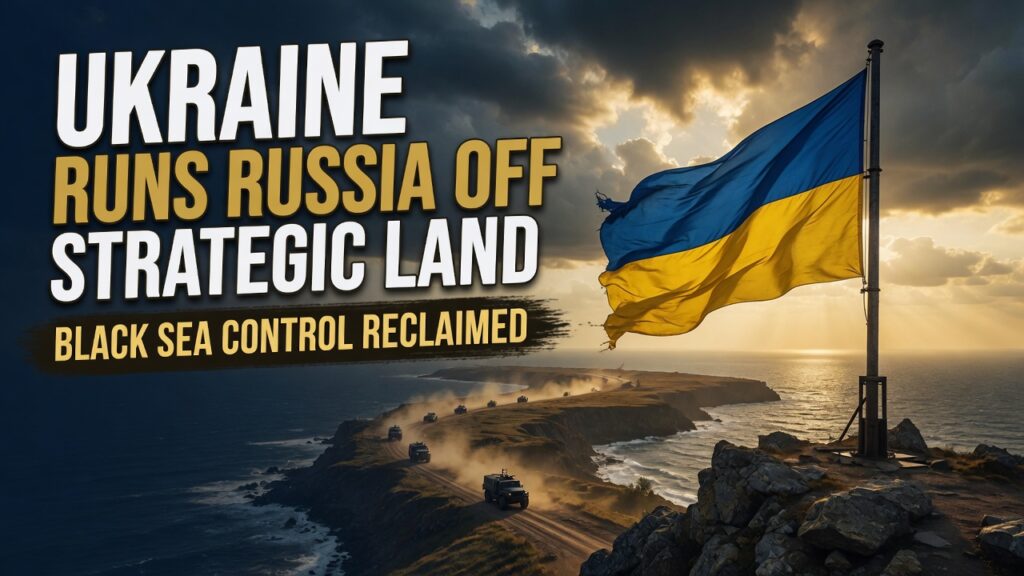
The collapse of Russia’s Kinburn Spit position isn’t just a battlefield win. It unlocks Ukraine’s ports, chokes off Crimea, and proves drones can do what armies couldn’t.
Russia held it for four years. It took no tanks, no amphibious assault, and no massive ground offensive to take it back.
Ukraine starved them out.
Support Independent Local Journalism
TheTownHall.News is a non-profit reader-supported journalism. Just $5 helps us hire local reporters, investigate important issues, and hold public officials accountable across Alameda County. If you believe our community deserves strong, independent journalism, please consider donating $5 today to support our work.On Thursday, June 25, Ukrainian forces raised the blue-and-yellow national flag on the Kinburn Spit — a narrow strip of sand and coast in southern Mykolaiv Oblast that Russia had occupied since 2022, and from which it had terrorized Ukrainian port cities, threatened maritime shipping, and used as a forward base for drones, artillery, and electronic warfare. The evacuation of surviving Russian personnel is underway. The defensive lines have been abandoned.
“The Defence Forces of Ukraine’s South have forced the occupiers to retreat from their positions through powerful strikes,” the Command of Ukraine’s Southern Territorial Defense Forces announced. “The evacuation of the surviving personnel is underway, and the occupiers are abandoning their defensive lines.”
They added, pointedly: “One day our tanks will reach Dzhankoi.” That’s in northern Crimea.
What Is the Kinburn Spit — and Why Does It Matter So Much?
Most people couldn’t find it on a map. That’s exactly the kind of obscurity Russia counts on when it seizes strategic terrain.

The Kinburn Spit is a 40-kilometer-long sandbar jutting into the Black Sea at the mouth of the Dnipro-Buh estuary — a geographic chokepoint that has decided the fate of empires for three centuries. The Ottomans built a fort there. Catherine the Great fought to take it. Anglo-French forces stormed it during the Crimean War. Russia captured it in 2022.
“Just by looking at the map you can understand the critical importance of this small strip of land,” said Anastasiia Khmel, dean of the faculty of political sciences at Black Sea National University in Mykolaiv. “Its role as a gateway to ports and distant regions explains why powers have fought for centuries to control it.”
The geography is simple and brutal: every vessel moving between the Black Sea and the ports of Mykolaiv and Kherson must pass within artillery range of the spit. Russia understood this. The moment it captured Kinburn in June 2022 — one of the last significant Russian military victories in the south — it effectively put a gun to the throat of Ukraine’s entire maritime economy.
Mykolaiv, Ukraine’s second-largest port and a historic shipbuilding hub that produced the Soviet Union’s first aircraft carrier, was strangled. Before the invasion, it exported millions of tons of grain annually. After Kinburn fell, over 100 vessels — cargo ships, tankers, private yachts — sat stranded in port with nowhere to go. One of Ukraine’s top grain producers, Nibulon Ltd., saw its Black Sea shipping operations grind to a halt. “With the Kinburn Spit in their hands, everything is blocked,” the company’s director said.
Russia didn’t just hold the spit. It weaponized it. Russian forces deployed electronic warfare systems from the peninsula, coordinated missile and artillery attacks on Ochakiv — just 4 kilometers across the water — and used the spit as a launch pad for drone strikes against the southern Mykolaiv region. They built concrete bunkers, established at least one ammunition depot, and potentially ran a combat drone control center from the spit. In short: they fortified it and dug in.
Support Independent Local Journalism
TheTownHall.News is a non-profit reader-supported journalism. Just $5 helps us hire local reporters, investigate important issues, and hold public officials accountable across Alameda County. If you believe our community deserves strong, independent journalism, please consider donating $5 today to support our work.Until they couldn’t hold it anymore.
How Ukraine Collapsed Russia’s Position Without Firing a Single Ground Shot
Ukraine didn’t storm the beaches. It cut the supply lines.
Beginning in early June, Ukrainian drone forces launched a systematic campaign to sever the two roads — one paved, one dirt — that provided the only land access to the Kinburn Spit from the occupied left bank of Kherson Oblast. With those routes under constant attack, the logistics chain for Russia’s 337th Guards Air Assault Regiment simply disintegrated.
By June 8, the Atesh partisan network — which has an agent embedded inside the headquarters of Russia’s “Dnipro” Grouping of Forces — reported what was happening from the inside: ammunition had stopped arriving. So had food. So had fuel. The fire teams assigned to shoot down Ukrainian drones were taking unsustainable losses and failing at their mission. Part of the regiment had already been redeployed to the Zaporizhzhia front, leaving the remaining troops on Kinburn with no reinforcements, no resupply, and no way out except evacuation.
“The supply of ammunition, food and fuel has actually stopped,” Colonel Denis Nosikov, commander of the Odesa Special Operations Command, confirmed. “A soldier will not be able to fight without food and fresh water. Therefore, according to intelligence, they are currently being evacuated.”
Ukrainian Navy spokesperson Dmytro Pletenchuk confirmed that a Ukrainian flag had been planted on the spit Thursday, while noting that combat operations are still ongoing and Russian forces remain in the area. “The Kinburn Spit is an active combat zone,” he said — a reminder that flag-raising and full liberation are not the same thing. The battle for the peninsula is not officially over.
But Russia’s position there has functionally collapsed.
The Bigger Picture: This Is Part of a Strategic Unraveling in the South
The Kinburn Spit did not fall in isolation. It is one piece of a broader Ukrainian campaign to isolate and degrade Russian positions across the south by targeting logistics rather than frontlines.
Ukraine’s Unmanned Systems Forces commander Robert “Madyar” Brovdi has described the strategy plainly: the goal is to isolate Crimea. By striking supply bridges, fuel depots, road networks, and ammunition routes across occupied Kherson and Zaporizhzhia — Ukraine’s drone forces have created what analysts are calling a “logistical lockdown.” The Kinburn Spit collapse is the most visible product of that strategy so far.
The week in which Kinburn fell to Ukrainian pressure also saw strikes on the Crimea bridge network, a major Russian refinery halted, a semiconductor plant in Voronezh destroyed, and space communications centers struck near Moscow. Russia came to stay in southern Ukraine. It is leaving.
Military analysts have long argued that control of the Kinburn Spit is a stepping stone toward Crimea. With the spit in Ukrainian hands — or at minimum no longer in Russian hands — the artillery threat to Ochakiv diminishes, the maritime chokepoint is relieved, and Ukraine’s strategic options in the south expand meaningfully. The port of Mykolaiv may be closer to reopening than at any point since February 2022.
What’s Still Not Confirmed — and Why It Matters
Accountability requires precision. Several key questions remain open as of Thursday evening.
Ukrainian Navy spokesperson Pletenchuk confirmed the flag was raised and that some Russian positions had been abandoned — but explicitly said it is “too early to say that the enemy has completely withdrawn.” Russian forces remain present in parts of the area. Ukraine has not confirmed its own troops are physically present on the spit in an infantry capacity. “When you see Ukrainian marines on Kinburn, then we can say that this event has happened,” Pletenchuk said.
The Odesa Military District has characterized the flag-raising as part of a larger operation, not its conclusion: “The raising of the flag on the peninsula is part of a large-scale operation to reduce the combat capabilities of the Russian group on the Kinburn Spit and adjacent territories.”
In other words: this is a major inflection point, not a formal liberation. The fighting continues. The significance is real — but it is measured in momentum, not finality.
Key Questions
Is the Kinburn Spit fully liberated? Not officially. Ukrainian forces have raised their flag and Russian positions have collapsed, but Ukrainian infantry presence has not been confirmed and Russian forces remain in the area.
What happens to Mykolaiv’s ports now? Control of the spit removes the primary Russian artillery and drone threat to shipping access. Reopening the port of Mykolaiv — Ukraine’s second-largest — becomes significantly more feasible. Analysts estimate this could unlock billions in blocked agricultural exports.
Does this open a path to Crimea? Potentially. The spit sits roughly 100 kilometers from the Perekop Isthmus, the narrow land bridge connecting Crimea to the Ukrainian mainland. Ukrainian forces gaining a foothold changes the strategic geometry of the south.
How did Ukraine take it without a ground assault? Drone interdiction of supply routes. Russia’s 337th Regiment was cut off, ran out of food, fuel, and ammunition, and evacuated. This is the new model of warfare — and it works.