Fiumicino Khat Seizure: 216 Kg Stopped at Rome Airport — Real Facts vs. Viral Claim
A viral post claims Italian police arrested an Israeli “drug smuggler” now demanding deportation. The real story — confirmed by Italian authorities — is both more ordinary and more revealing.
Two hundred sixteen kilograms of narcotics, hidden in seven suitcases. That is what Italy’s Guardia di Finanza pulled off a single passenger’s baggage at Rome’s Leonardo da Vinci Airport in Fiumicino this week, in one of the largest single-traveler seizures the airport has reported in months. Within hours, a version of the story was ricocheting across social media — and much of what went viral simply is not true.
The timing matters. The seizure was announced Monday, July 13, 2026, just days after ITA Airways resumed direct Rome–Tel Aviv service on July 1 with two daily flights. Renewed air links mean renewed smuggling opportunities, and this bust is an early test of whether border enforcement can keep pace. It is also a test of something else: whether readers can still tell the difference between a verified law enforcement operation and an internet embellishment designed to inflame.
What Actually Happened at Fiumicino?
Start with the facts, because in this story the facts are strong enough on their own. According to Italy’s Guardia di Finanza and the Customs and Monopolies Agency (ADM), officers at Fiumicino flagged a passenger of Israeli nationality arriving from Tel Aviv for a targeted secondary inspection. The reason was old-fashioned police work: the traveler gave vague and contradictory answers about the purpose of his trip and the details of his stay in Italy.
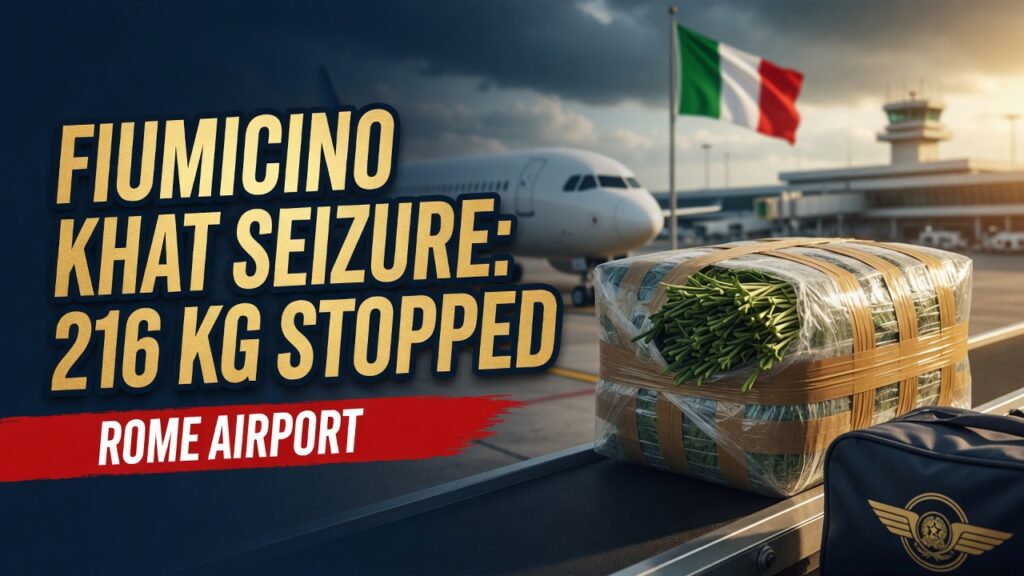
Officers ran his seven checked bags through X-ray scanning, then opened them. Inside they found 216 kilograms of khat — fresh bunches and shrubs of Catha edulis, a plant whose leaves produce stimulant effects comparable to amphetamines when chewed. Italian law classifies khat as a controlled narcotic. The entire load was seized, and the passenger, the sole registered owner of all seven bags, was referred to the public prosecutor’s office in Civitavecchia for violating Italy’s narcotics statute [Guardia di Finanza / Italian wire reports].
A single passenger. Seven suitcases. 216 kilograms of a banned substance — stopped not by luck, but by an officer asking basic questions.
Support Independent Local Journalism
TheTownHall.News is a non-profit reader-supported journalism. Just $5 helps us hire local reporters, investigate important issues, and hold public officials accountable across Alameda County. If you believe our community deserves strong, independent journalism, please consider donating $5 today to support our work.What Did the Viral Version Get Wrong?
Here is where the story splits in two. The version circulating on social media makes three claims that no verified report supports. First, it describes a generic “massive drug smuggling operation,” inviting readers to picture cocaine or heroin. The substance was khat — illegal in Italy, but a plant-based stimulant that is legal in several countries, including parts of East Africa and the Arabian Peninsula, where it is chewed socially.
Second, the viral post says the suspect was arrested. He was not. Under Italian procedure he was “denunciato a piede libero” — formally reported to prosecutors while remaining free pending proceedings. That is a meaningful legal distinction, not a technicality.
Third, and most tellingly, the post claims the man is “demanding to be bypassed from Italian judicial proceedings and deported immediately back to Israel.” That detail appears in no official statement and no credible news account. It is an invention — a dramatic flourish added somewhere along the chain of shares, seemingly designed to provoke outrage about foreign nationals dodging accountability.
If a story needs fabricated details to make you angry, what does that tell you about who is telling it — and why?
Why Does the Khat Trade Keep Testing European Borders?
Khat presents a genuine enforcement puzzle. Because the plant’s active compounds degrade rapidly after harvest, traffickers must move it fresh — typically by air, in bulk, within days of picking. That creates a recurring pattern European customs agencies know well: couriers with heavy, plant-filled luggage flying established routes toward diaspora communities where demand exists but the substance is banned.
The legal patchwork complicates things further. Khat remains legal or tolerated in countries such as Kenya, Ethiopia, and Yemen, while Italy, most of the EU, and the United States treat it as a controlled substance. A courier can board a flight in a jurisdiction where the cargo is unremarkable and land in one where it carries serious penalties. That gap is exactly what smuggling networks exploit, and exactly why airport-level vigilance matters.
Is This What Border Enforcement Looks Like When It Works?
Strip away the viral noise and this case is a straightforward win for law and order. No mass surveillance, no dragnet — a trained officer noticed inconsistent answers, followed procedure, and used a targeted inspection to stop a massive quantity of contraband at the border. That is precisely the model of enforcement that respects both public safety and due process: suspicion based on behavior, verification through lawful search, and referral to prosecutors rather than summary punishment.
If the truth was already a major bust, why did someone feel the need to invent an arrest that never happened?
It is also a reminder that borders are not abstractions. Every kilogram intercepted at Fiumicino is a kilogram that does not reach street-level distribution networks. Taxpayers fund customs agencies for exactly this outcome, and when the system delivers, it deserves to be reported accurately — not rewritten for engagement farming.
216 kilograms in seven suitcases. The question worth asking: how many bags like these board flights every week and are never opened?

What Do Skeptics of This Framing Actually Believe?
A fair-minded reader might push back: does correcting a viral post really matter if the underlying bust was real? Some argue that quibbling over “reported” versus “arrested,” or “khat” versus “drugs,” is pedantry — the man allegedly carried a banned substance either way, and public anger at smuggling is healthy regardless of the details.
That objection deserves a serious answer. Details are not decoration; they are the difference between journalism and rumor. The fabricated deportation-demand claim did not just exaggerate — it invented a legal confrontation that never occurred and attached it to a real criminal case involving a real person who has not been convicted of anything. In an era when defamation suits and platform credibility collapses can follow a single viral falsehood, publishing invented details is not righteous anger. It is recklessness. Accountability journalism only works if the accountability runs both ways — toward governments, and toward the information ecosystem itself.
What Happens When No One Checks the Story?
The Fiumicino seizure will wind through the Civitavecchia prosecutor’s office, where the passenger — who, it must be said, is entitled to the presumption of innocence — will answer to Italian narcotics law. Investigators have not publicly described any wider network, and responsible coverage should not assume one exists until authorities say so.
Meanwhile, the embellished version of this story will keep circulating, shared by people who never read past a headline. That is the deeper problem this case exposes. When a true story about effective law enforcement gets rewritten into fiction, who is left defending the truth?
Key Questions
- Why did the viral version invent an arrest and a deportation demand that Italian authorities never reported?
- With Rome–Tel Aviv flights newly restored, will customs screening keep pace with rising passenger volume?
- How many similar shipments cross European borders undetected each year — and would the public ever know?
The officers at Fiumicino did their job. The question is whether the rest of us — readers, sharers, publishers — are willing to do ours before hitting repost. The real question isn’t whether misinformation will reach your feed. It’s whether you’ll check the facts before you pass it on.
What do you think — should platforms do more to flag embellished crime stories, or is that the reader’s job? Share this article and let us know.
Still have questions? Stay informed — subscribe to the TTHN Weekly Roundup for verified coverage. Think others need to hear this? Share the article. Want to make your voice count? Contact your representatives and ask what percentage of inbound air baggage is actually screened at your nearest international airport.