San Leandro Marina Police Shooting: What We Know So Far
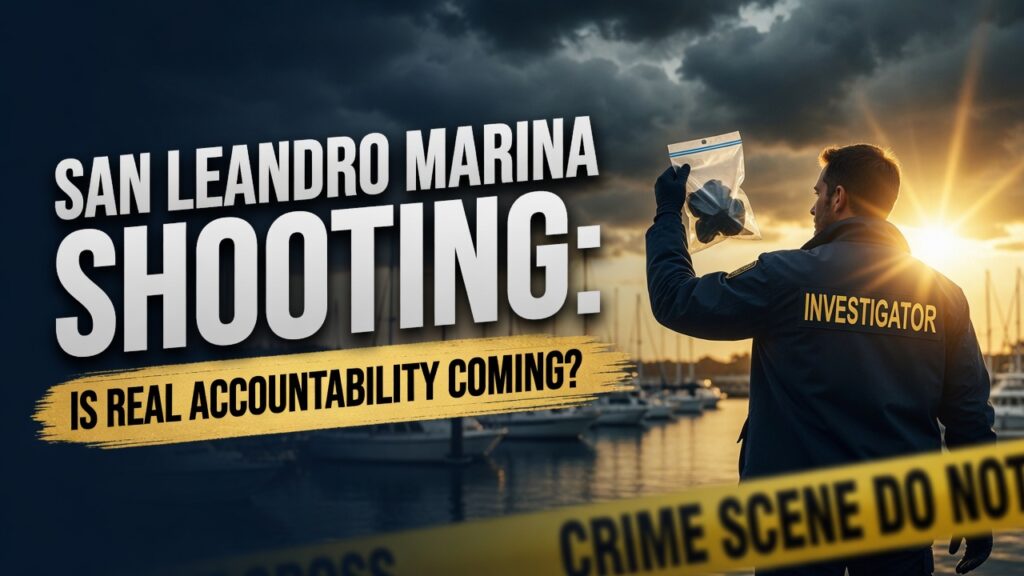
As investigators pick through what happened at San Leandro Marina in May, residents are left asking a harder question: is California’s crisis-response system built to save lives, or just to manage the paperwork after one is lost?
A welfare check ended in gunfire. Now the questions are piling up.
The shooting happened months ago, but San Leandro is still waiting on answers, and so is the rest of California. As officer-involved shootings during mental health crises continue to draw scrutiny statewide, this case has become a test of whether the state’s layered oversight promises actually translate into accountability, or whether they simply produce paperwork after the fact.
Support Independent Local Journalism
TheTownHall.News is a non-profit reader-supported journalism. Just $5 helps us hire local reporters, investigate important issues, and hold public officials accountable across Alameda County. If you believe our community deserves strong, independent journalism, please consider donating $5 today to support our work.What Happened at the San Leandro Marina That Night?
The call came in just after 8 p.m. on May 7, according to the San Leandro Police Department. A friend had reported that a man was making suicidal statements and appeared to be struggling with depression. Officers first went to a home in the 14500 block of Santiago Road, in the Marina Faire neighborhood, but he wasn’t there.
A search led officers to the San Leandro Marina, where they found the man seated inside a vehicle near the boat launch. Police say officers spoke with him for several minutes while he remained in the car. A man reached out for help, and a welfare check ended with him dead. How does that happen, and who is responsible for making sure it doesn’t happen again?
During that conversation, police allege the man produced a firearm and pointed it at officers. Three officers opened fire. Medics treated him at the scene, but he was pronounced dead. None of the officers were injured, and a firearm was recovered, according to police. The man’s identity has not been publicly released.
Who Is Reviewing This Shooting, and Can Residents Trust the Process?
Under standard department policy, the three officers involved were placed on administrative leave. San Leandro police say they are conducting both a criminal and an administrative investigation into the shooting. The Alameda County District Attorney’s Office is running a concurrent, independent review, and the city’s independent police auditor has also been brought in.

That sounds like layered accountability. But nearly all of these reviewers, aside from the DA’s office, answer to the same city government whose officers fired the shots. California’s Assembly Bill 1506 authorizes the state Department of Justice to independently investigate certain officer-involved shootings resulting in the death of an unarmed civilian. Because this case involves an alleged firearm, it may fall outside that statute’s automatic trigger, leaving local and county officials to police their own.
That distinction matters. A system where the toughest scrutiny is reserved for the cases with the least ambiguity, and locally run reviews handle everything else, is not obviously built to earn public trust.
“When the department investigating a shooting shares a payroll with the officers who fired the shots, is that oversight, or is it simply a formality?”
Is California’s Crisis-Response System Actually Working?
At least one in four. That is the share of people fatally shot by police nationwide who were experiencing a mental health crisis at the time, according to The Washington Post’s police shootings database [Washington Post data]. The question that leaves hanging over San Leandro: why does calling for help during a mental health emergency still carry a real risk of ending in death?
California has spent heavily in recent years on mobile crisis teams and co-responder programs designed to pair mental health clinicians with, or in place of, armed officers on exactly these kinds of calls. Taxpayers have funded crisis-response reform for years. So why is a routine welfare check still ending with three officers and a body bag instead of a clinician and a conversation? The honest answer is that these programs remain unevenly funded and unevenly staffed across California’s cities and counties, and there is no indication a clinician-led team was dispatched, or even available, in San Leandro that night.
That is not a partisan complaint. It is a basic accountability question about whether public money allocated for crisis response is reaching the departments and situations it was meant to reach, or whether it exists mostly as a talking point in council chambers.
Support Independent Local Journalism
TheTownHall.News is a non-profit reader-supported journalism. Just $5 helps us hire local reporters, investigate important issues, and hold public officials accountable across Alameda County. If you believe our community deserves strong, independent journalism, please consider donating $5 today to support our work.The Cost of Getting Crisis Response Wrong
Every officer-involved shooting triggers a cascade of public cost: administrative leave pay, a criminal investigation, an administrative investigation, an independent auditor’s review, and often a wrongful-death claim or lawsuit that can take years and significant taxpayer dollars to resolve. None of that spending prevents a future shooting. It only responds to one that has already happened.
Limited-government principles do not mean fewer resources for public safety. They mean demanding that the resources already committed produce results. A city that funds a crisis program but can’t deploy it to a documented mental health call is asking residents to pay twice: once for the program, and again for the investigation that follows.
What Do Supporters of the Current Response System Actually Believe?
Defenders of standard police response to these calls make a fair point worth engaging directly: officers did not rush the encounter. They spent several minutes talking with the man before any weapon was drawn, which police describe as an attempt at de-escalation. When a firearm is allegedly pointed at officers, the law generally treats a lethal response as a justified last resort to protect officer safety, and second-guessing that split-second decision from a distance is easy in hindsight but difficult in the moment. Supporters also argue that sending unarmed civilian responders into calls involving a reported weapon could put those responders, not just officers, at serious risk.
That argument deserves a real answer, not dismissal. Officer safety is a legitimate and serious concern, and no reform proposal should ask officers to face armed encounters without backup. But the strongest version of the reform argument isn’t about replacing officers in dangerous moments. It’s about reducing how often trained clinicians and officers are forced into that split-second choice in the first place, through earlier intervention, better dispatch screening, and crisis teams that reach a struggling person before a friend has to call 911 out of desperation. Better tools upstream protect officers too.
Key Questions This Case Still Raises
- Did San Leandro officers have access to every de-escalation and crisis-intervention resource available to them that night?
- When will the Alameda County District Attorney’s independent findings be made public, and will the public actually see them?
- Is California’s crisis-response infrastructure funded and staffed well enough to reach cities like San Leandro before, not after, a call turns fatal?
This case was never really about one man, one department, or one night at a marina boat launch. It is about whether the systems built to answer a mental health crisis are actually designed to prevent tragedy, or whether they are simply designed to explain it afterward.
The real question isn’t whether San Leandro finishes investigating this shooting. It’s whether anyone changes what happens the next time someone calls for help.
Still have questions about how your city handles mental health crisis calls? Stay informed, subscribe for daily coverage. Think your neighbors need to see this? Share the article. Want your voice to count? Alameda County residents can request the case status directly from the District Attorney’s Office and can attend the next San Leandro City Council or Police Auditor public session to ask how crisis-response funding is being spent.