Tooth Enamel Regeneration Gel: Human Trials Update 2026
Tooth Enamel Regrowth Gel: Has It Finally Reached Trials?
As Washington argues over government-mandated fluoride, millions of Americans are asking a simpler question: why wait on regulators when the private sector may have already solved the problem?
Cavities have always meant the same thing. A drill. A needle. A bill you did not budget for. For decades, dentists told patients that enamel, once lost, was gone for good. That premise is now being tested in human volunteers.
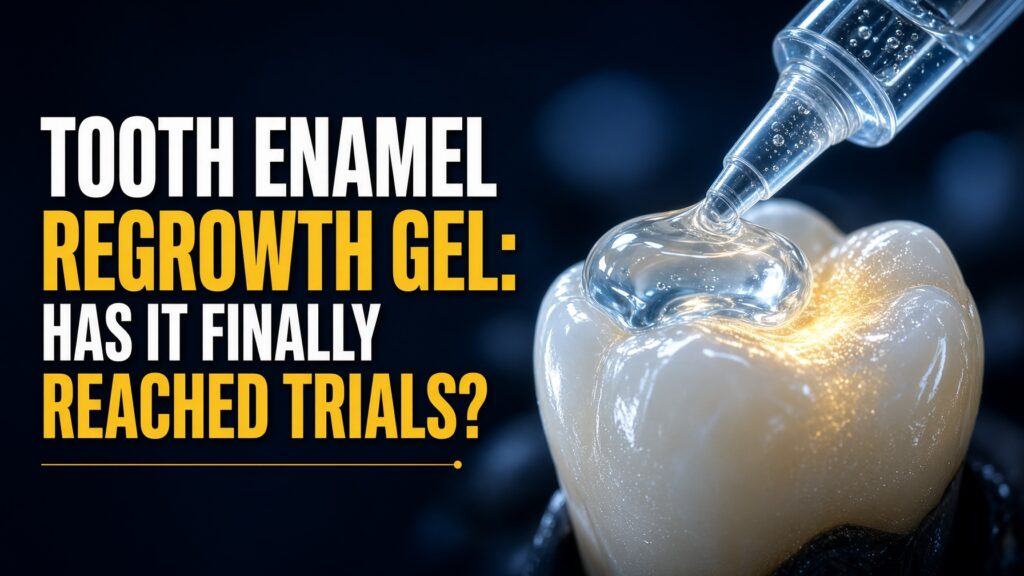
Researchers at the University of Nottingham published findings in Nature Communications on November 4, 2025, describing a protein-based gel capable of regenerating lost tooth enamel through a process called epitaxial mineralization [peer-reviewed study, Nature Communications]. The team has since founded a private company, Mintech-Bio, to commercialize the technology, and multiple industry outlets now report that human clinical trials have moved forward in 2026 [industry press reports]. A fluoride-free gel can regrow lost tooth enamel using nothing but a patient’s own saliva.
What Does the Gel Actually Do?
The gel is built from engineered proteins called elastin-like recombinamers, designed to mimic the molecules the body uses to build enamel in infancy. Applied in a thin layer much like a fluoride varnish, it seeps into microscopic cracks and eroded patches on the tooth surface. Once in place, it acts as a scaffold, drawing calcium and phosphate ions directly from the patient’s own saliva.
That process, epitaxial mineralization, allows new mineral crystals to grow in precise alignment with the tooth’s existing structure rather than sitting on top of it as a separate coating. In laboratory testing on 32 demineralized human molars, the treated teeth developed densely packed, organized enamel crystals within two weeks [university-published research]. Independent measurements found the regenerated material approached the strength of natural enamel.
Support Independent Local Journalism
TheTownHall.News is a non-profit reader-supported journalism. Just $5 helps us hire local reporters, investigate important issues, and hold public officials accountable across Alameda County. If you believe our community deserves strong, independent journalism, please consider donating $5 today to support our work.Why Does This Matter Right Now?
The timing is not accidental. In February 2026, Health and Human Services Secretary Robert F. Kennedy Jr. renewed a push to remove fluoride from American drinking water, reigniting a decades-old fight over whether government has any business mandating a chemical additive for an entire population [federal policy reporting]. A fluoride-free alternative that actually rebuilds enamel changes that debate considerably. It reframes dental health as a matter of individual choice and private innovation rather than a public utility mandate.
Untreated tooth decay is not a small problem. The World Health Organization estimates nearly 2.3 billion people worldwide live with untreated dental caries [WHO estimate]. In the United States, roughly one in four adults has untreated tooth decay, and the burden falls hardest on lower-income households with limited access to routine dental care [federal health data]. A gel that regenerates enamel rather than simply slowing its loss could meaningfully reduce that burden, but only if it reaches patients.
Where Do the Human Trials Actually Stand?
This is where the story gets murkier, and where regulatory caution starts to look like an obstacle. Formal clinical trials in human patients are described as beginning sometime in 2026, with several industry outlets reporting that early-stage trials had already started by mid-year. The company itself has not issued a detailed public timeline, and no major wire service has independently confirmed enrollment numbers or trial locations. Readers should treat mid-2026 trial-start claims as reported by industry press rather than confirmed fact until Mintech-Bio or the university publishes primary trial data.
What is not in dispute is the lab data underpinning the trials. The regenerated enamel layer measured roughly 10 micrometers thick in testing, thinner than natural enamel but mechanically comparable in hardness and elasticity. Researchers say the material also works on exposed dentine, potentially easing the sharp sensitivity that comes with receding gums or worn enamel, and helping fillings and veneers bond more securely to the tooth.
Is Regulatory Speed the Real Risk Here?
Nobody disputes that new medical materials need rigorous safety testing before reaching the public. Nobody is asking regulators to skip that step. The question worth asking is different: does the current approval pathway move at a pace that matches the urgency of the problem it is meant to solve.
The Food and Drug Administration’s device and biologic approval processes routinely take years, sometimes a decade, from published research to market availability. That timeline exists to protect patients from unproven or unsafe treatments. It also means a technology validated in a peer-reviewed journal in late 2025 may not reach a dentist’s office until the early 2030s, if it reaches one at all.
The study’s lead author has described the treated enamel as recovering its natural, organized crystal architecture rather than simply forming a surface patch. That describes a genuine medical breakthrough. Whether patients ever benefit from it depends less on the science and more on how quickly a federal bureaucracy is willing to move.
Science solved a problem dentists called impossible. The only thing standing between patients and regrown enamel now may be paperwork.
Scientists solved a piece of tooth decay a year ago. So why are millions of Americans still waiting on regulators to catch up?
$4.2 billion is roughly what Americans spend annually treating advanced tooth decay and its complications, according to industry estimates. The question nobody in the regulatory apparatus seems eager to answer: how much of that spending could be avoided if proven innovations reached patients faster?

What Do Supporters of Continued Water Fluoridation Actually Believe?
Public health advocates who favor mandatory water fluoridation raise a fair point worth engaging directly. Fluoridated water reaches everyone, including children and adults who never see a dentist regularly and would never have access to an in-office gel treatment. They argue that removing fluoride from public water systems before an alternative is affordable, approved, and widely available would leave the most vulnerable populations worse off, not better.
That concern deserves a serious answer, not dismissal. The strongest response is not that fluoridation is inherently harmful, but that a government mandate applied to an entire population should not survive simply because ending it feels inconvenient to public health agencies. If private innovation offers a targeted, opt-in alternative that individuals and dentists can choose for themselves, the case for a blanket government mandate weakens considerably. Personal responsibility and informed consent, not automatic compliance, should guide how new dental science reaches the public.
What Happens If Regulators Move Too Slowly?
If history is any guide, promising medical breakthroughs do not always reach patients on a reasonable timeline. Years can pass between a published study and an approved product, and in that gap, patients keep paying for drills, fillings, and crowns that a regenerative alternative might have prevented. Taxpayers underwrite a significant share of that cost through public health programs.
Every year a proven medical breakthrough sits in regulatory limbo, patients keep paying for drills, fillings, and crowns that never had to happen. That is not a neutral outcome. Are federal regulators moving with the urgency this discovery deserves, or is this another case of good science stuck behind a bureaucratic wall built for an earlier era of medicine?
Key Questions This Story Raises
Will Mintech-Bio publish transparent, independently verifiable data as human trials progress?
How long will FDA review realistically take once trial results are in, and will regulators expedite a genuine breakthrough?
If a private, opt-in dental treatment proves effective, does that undercut the case for mandatory government water fluoridation?
Where Does This Leave Patients Today?
For now, the enamel gel is not available in any dental office, and no one should delay ordinary preventive care waiting for it. Regular brushing, routine cleanings, and existing treatments remain the best defense against decay. But the science is real, the mechanism is published and peer-reviewed, and human trials appear to be moving forward faster than typical bureaucratic timelines would suggest.
The real question isn’t whether this technology could change dentistry. It’s whether the systems meant to protect patients will also let them benefit from it in time.
Still have questions about how this story develops? Stay informed with daily coverage from The Town Hall News. Think your neighbors and family should know about this? Share this article. Want your voice to count on how new medical treatments get approved? Contact your congressional representative and ask where they stand on modernizing FDA review timelines for non-pharmaceutical medical breakthroughs.