Casgevy Gene Therapy for Sickle Cell: Age 2 Approval, Medicaid Gaps
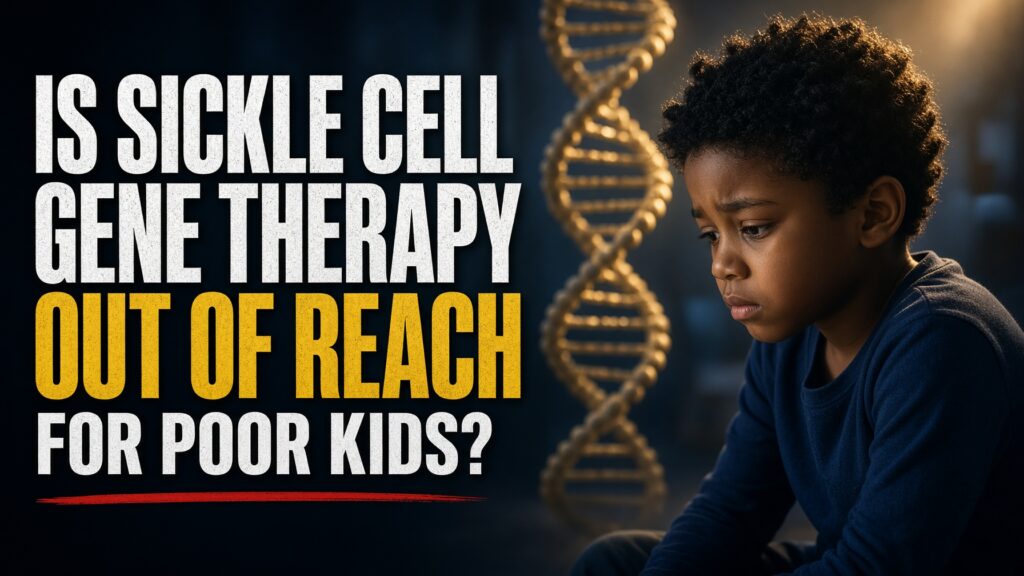
As the FDA clears a landmark cure for children as young as two, a harder question is emerging: will every eligible family actually be able to get it?
A cure now exists. Will every eligible child actually get it?
On July 1, 2026, the FDA expanded approval of the gene therapy Casgevy to children as young as two with severe sickle cell disease. Roughly 5,500 more American kids are now eligible for a one-time treatment that can prevent decades of organ damage. But whether they receive it may depend less on medicine than on which state they happen to live in.
For families who have spent years managing a disease with no cure, the announcement landed like a breakthrough. And in a real sense, it was one. Casgevy is the first CRISPR-based gene therapy ever approved for children this young, and it targets a disease that has historically received far less research investment and public attention than its severity warrants.
But a $2.2 million price tag does not disappear because a child is finally eligible for treatment. It lands somewhere. And increasingly, that somewhere is a state Medicaid budget that was never built to absorb it.
What Is Casgevy, and Why Does the Age-2 Approval Matter?
Casgevy, developed by Vertex Pharmaceuticals and CRISPR Therapeutics, uses gene-editing technology to modify a patient’s own stem cells so the body produces fetal hemoglobin, the form of hemoglobin present before birth. Fetal hemoglobin does not sickle the way adult hemoglobin does in patients with the disease, which means red blood cells stop clogging blood vessels and starving organs of oxygen.
The therapy was first approved in December 2023, but only for patients 12 and older. That left younger children, who often suffer some of the disease’s worst damage during early development, without access. The July 2026 expansion changes that. It was reviewed under the FDA’s Commissioner’s National Priority Voucher program, an initiative meant to speed approvals of therapies addressing urgent national health needs, and cleared in just 53 days.
Sickle cell disease causes rigid, misshapen red blood cells that block circulation and trigger vaso-occlusive crises, episodes of severe pain that often require hospitalization. Left unmanaged, the disease progressively damages the brain, lungs, kidneys, and heart. Early intervention has always been the clinical goal. Now, for the first time, medicine has a tool that can meet that goal head-on.
A disease with no cure for generations just got one — the only question left is who can actually reach it.
Support Independent Local Journalism
TheTownHall.News is a non-profit reader-supported journalism. Just $5 helps us hire local reporters, investigate important issues, and hold public officials accountable across Alameda County. If you believe our community deserves strong, independent journalism, please consider donating $5 today to support our work.Who Actually Pays for a $2.2 Million Cure?
This is where the celebration runs into arithmetic. Casgevy’s list price has held steady at $2.2 million per patient since its original 2023 approval. That figure covers only the drug product itself, not the months of hospital-based conditioning, cell collection, and recovery that surround the actual infusion.
An estimated 60 percent of Americans living with severe sickle cell disease are covered by Medicaid [industry pricing analysis], a program administered state by state with sharply different reimbursement rules. Some states have negotiated outcomes-based payment agreements with Vertex to spread costs over time. Others have not, leaving hospitals and families to navigate a reimbursement system that was never designed for single-dose, seven-figure therapies.
$2.2 million. The question no state legislature has fully answered: who decides which sick two-year-old gets funded first?
That is not a hypothetical. Reimbursement frameworks for advanced gene therapies remain a genuine work in progress in many states [trade press, citing FDA announcement coverage]. A federally approved cure means little to a family whose home state has not yet built the payment infrastructure to deliver it.
Is This a Medical Story or a Government Accountability Story?
It is both, and pretending otherwise does a disservice to the families waiting on an answer. The FDA did its job. It reviewed the clinical data, found the therapy safe and effective for younger children, and approved it faster than almost any therapy in recent memory.
What happens next is not an FDA question. It is a question for state Medicaid directors, legislators, and hospital systems that must decide how to fund a treatment that could strain a small program’s annual budget with a handful of patients.
If a federally approved cure exists but a child can’t get it because of where they live, who is actually responsible for that failure?
Limited government does not mean no government. It means government that does its narrow job well and gets out of the way for everything else. Drug approval is a narrow, appropriate federal role, and the FDA executed it efficiently. Distributing the fiscal burden of that approval, however, is where accountable state-level governance actually earns its keep, or fails to.
What Do Supporters of the Current System Actually Believe?
Defenders of the existing Medicaid framework make a fair point: state flexibility allows tailored solutions, and outcomes-based payment deals, where states pay Vertex over years and only if the therapy continues working, are a genuinely innovative way to manage risk without a federal mandate. Several states have structured agreements along these lines, and more are reportedly in negotiation.
That argument has real merit. A one-size-fits-all federal payment scheme could be slower and less adaptable than state-level deal-making, and taxpayers in fiscally disciplined states have a legitimate interest in not writing a blank check for every emerging biotech price tag.
But merit is not the same as sufficiency. A patchwork system only works if every state actually builds the framework, and right now, not all of them have. A child’s access to a federally approved cure should not hinge on a legislative session that hasn’t gotten around to gene therapy reimbursement yet. Flexibility without follow-through is not a policy. It’s a gap.
What Happens If States Don’t Move Fast Enough?
Every year without a completed reimbursement framework is a year a two-year-old with sickle cell disease ages further into organ damage that gene therapy cannot reverse. Vaso-occlusive crises do not wait for budget cycles. Neither does brain and kidney damage.
Hospitals operating the limited number of authorized treatment centers already face capacity constraints. Add inconsistent state payment structures, and the bottleneck compounds. A therapy exists. The infrastructure to deliver it equitably does not yet exist everywhere it’s needed.
This is precisely the kind of outcome that should trouble anyone who believes government’s core job is competent execution, not just good intentions. The FDA delivered. The question is whether the rest of the system will.

Key Questions This Story Raises:
- Which states have finalized Medicaid reimbursement frameworks for Casgevy, and which have not?
- Should states be required to disclose gene therapy access timelines to affected families?
- Who bears accountability when a federally approved cure sits out of reach due to state-level inaction?
If a cure exists but access depends on your zip code, is it really a cure at all — or just a promise some children will never see kept?
The Bottom Line
Casgevy’s expansion to children as young as two is a genuine medical milestone, one built on rigorous federal review and years of research into a disease that deserved more attention decades ago. That part of the story is worth celebrating without reservation.
But a cure that exists on paper and a cure a family can actually access are two different things. The real test of this moment isn’t whether the science works. It’s whether the systems responsible for paying for it will move as fast as the disease does.
The real question isn’t whether Casgevy works. It’s whether the government agencies standing between a diagnosis and a cure will get out of the way in time.
Still have questions about how gene therapy access varies by state? Stay informed with our ongoing coverage, subscribe for daily accountability reporting. Think other families need to see this? Share the article. Want your voice to count? Contact your state Medicaid director or legislator and ask directly whether your state has a Casgevy reimbursement framework in place.