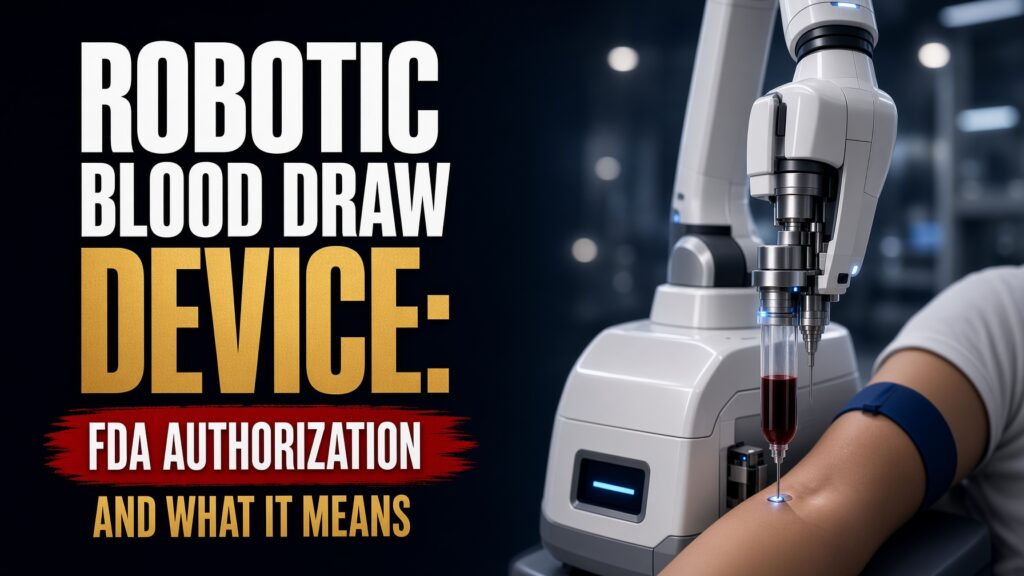
Robotic Blood Draw Device: FDA Authorization and What It Means
The FDA just cleared a machine to stick a needle in your arm without a human doing it. As the agency touts innovation, millions of Americans are asking a simpler question: who’s actually accountable when the patient is you?
A robot named Aletta can now find a vein, insert a needle, and fill the tubes on its own. The Food and Drug Administration authorized it on August 19, 2026, for adult outpatient use — the first device of its kind ever cleared in the United States. That decision didn’t happen in a vacuum. It happened because the system meant to staff America’s labs has been quietly failing for years.
Why Is a Robot Drawing Blood in America’s Clinics Now?
Aletta doesn’t work alone, but it works with almost no human contact. It uses near-infrared light to spot a vein, then ultrasound and Doppler imaging to measure its depth and confirm it isn’t an artery, before a robotic arm places the needle with sub-millimeter precision. One trained phlebotomist can now supervise up to three machines at once, stepping in only to confirm the tube order, check sample volume, and answer alerts.
Support Independent Local Journalism
TheTownHall.News is a non-profit reader-supported journalism. Just $5 helps us hire local reporters, investigate important issues, and hold public officials accountable across Alameda County. If you believe our community deserves strong, independent journalism, please consider donating $5 today to support our work.That’s a real shift in how basic medicine gets delivered. It didn’t emerge from a five-year federal plan. It emerged from a private Dutch company, Vitestro, chasing a problem that public health systems have struggled to solve on their own: a persistent, worsening shortage of trained phlebotomists nationwide.
The Trial Numbers Behind the Headlines
In a 1,633-patient trial published in the peer-reviewed journal Clinical Chemistry, Aletta hit the vein on the first attempt 94.5% of the time — a rate the FDA says is comparable to or better than trained human phlebotomists, including in patients with difficult vein access and across different skin tones. [Clinical Chemistry, peer-reviewed trial data]
If a machine can match a trained professional 94.5% of the time, why has government policy spent years failing to keep enough trained professionals on staff?
94.5%. That’s the first-stick success rate in a controlled trial of more than 1,600 patients. The question no one in Washington wants to answer: why did it take a private company, not a federal workforce program, to get there?

Who Created the Shortage the Robot Is Fixing?
This is the part of the story that rarely makes the press release. The phlebotomist shortage didn’t appear overnight. It’s the product of years of stagnant wages, understaffed labs, and licensing bottlenecks that never kept pace with patient demand — the kind of slow-moving bureaucratic drift that free-market advocates have warned about for a generation.
Vitestro didn’t wait for a federal solution. It spent years and tens of millions of dollars in private capital — including a $70 million Series B round in March 2026 backed by Labcorp Ventures, Mayo Clinic, and Sutter Health — building a device that could do the job Washington couldn’t staff. [company funding disclosure] That’s the free market answering a public failure, not government solving its own mess.
Who Pays — and Who’s Accountable — When Something Goes Wrong?
Here’s where the celebration should pause. The FDA’s de novo clearance comes with real conditions: a phlebotomist must be present to start each session, and the agency has now written special controls that will govern every robotic blood-draw device that follows. That’s a meaningful safeguard — but it also means the line of accountability, when something does go wrong, runs through both a private company and a federal regulator at once.
A machine can be 94.5% accurate and still leave 100% of the responsibility unanswered when the other 5.5% happens to your family.
Device-related adverse events in the trial were described as rare and mild — a genuinely strong safety signal. But “rare” is not “never,” and patients deserve a clear answer, in writing, about who is liable and who is regulating whom before this technology reaches every outpatient clinic in the country.
Support Independent Local Journalism
TheTownHall.News is a non-profit reader-supported journalism. Just $5 helps us hire local reporters, investigate important issues, and hold public officials accountable across Alameda County. If you believe our community deserves strong, independent journalism, please consider donating $5 today to support our work.Is it innovation if no one can tell you, in plain language, who is responsible when the robot is wrong?
Do Patients Get a Say in Who — or What — Draws Their Blood?
This is where personal responsibility and patient choice matter most. Nothing in the FDA’s authorization requires a clinic to offer patients the option of a human phlebotomist instead of a machine. For most routine draws, that may be a non-issue. For an anxious patient, a child, an elderly parent, or anyone with a complex medical history, it’s a legitimate question of consent — not a footnote.
Families who want a human hand for a loved one’s procedure should be able to ask for one, plainly and without friction, and clinics should be transparent about which option is on offer before the needle comes anywhere near the arm.
Key Questions This Story Raises:
- Who is legally and financially accountable when a robotic blood draw goes wrong — the manufacturer, the supervising phlebotomist, or the clinic?
- Why did a private company solve the phlebotomist shortage faster than the public health systems responsible for staffing it?
- Should patients and families have a guaranteed right to request a human phlebotomist instead of a machine?
What Do Supporters of Robotic Blood Draws Actually Believe?
Supporters make a fair case, and it deserves a real answer rather than dismissal. They argue that a persistent phlebotomist shortage already means longer waits, more missed collection windows, and more repeat needle sticks when a first attempt fails — all of which harm patients today. A device with a 94.5% first-attempt success rate, they say, reduces exactly that kind of harm, and doing nothing while the shortage worsens isn’t a neutral, risk-free choice either.
That argument holds up on the data. The trial results are real, peer-reviewed, and reasonably strong. But accepting that the technology works is not the same as accepting that oversight, consent standards, and liability rules have caught up to it. Both things can be true at once: the device may be sound, and the accountability framework around it may still be incomplete. Supporters are right that inaction has costs — they’re wrong if they think that settles the accountability question rather than opening it.
The Question That Outlasts the Headline
Strip away the press releases, and one question remains: does replacing a stretched, underfunded human workforce with a machine fix the underlying failure, or just automate around it while leaving patients to sort out who’s responsible if it fails? A 94.5% success rate is a genuine achievement. It is not the same thing as genuine accountability.
What do you think — should robotic blood draws expand nationwide before liability and consent rules are fully settled? Share this article and tell us where you stand.
The real question isn’t whether a robot can find your vein. It’s whether anyone will still be accountable to you if it doesn’t.
Still Have Questions? Here’s How to Get Involved
Want to stay informed as this technology reaches more clinics? Subscribe for daily coverage of the policies and products shaping American healthcare.
Think your neighbors need to see this? Share the article and start the conversation in your own community.
Want your voice to count on the accountability question raised here? Contact your member of Congress or your state’s health department and ask what patient-consent and liability standards apply to robotic medical devices in your state — most state legislative websites list direct contact information for your representative.