Nidal Hasan Execution: Why Justice Remains on Hold 13 Years Later
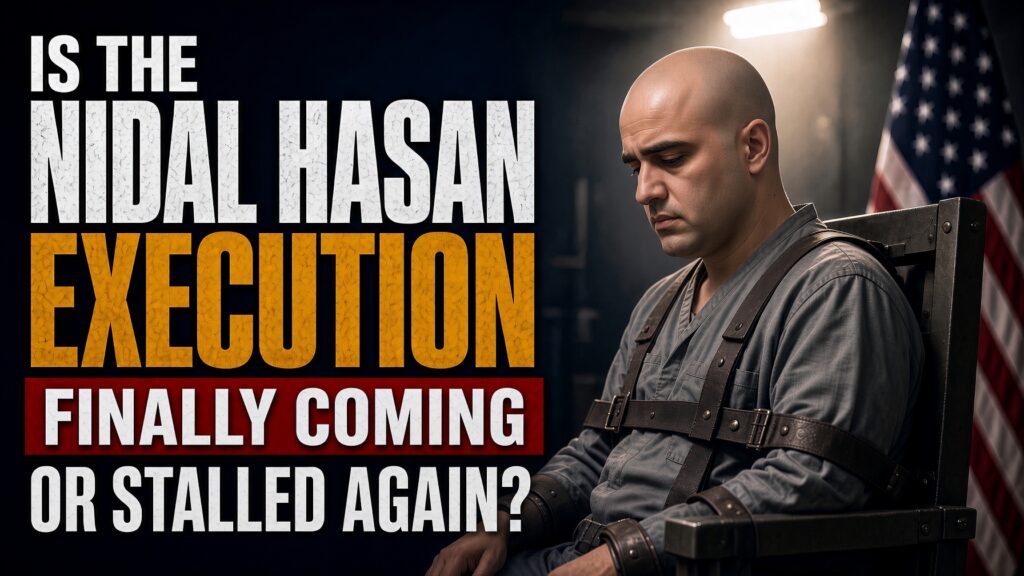
Seventeen years after a mass murder on American soil, the man responsible has exhausted every appeal — yet the order that would finally execute him still hasn’t been signed.
Thirteen soldiers never came home. That single fact has waited more than a decade for an answer.
The 2009 Fort Hood massacre remains one of the deadliest attacks ever carried out on a U.S. military installation, and the man convicted of it, former Army Major Nidal Hasan, has sat on military death row ever since. His final appeals ran out in 2025, clearing the last legal obstacle to his execution. What hasn’t happened yet, despite public pressure from the Pentagon’s top official, is a presidential order actually authorizing it.
Support Independent Local Journalism
TheTownHall.News is a non-profit reader-supported journalism. Just $5 helps us hire local reporters, investigate important issues, and hold public officials accountable across Alameda County. If you believe our community deserves strong, independent journalism, please consider donating $5 today to support our work.What Did Nidal Hasan Actually Do?
On November 5, 2009, Hasan, then an Army psychiatrist, opened fire at a Fort Hood readiness processing center where unarmed soldiers were preparing for deployment. He killed 13 people, including a pregnant soldier and her unborn child, and wounded more than 30 others while reportedly shouting “Allahu Akbar” as he fired. A 2013 general court-martial convicted him on 13 counts of premeditated murder and 32 counts of attempted premeditated murder. He was stripped of his rank and sentenced to death.
That verdict was never seriously in doubt. Hasan represented himself at trial, called no witnesses in his own defense, and offered no expression of remorse then or since. A man who slaughtered his own unarmed brothers and sisters in uniform has shown zero remorse for thirteen years — how is that not the clearest case for capital punishment on the books? The legal question was settled over a decade ago. The political question — whether anyone in Washington will actually carry out the sentence — is not.
Why Has It Taken This Long?
Military executions operate under a different chain of command than civilian ones. A death sentence handed down by a court-martial does not become final until a president personally signs off on it — a step no recent commander in chief has taken for any of the small number of men currently on U.S. military death row [Department of Defense]. Hasan’s case sat in appellate review for years after his 2013 conviction, and his final appeal was not exhausted until around April 2025.
That timeline matters because it explains, without excusing, why an attack from 2009 is still an open question in 2026. The legal machinery moved. The political will to finish the job did not.

Who Is Pushing for the Execution Now?
Defense Secretary Pete Hegseth has been unusually direct about where he stands. He has publicly stated he is “100% committed to ensuring the death penalty is carried out” for Hasan, calling him a “savage terrorist” who deserves the harshest lawful punishment available [public statements reported by Washington Examiner, The Hill]. The Army secretary has already recommended execution move forward, and the request has been forwarded up the chain toward the White House.
If the Pentagon’s own leadership is 100% committed to justice for Fort Hood, why is the file still sitting unsigned? That is the question survivors and grieving families are left asking. The Army has confirmed the request exists. It has not confirmed a decision.
What Is “Operation Resolute Justice”?
The Army has maintained a standing contingency plan, reportedly known as Operation Resolute Justice, for carrying out a military execution whenever a president authorizes one [Task & Purpose reporting]. The plan reportedly covers logistics like transporting a condemned inmate from the U.S. Disciplinary Barracks at Fort Leavenworth, Kansas to the federal execution facility in Terre Haute, Indiana, where military executions are legally carried out. According to reporting, the plan has existed and been exercised in some form for roughly two decades — it was not invented specifically for Hasan.
That distinction matters for accuracy. The infrastructure to carry out a sentence has long existed. What has been missing is presidential authorization, the one step in the process that remains entirely discretionary.
Is a case this clear-cut, sitting this long without action, really about the law — or about a lack of political will?
Has Any President Actually Signed Off?
No. As of the most recent public reporting, an Army spokeswoman confirmed that the president “has not taken action” on the death sentences of the military inmates awaiting presidential review, Hasan included [Army statement via Task & Purpose]. Hegseth’s request was reported as advancing toward President Trump in the fall of 2025. No public record indicates it has been approved since.
Support Independent Local Journalism
TheTownHall.News is a non-profit reader-supported journalism. Just $5 helps us hire local reporters, investigate important issues, and hold public officials accountable across Alameda County. If you believe our community deserves strong, independent journalism, please consider donating $5 today to support our work.64 years. That’s how long it has been since the U.S. military last carried out an execution — the question Washington still hasn’t answered is why the next one keeps getting delayed [Department of Defense historical record].
If it is eventually carried out, Hasan’s execution would be the first by the U.S. military since 1961, when Army Private John A. Bennett was hanged. It would end a six-decade gap during which the military death penalty existed almost entirely on paper.
What Do Opponents of Executing Hasan Actually Believe?
It’s worth engaging honestly with the other side of this debate rather than dismissing it. Death penalty opponents, including some legal scholars and advocacy groups, argue that capital punishment is applied unevenly across the justice system, that it forecloses any possibility of reconsideration if new information ever emerged, and that decades on death row already function as a form of severe punishment. Some raise broader moral objections to state-sanctioned execution in any case, regardless of the crime.
Those arguments deserve a real answer, not a shrug. On the fairness point, Hasan’s case is not a close call: he confessed his intent in the courtroom, presented no meaningful defense, and has never disputed the facts underlying his conviction. The uneven-application critique, whatever its merits elsewhere in the justice system, does not describe a case built on eyewitness testimony from dozens of survivors and Hasan’s own courtroom conduct. And the argument that decades of imprisonment already constitute punishment enough is a values judgment reasonable people can disagree on — but it is a different argument than “he might be innocent,” which is not in dispute here.
Why Does This Case Still Matter to Americans Today?
Fort Hood was an attack on soldiers who were unarmed by policy, gathered to prepare for deployment in service of the country. Thirteen families have waited seventeen years for the legal process to finish what the courtroom already decided. That kind of delay erodes public confidence not in whether justice was determined, but in whether institutions are willing to deliver it once determined.
This is not a call to shortcut due process — Hasan received a full court-martial, a full appellate review, and every legal safeguard the system provides. It is a question about what happens after due process concludes. When a sentence is final and appeals are exhausted, continued delay stops being caution and starts looking like avoidance.
Key Questions This Story Raises:
- If Hasan’s appeals are fully exhausted, what specific decision is still pending, and who is responsible for making it?
- Is the absence of a presidential signature a deliberate policy choice, or simply an issue no recent administration has prioritized?
- What does a 65-year gap in military executions say about how seriously the death penalty is actually enforced when a president must personally authorize each one?
So is the Nidal Hasan execution finally coming, or will this case join a growing list of finalized death sentences that quietly go unenforced? The legal system reached its verdict years ago. The only remaining question is whether anyone in Washington will act on it. The real question isn’t whether Hasan deserves the sentence a jury and years of appellate courts already upheld — it’s whether the country he attacked will actually see that sentence carried out.
Still have questions about where this case stands? Stay informed — subscribe for daily coverage of accountability and justice issues. Think others need to know how long this has dragged on? Share this article. Want your voice to count? Contact your member of Congress and ask them to press the administration for a public timeline on Hasan’s case.