School Bus Facial Recognition Cameras: What Parents Should Know
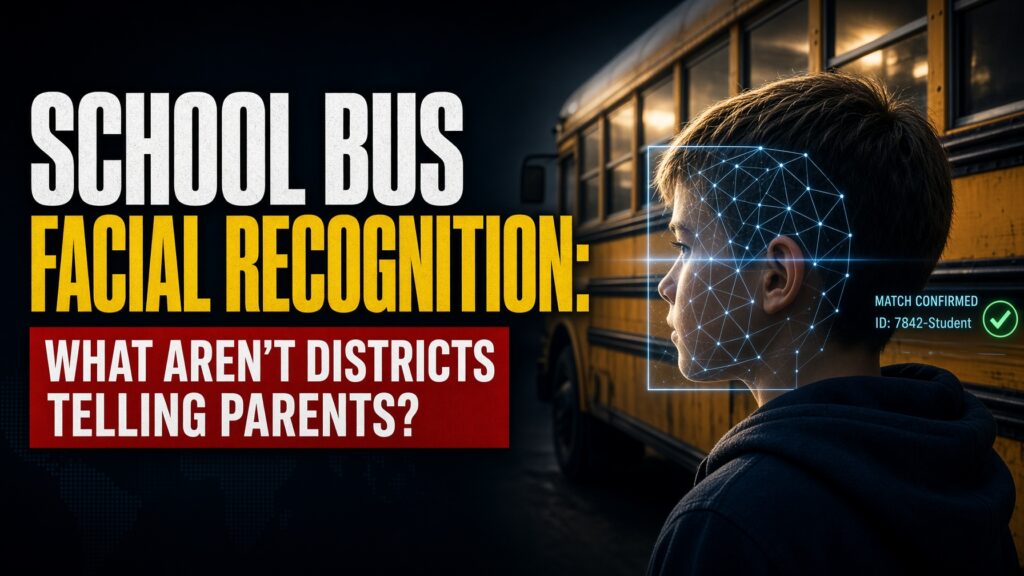
As school bus cameras evolve from simple safety recorders into AI-powered facial recognition systems, a growing number of parents are asking a basic question: who approved this, and who gets to see the results?
Your child’s face is now a data point. That sentence should stop you.
Across the country, school transportation departments have quietly upgraded standard bus cameras into AI platforms capable of identifying individual students by face, matching them to incidents, and letting administrators search footage the way you’d search Google. This isn’t a hypothetical future. It’s already installed on buses serving American children right now, and in most districts, parents were never asked to opt in.
What Is Actually Being Deployed on School Buses Today?
The company Coram markets AI-powered bus cameras that use facial recognition to identify students and track their activity across rides, connecting faces to specific incidents so staff can verify who boarded at each stop and who was present during a fight or stop-arm violation. Administrators use a natural-language search tool to pull footage by typing phrases like “student in red hoodie” or “fighting in back row,” and the same platform extends into campus-wide visitor identity verification. Coram frames this as safety infrastructure. Functionally, it is a searchable biometric database of minors.
Separately, publicly traded Gatekeeper Systems has expanded aggressively into American school districts, including a $6.7 million California contract announced in 2025, its largest school bus deal in company history, alongside a full-fleet contract with a private school in Florida. Its “Live View Wireless” product streams bus video in real time. These are verified, on-the-record deployments, not rumors.
Who Is Really Deciding What Happens to This Footage?
Stop-arm enforcement cameras, made by companies like Verra Mobility, BusPatrol, and AngelTrax, are a separate and more established category. As of mid-2025, 26 states explicitly authorized these cameras to photograph vehicles that illegally pass a stopped bus, according to the National Conference of State Legislatures. Minnesota alone has distributed more than $15 million since 2022 to equip roughly 8,000 buses.
That program has a clear, narrow purpose: catching a driver who blows past a stopped bus. Facial recognition and cross-incident student tracking are a fundamentally different animal, and districts frequently roll both technologies into the same procurement conversation, leaving parents unclear on which system does what.
A searchable biometric profile of your child now exists on a private company’s server, and most parents have never seen the contract.
Support Independent Local Journalism
TheTownHall.News is a non-profit reader-supported journalism. Just $5 helps us hire local reporters, investigate important issues, and hold public officials accountable across Alameda County. If you believe our community deserves strong, independent journalism, please consider donating $5 today to support our work.Is This Even Legal?
It depends entirely on your state, and that patchwork is itself the story. New York banned the purchase and use of facial recognition technology in schools outright after a state-commissioned review found the risks outweighed the claimed benefits, and lawmakers introduced further legislation in 2026 to make that ban permanent. Illinois enforces the Biometric Information Privacy Act, which requires informed consent before biometric data is collected on anyone, including minors. More than 20 states now have some form of comprehensive data privacy law, several of which classify biometric identifiers as sensitive data requiring opt-in consent.
Federal law offers a partial backstop. The Family Educational Rights and Privacy Act covers biometric records as part of a student’s education file and restricts how schools share that data. But FERPA was written decades before facial recognition existed, and enforcement is complaint-driven, not proactive. Civil liberties organizations have raised concerns that some vendor agreements could route student biometric data toward third-party or law enforcement databases; that risk is a documented concern raised by advocacy groups, not a confirmed practice at any named vendor, and it deserves scrutiny rather than assumption.
What Do the Numbers Actually Tell Us?
26 states. The question no one at your next school board meeting wants to answer: does yours require a facial recognition vendor to disclose data-sharing terms before signing a contract?
Why Are So Many Parents Starting to Ask Questions?
Because the sales pitch and the fine print don’t match. Vendors market these systems as bullying prevention and incident response tools, and there is a legitimate safety case for basic video monitoring, GPS tracking, and stop-arm enforcement. Nobody disputes that a bus full of children benefits from cameras that catch reckless drivers or document a fight.
The concern is narrower and sharper: facial recognition adds a permanent biometric identifier to that footage, one that cannot be changed if a vendor is breached, sold, or acquired. If a company holding your child’s face data gets hacked, what exactly is your recourse? That is not a rhetorical flourish. Data breach notification laws exist in all 50 states precisely because breaches happen, and biometric identifiers are the one category of personal data a person cannot reset.
Should a five-year-old need a privacy policy to ride the bus to kindergarten?
What Do Supporters of This Policy Actually Believe?
Proponents make a genuinely defensible case. School transportation officials argue that AI-assisted cameras solve real, documented problems: they help resolve bullying disputes with objective evidence instead of he-said-she-said accounts, verify which students boarded and exited at each stop, and give administrators fast access to footage during safety investigations rather than hours of manual review. Supporters also note that many of these systems, including stop-arm enforcement, are funded through violation fines rather than taxpayer dollars, and that districts retain contractual control over data retention and access.
That argument has merit for basic video and GPS tracking. It grows weaker specifically where facial recognition and permanent biometric identification enter the picture, because the marginal safety benefit of identifying a face rather than reviewing timestamped video is unclear, while the marginal privacy and breach risk is significant and irreversible. A district can achieve nearly identical bullying-investigation outcomes with standard timestamped video and RFID boarding logs, without creating a biometric database of every child on the route.

What Happens If No One Speaks Up?
Absent local pushback, procurement tends to move toward whatever the vendor bundles into a package deal, and biometric features get adopted by default rather than by deliberate parental consent. New York’s statewide ban did not happen because Albany volunteered it. It happened because parents, journalists, and civil liberties groups in Lockport pushed back on a specific district’s rollout until lawmakers acted. That is the model that works, and it starts with a single public records request.
Key Questions This Raises
- Does your school district’s bus camera vendor use facial recognition, and was that disclosed in board meeting minutes?
- What is the data retention period, and does the contract permit third-party data sharing?
- Does your state require opt-in parental consent for biometric collection on minors, and if not, why not?
Where Does This Leave Parents Right Now?
Start with your district’s transportation department and ask for the actual vendor contract, not the marketing brochure. Contracts are public records in every state, and the specific clauses on data retention, third-party sharing, and biometric consent will tell you far more than any vendor’s safety pitch. If your state hasn’t addressed school biometric surveillance the way New York and Illinois have, that is a conversation worth having with your state representative before the next procurement cycle, not after.
The real question isn’t whether your child’s school bus has a camera. It’s whether anyone asked you before that camera learned to recognize your child’s face.
What do you think? Is facial recognition on school buses a reasonable safety upgrade or a step too far? Share this with another parent in your district and find out what their bus is actually running.
Still have questions? Stay informed. Subscribe for daily accountability coverage. Want your voice to count? Request your district’s bus camera vendor contract through a public records request, and raise it at the next school board meeting.