US-Canada Trade War: How Retaliatory Tariffs Are Hitting American Wallets
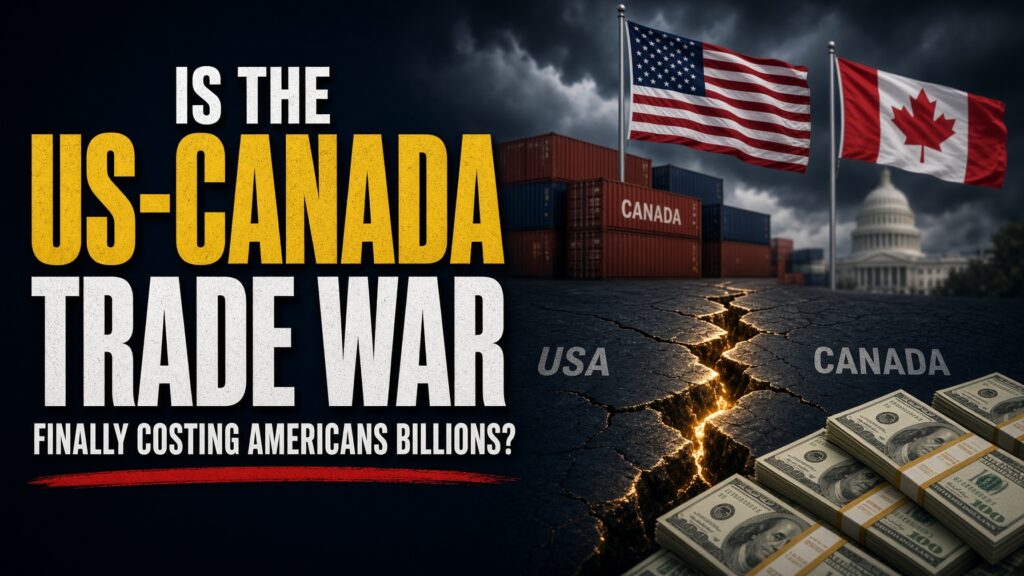
As Canada prepares nearly $20 billion in retaliatory tariffs on American steel, dairy, and manufactured goods, millions of Americans are asking a simple question: who actually pays when two governments can’t finish a trade deal?
Trade talks collapsed on a Friday night. By Saturday, Americans were already paying for it.
That’s not exaggeration. President Trump imposed 50 percent tariffs on roughly $20 billion worth of Canadian goods after negotiations broke down late on August 21, 2026, just before a midnight deadline [contemporaneous reporting, NPR]. Within days, Canada announced it would match those tariffs “dollar for dollar, rate for rate” starting September 8, and Prime Minister Mark Carney told reporters plainly: “You’re at war when you get attacked. We got attacked” [Carney press conference, reported by NPR]. A trade relationship built over decades is unraveling in days, and neither government has explained who bears the cost.
What Actually Broke Down the Trade Talks?
Negotiations between Washington and Ottawa collapsed on the night of August 21, 2026, ahead of a deadline both sides had been working toward [NPR, Irish Times]. Trump’s 50 percent tariffs on Canadian goods took effect that Saturday. Two days later, on Monday, August 24, the administration raised tariffs specifically on Canadian cars and automotive parts [Irish Times]. Neither government has publicly detailed the sticking point that ended the talks — itself a fair question about transparency on both sides of the border.
When two governments can’t finish a trade deal, why is it always the public that pays the bill first? That question sits at the center of this entire dispute, and neither Washington nor Ottawa has offered a satisfying answer.
Support Independent Local Journalism
TheTownHall.News is a non-profit reader-supported journalism. Just $5 helps us hire local reporters, investigate important issues, and hold public officials accountable across Alameda County. If you believe our community deserves strong, independent journalism, please consider donating $5 today to support our work.What Is Canada Actually Doing in Response?
Finance Minister François-Philippe Champagne unveiled the retaliation package on Tuesday, August 25, releasing a detailed list covering roughly 700 American products [Washington Post, CNN]. Starting September 8, Canada will double its tariffs on American steel and aluminum to 50 percent and impose new duties of 15, 25, or 50 percent across dairy, appliances, agricultural equipment, pulp and paper, and electronics [NPR, CNN]. The total value of targeted exports runs close to $20 billion, mirroring U.S. tariff rates category by category [Irish Times].
Ottawa isn’t just imposing costs — it’s also cushioning them. Canadian officials paired the tariff announcement with a domestic support package worth roughly $7.5 billion Canadian, about $5.4 billion U.S., meant to help Canadian businesses and workers absorb the impact [CNN]. That’s a government spending billions to soften a fight it didn’t start alone, and taxpayers on both sides of the border are footing that bill either way.
Who Is Actually Going to Pay for This?
Here’s the part that gets buried under diplomatic language: tariffs are not paid by foreign governments. They’re paid, in practice, by the importers and consumers who buy the taxed goods. American manufacturers that rely on Canadian steel, aluminum, and potash face higher input costs the moment Canada’s countermeasures take effect. Canadian consumers face the same dynamic in reverse on dairy, electronics, and appliances sourced from the United States.
$20 billion. That’s the value of goods now caught in a tariff fight neither government fully explains — the question is how much of that lands on your next grocery bill.
Analysts cited by CNN note the immediate effect may be limited, since the new duties are expected to touch a relatively small share of overall trade volume in the short term. But steel, aluminum, and auto-sector tariffs tend to work their way into finished goods over months, not days — the real price tag may not show up until after the news cycle moves on.
Is There More Escalation Coming?
Possibly. Ontario Premier Doug Ford has said Canada should be prepared to cut off electricity exports to the United States if the trade war worsens further [CNN]. Policy analysts have also floated the idea that Canada could restrict exports of potash — a key fertilizer ingredient — and energy products if Washington escalates again [CNN]. None of these steps have been implemented, but all are now openly discussed as live options.
Is a decades-old trading partnership really worth dismantling over a negotiation neither government will fully explain?
The United States and Canada have operated under integrated trade rules since the original Canada-U.S. Free Trade Agreement in 1989, later folded into NAFTA and then the USMCA. This is not a minor dispute between distant partners. It’s a rupture in the closest economic relationship the United States has.

Why Does This Keep Happening?
This isn’t the first flare-up, and it likely won’t be the last. Trump first imposed broad tariffs on Canadian and Mexican goods in February 2025, and Canada retaliated then too, before later winding back many of those measures as talks continued through the year [Wikipedia timeline; KPMG trade advisory]. Tensions resurfaced repeatedly, including an October 2025 episode in which Trump raised tariffs by an additional 10 percent after Canada aired an ad featuring Ronald Reagan’s past comments on tariffs, which the administration called misleading.
That pattern — escalation, partial retreat, renewed escalation — has defined the relationship for more than eighteen months. If this same cycle keeps repeating every few months, at what point does “negotiation” stop being the right word for what’s actually happening? A pattern this consistent isn’t chaos. It’s a structural failure to reach a durable deal, and someone in Washington owes the public an explanation for why.
What Do Supporters of the Tariffs Actually Believe?
Supporters of Trump’s approach make an argument that deserves a fair hearing rather than dismissal. They contend that decades of trade arrangements hollowed out American steel, aluminum, and manufacturing capacity, and that only sustained tariff pressure forces trading partners to renegotiate terms that better protect domestic industry and national security supply chains. From this view, short-term price pain is the cost of correcting a longer-term structural imbalance, and Canada’s willingness to retaliate proves the pressure is working.
That argument has real merit on the underlying problem — domestic manufacturing capacity is a legitimate national security concern, not a talking point. But merit on the diagnosis doesn’t validate this specific execution. A tariff fight that escalates unpredictably, collapses talks with a decades-old trading partner, and triggers billion-dollar retaliation on both sides is a blunter instrument than a negotiated agreement with enforceable terms. Supporters are right the underlying problem is real. They have a harder case that this path is the most accountable fix.
What Happens to Ordinary Americans While This Plays Out?
Steelworkers in tariff-protected industries may see short-term benefits. Families buying Canadian dairy, appliances, or vehicles built with cross-border parts will likely see costs climb instead. Farmers who export to Canada face a shrinking market for agricultural equipment now subject to Canadian duties. The costs and benefits of this fight are not evenly distributed, and no one in either capital has offered a clear account of who wins and who absorbs the loss — a policy taxing millions of households through higher prices needs public scrutiny, not just press-conference talking points.
Key Questions This Story Raises:
- Why did talks collapse on August 21, and has either government given the public a real explanation?
- If tariffs function as a tax on imported goods, how much of this $20 billion dispute will ultimately be paid by American and Canadian consumers rather than by either government?
- Given the repeated cycle of escalation and partial retreat since February 2025, what would an actual, lasting resolution between these two allies look like?
So is this trade war finally costing Americans in a way they’ll notice at the checkout counter, or will Washington and Ottawa find another temporary de-escalation before anyone has to answer for the price tag? The tariffs take effect September 8. The bill, in one form or another, comes due after that. The real question isn’t whether this trade war will affect your wallet — it’s whether either government will admit it before you notice the difference yourself.
Still have questions about how this trade war affects you? Stay informed — subscribe for daily coverage of the economic policy decisions shaping your household budget. Think your neighbors need to see who actually pays for tariff fights like this one? Share this article. Want your voice to count? Contact your member of Congress and ask them to demand a public accounting of which American industries and consumers are absorbing the cost of the current tariff dispute with Canada.