California Medi-Cal: Are Taxpayers Being Forced to Fund a $15 Billion Immigration Entitlement?
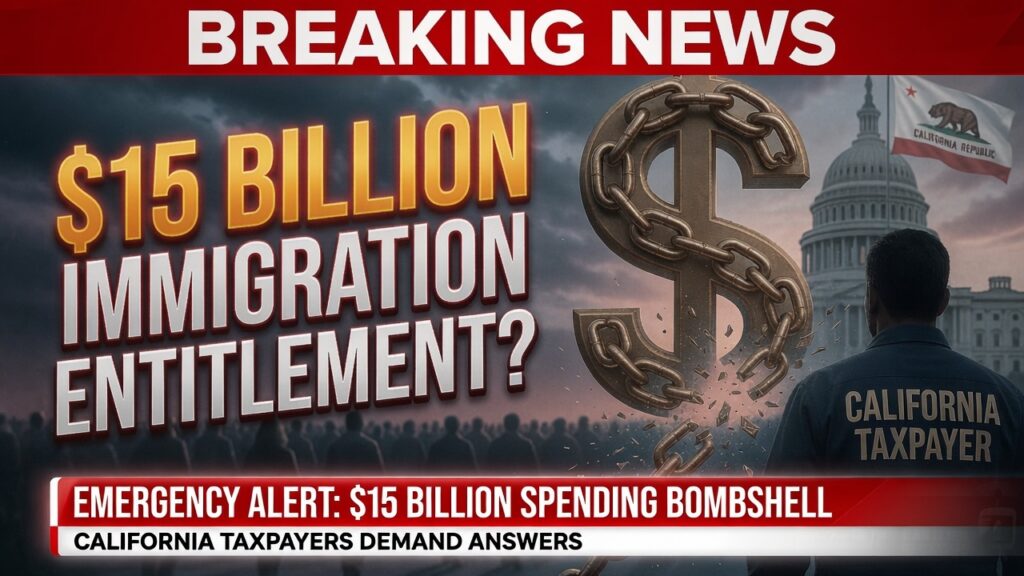
California is staring down a $12 billion deficit — and the bill is coming due for ordinary working residents. As Sacramento scrambles to patch a fiscal hole it helped dig, millions of Californians are asking: who decided this was their responsibility, and when did anyone ask them?
The math is no longer abstract. California’s decision to expand Medi-Cal — the state’s health insurance program for low-income residents — to all undocumented immigrants regardless of age has collided with fiscal reality in 2025. The program now covers approximately 1.6 million undocumented adults at a cost the state’s own Republican caucus has identified as “the dominant factor driving spending growth.” A budget that once looked manageable has become a structural crisis, and the people not in the room when these decisions were made are now being handed the tab.
Who Is Really Paying for California’s Budget Crisis?
The answer is straightforward, even if Sacramento prefers not to say it plainly: working Californians are. Governor Gavin Newsom signed a 2025-26 budget in June 2025 that closed a $12-to-$15 billion deficit through a combination of spending delays, borrowed money, and targeted cuts — but the structural problem remains. The state’s Legislative Analyst Office projected a $17 billion deficit for 2026-27 even before Congress passed H.R. 1, the federal reconciliation bill that further reduced federal matching funds to California’s Medi-Cal program.
Support Independent Local Journalism
TheTownHall.News is a non-profit reader-supported journalism. Just $5 helps us hire local reporters, investigate important issues, and hold public officials accountable across Alameda County. If you believe our community deserves strong, independent journalism, please consider donating $5 today to support our work.The Medi-Cal expansion to undocumented immigrants was projected to require an additional $11.6 billion in annual expenditures, according to an analysis by the Pacific Research Institute [conservative think tank, May 2025]. When federal funding reductions are factored in, that figure climbs. Maintaining the program now requires the state to backfill costs previously covered by federal dollars — a gap estimated at roughly $15 billion annually when combined with lost federal revenue. California now faces the compounding consequence of a policy designed without a sustainable funding mechanism.
What Do the Numbers Actually Tell Us?
$15.4 billion. That is the estimated annual cost of maintaining full Medi-Cal coverage for undocumented immigrants once federal funding reductions under H.R. 1 are accounted for. The question California’s legislature has not answered: where does that money come from without raising taxes or gutting other services?
The state’s own budget documents show that Medi-Cal spending for the 2025-26 fiscal year totals $196.7 billion in combined state and federal funding, with $46.4 billion coming from the General Fund alone. Cuts already enacted for 2025-26 include freezing new Medi-Cal enrollment for undocumented adults starting January 1, 2026, imposing $30 monthly premiums for those already enrolled starting July 2027, and eliminating dental coverage for undocumented adults beginning July 2026. These are real reductions — but analysts warn they are insufficient to close the structural gap projected for future years.
“California legislators will likely not reduce spending enough to accommodate these increased Medi-Cal costs — which means the state will have to raise taxes to finance the expanded entitlement program.” — Pacific Research Institute, May 2025
Has the Supermajority Lost Touch With the Voters Paying the Bills?
Democratic leaders in Sacramento have sent mixed signals. Newsom’s May 2025 revision proposed enrollment freezes and premiums — modest retreats from the full expansion. But leaders of the Democratic Legislative Latino Caucus publicly stated that “everything should be considered” to preserve immigrant coverage, including “a new tax on Californians,” as reported by Sacramento’s NBC affiliate. Assembly Speaker Robert Rivas, meanwhile, vowed to protect immigrant access to care, calling it a matter of fiscal contribution and human dignity.

If California’s Democratic supermajority is willing to consider new taxes to preserve health coverage for non-citizens, the question every working resident should be asking is: who, exactly, is being represented here? The state’s majority party faces no meaningful electoral check — it holds a supermajority in both chambers of the legislature. That insulation from competitive politics may explain the confidence with which tax increases are floated as a solution rather than a last resort.
Are There Deeper Structural Problems Being Ignored?
The deficit crisis does not exist in a vacuum. California’s revenues took a significant hit from an unexpected source: federal tariff policy. The state estimates it would have collected $16 billion more in revenue next year absent the Trump administration’s tariff regime, which has depressed stock market valuations and corporate income — two areas that disproportionately drive California’s tax base. A potential $10 billion revenue decline linked to stock market volatility compounds the problem further.
The wildfire damage to Los Angeles County, which triggered a six-month tax filing extension for residents, also delayed revenue collection. California’s budget is being squeezed from multiple directions simultaneously. The Medi-Cal expansion did not create all of these pressures — but it did commit the state to a recurring $11-plus billion annual obligation at precisely the wrong moment. When a state adds a permanent spending commitment without a permanent funding mechanism, a reckoning is not a possibility — it is a schedule.
What Do Supporters of This Policy Actually Believe?
This question deserves a serious answer, not a dismissal. Supporters of Medi-Cal expansion for undocumented immigrants make two primary arguments: a fiscal case and a moral one.
On the fiscal side, multiple analyses — including one from the nonpartisan Institute on Taxation and Economic Policy — estimate that undocumented immigrants in California paid approximately $8.5 billion in state and local taxes in 2022 [ITEP, 2024]. These contributions come through sales taxes, property taxes, and income taxes. Proponents argue that a population paying into the system should have access to basic health coverage, and that preventive care reduces long-term emergency room costs.
Support Independent Local Journalism
TheTownHall.News is a non-profit reader-supported journalism. Just $5 helps us hire local reporters, investigate important issues, and hold public officials accountable across Alameda County. If you believe our community deserves strong, independent journalism, please consider donating $5 today to support our work.The moral argument holds that denying health coverage based on immigration status causes measurable human harm — particularly to children, elderly residents, and people with chronic conditions — and that a wealthy state has an obligation to provide a basic safety net regardless of documentation.
These are not frivolous positions. But they do not resolve the core fiscal problem. An $8.5 billion tax contribution does not offset a $15.4 billion annual cost. And the argument that undocumented residents “pay in” overlooks that they are, by definition, present in violation of federal law — a condition the state cannot unilaterally resolve. Compassion and solvency are not mutually exclusive, but a program designed without accounting for both eventually fails people on both counts.
Is This the Accountability Moment California Has Been Waiting For?
The 2026-27 fiscal year will be the real test. With a projected $17 billion deficit already on the books before any further federal funding reductions, California’s legislature faces choices it has deferred for years. Raising income taxes on earners above roughly $56,000 — the threshold identified in the Pacific Research Institute model — would generate sufficient revenue to cover expanded Medi-Cal costs, but analysts project it would also cost the state more than 500,000 jobs over five years, shrink the economy by 4.5 percent, and accelerate outmigration by an estimated 333,000 people [Pacific Research Institute, May 2025].
The state is already losing population. It is already losing businesses. And it is already asking residents to absorb a cost of living that consistently ranks among the highest in the nation. At some point, the question stops being about ideology and starts being about arithmetic.
The residents of California did not vote on Medi-Cal expansion. Their representatives did — in a capitol insulated from competitive elections, under a supermajority that has consistently prioritized expanding entitlements over ensuring the state can pay for them.
KEY QUESTIONS THIS ARTICLE RAISES
- If California cannot sustain Medi-Cal for undocumented immigrants without raising taxes or cutting other services, why did legislators expand the program without a long-term funding plan?
- At what point does a state’s fiscal obligation to its legal residents take precedence over its aspirational commitments to non-citizens?
- Will California voters have any meaningful recourse before the 2026-27 deficit forces either a tax increase or cuts to programs that serve legal residents?
The question no one in Sacramento has answered in plain language: if this program cannot be funded without either new taxes or service cuts to legal residents, why should those residents bear that cost alone?
The real test of a government’s priorities is not what it promises — it is who pays when the promises exceed the revenue. In California right now, the answer is becoming clearer by the budget cycle. What do you think — is it too late to reverse course? Share this article and let us know.
Still have questions? Stay informed — subscribe to The Town Hall for daily coverage of the policies affecting your wallet and your community. Want to make your voice heard? Contact your California state assemblymember or senator directly at legislature.ca.gov and tell them where you stand on the 2026-27 budget.