California Voter Fraud Conviction Fuels Debate Over Election Integrity and Voter ID
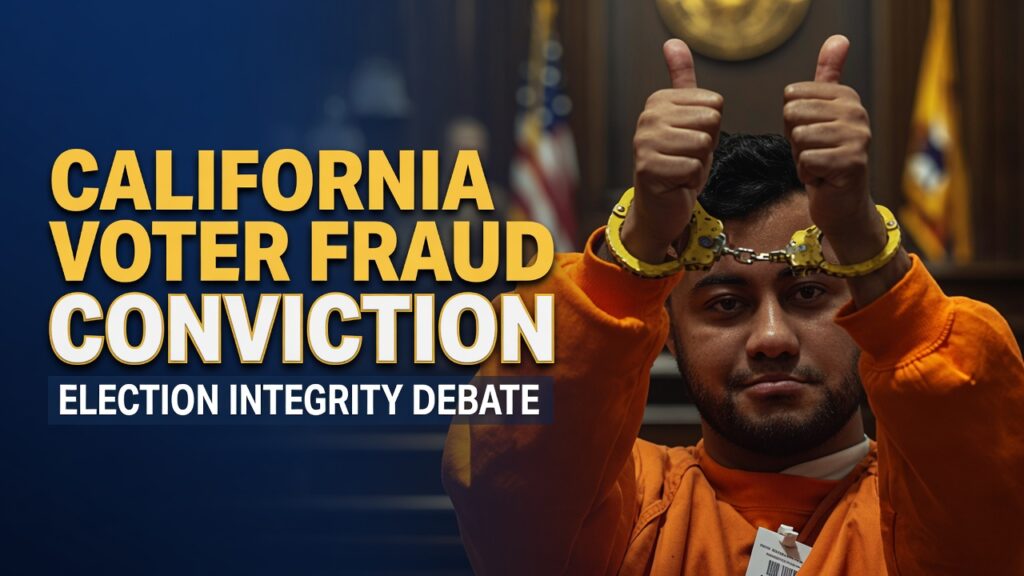
A disgraced councilman filled out ballots for his neighbors, registered 70 names to his own phone number, and still won a city council seat. Now he’s going to jail — and California voters are asking why it took this long.
When Shakir Khan won his 2020 Lodi City Council race by 282 votes, he wasn’t just beating three opponents — including the incumbent. He was running one of the most brazen local election fraud schemes California prosecutors have seen in years. It took nearly three years to arrest him, another year to secure a plea, and two more years to sentence him. In March 2026, a San Joaquin County judge finally handed down three years in county jail. The verdict was just. The timeline was not.
What Did Shakir Khan Actually Do?
The facts of this case are not in dispute. Khan pleaded no contest in January 2024 to 77 criminal counts — 71 felonies and 6 misdemeanors — that included voter registration fraud, registering fictitious persons, false filing declarations, and attempting to vote more than once. He did not go to trial. He did not maintain his innocence. He accepted the charges.
Support Independent Local Journalism
TheTownHall.News is a non-profit reader-supported journalism. Just $5 helps us hire local reporters, investigate important issues, and hold public officials accountable across Alameda County. If you believe our community deserves strong, independent journalism, please consider donating $5 today to support our work.Investigators found the scheme almost by accident. While executing a search warrant related to illegal gambling charges, San Joaquin County Sheriff’s deputies discovered approximately 100 sealed mail-in ballots inside Khan’s home. A closer look at the voter rolls revealed that 70 names were registered to his address, email address, or personal cell phone number. Many of these voters were members of Lodi’s Pakistani community — people who told authorities Khan had pressured them to vote for him, or that he had simply signed the ballots himself.
70 names. One phone number. One man’s will to win at any cost. And for years, nobody noticed.
After learning investigators were closing in, Khan posted a video on social media in Urdu, telling people to claim they had filled out their own ballots if questioned. It was not the act of a man who believed he had done nothing wrong.
Is This What an “Honor System” Election Looks Like?
The phrase matters. When the San Joaquin County Sheriff held a press conference on this case, he described California’s elections as operating on an “honor system.” That description was not an endorsement — it was a warning.

California is one of eight states that mails ballots to every active registered voter. Roughly 80 percent of California voters cast their ballots by mail. The system relies on signature verification as its primary security layer: election workers compare the signature on a returned envelope against the signature on file from when the voter registered. That is, in most cases, the only check standing between a legitimate ballot and a fraudulent one.
Khan’s scheme exploited exactly this gap. He registered people using his own contact information, filled out ballots on their behalf, and returned them. The signatures were presumably close enough, or the volume was low enough, that the system did not catch it — at least not automatically. It was a tip from a citizen reviewing voter rolls, not a routine audit, that first surfaced the irregularities.
“When the only thing protecting an election is the assumption that nobody is lying, the system has already lost the argument.”
What Do the Numbers Actually Tell Us?
Voter fraud, its defenders correctly point out, is statistically rare as a share of total ballots cast. The Heritage Foundation’s Election Fraud Database records approximately 1,500 proven cases across the United States between 1982 and 2023 — an average of roughly 40 cases per year in a nation where 158 million ballots were cast in 2020 alone. California specifically shows 69 documented fraud cases over that same four-decade span.
69 proven cases in 40 years. The question worth asking: how many cases were never detected?
That is not a rhetorical deflection — it is a genuine methodological problem. The Lodi case surfaced not through election office safeguards but through a citizen tip. A 2025 audit of “uncured” rejected ballots from California’s 2022 election, conducted by independent investigators and presented to the state Senate Elections Committee, found that approximately 14 percent of audited ballots in that sample were likely fraudulently cast — with voters vehemently denying they had voted at all. These are not numbers that inspire confidence in the idea that what gets caught is everything that happens.
Support Independent Local Journalism
TheTownHall.News is a non-profit reader-supported journalism. Just $5 helps us hire local reporters, investigate important issues, and hold public officials accountable across Alameda County. If you believe our community deserves strong, independent journalism, please consider donating $5 today to support our work.What Do Supporters of California’s Current System Actually Believe?
This is a fair question, and the answer deserves a fair hearing. Defenders of California’s mail ballot system — including the Secretary of State’s office and election integrity scholars — make several substantive arguments.
First, they note that signature verification is a real security layer, not theater. Election workers are trained to identify mismatches, and disputed envelopes are not counted until the voter’s identity is confirmed. Second, they argue that low prosecutorial numbers reflect low incidence, not low detection — that a system sending out 23 million ballots and catching fewer than 100 fraud cases per decade is, by definition, working. Third, they point out that red states with restrictive voting laws also appear regularly in fraud databases, suggesting that the form of voting does not dictate the frequency of abuse.
These are serious arguments. But the Lodi case answers each of them with a specific, documented counterexample. Signature verification did not catch Khan’s scheme — a citizen did. A low prosecution count means little if, as the independent audit suggests, fraudulent ballots exist in a category of rejections nobody is systematically reviewing. And comparisons across states do not address the local, hyperlocal nature of the fraud here: Khan did not try to swing a presidential election. He tried to win a city council seat by 282 votes. That kind of targeted, small-scale fraud is exactly what broad statistical baselines are designed to miss.
Is a Voter ID Law the Answer California Has Been Waiting For?
One solution is now heading to California voters. In April 2026, the California Voter Identification and Voter List Maintenance Requirements Initiative officially qualified for the November 3, 2026 ballot after supporters submitted over 1.3 million signatures — nearly 500,000 more than the 874,641 required. The initiative would amend the state constitution to require government-issued identification for in-person voting, and the last four digits of a government-issued ID number for mail-in ballots. It would also mandate that the state maintain and regularly verify accurate voter registration rolls.
Crucially, the initiative includes a provision requiring the state to provide free voter ID cards to any voter who requests one. The affordability argument — that ID requirements create barriers for low-income voters — is directly addressed in the text of the measure itself. If approved, California would become the 37th state to require voter ID.
If 36 other states have managed to run elections with voter ID requirements, why is California still debating whether the idea is even serious?
The opposition will argue that the real problem is not the absence of ID requirements but the presence of bad actors like Khan, and that no law deters someone already willing to commit 77 felonies. That argument misses the point. Khan’s scheme was possible because the system created no friction around registration and ballot submission using someone else’s identity. A requirement to provide even the last four digits of a government-issued number on a mail-in envelope would not have stopped a determined operator working at scale — but it would have raised the cost and complexity of doing so with 70 names at once.
What Happens if No One Speaks Up?
Khan’s own statement after sentencing deserves attention. “I am grateful for the hard work of my attorney and the court’s decision allowing me to remain out of custody while I work to fulfill restitution and support my family,” he said. “This has been a long and transformative journey.”
He will serve his time in county jail, not state prison. The eight-year state sentence is stayed, meaning it only activates if he violates the terms of his supervision. The man who ran a 77-count fraud scheme targeting his own community will likely be out and eligible to rebuild his life faster than many non-violent offenders serving time for far less. Meanwhile, the voters he defrauded — many of them first-generation immigrants from Pakistan who trusted him as a representative of their community — had their ballots cast without their consent.
That is the part of this story that does not appear in the sentencing memo. Khan did not defraud an abstract institution. He defrauded specific people. He used their identities, their names on voter rolls, and their community trust to manufacture a political result. Whatever the statistical rarity of proven voter fraud cases, those people cannot get their stolen votes back.
The District Attorney’s office stated after sentencing: “Today’s sentence shows the seriousness with which we take efforts to tamper with the electoral process in San Joaquin County.” The statement is a reasonable one. Whether it translates into systemic reform — better roll maintenance, mandatory audits, a verification layer that does not depend on hoping everyone is honest — is a question that now falls to California voters themselves.
The real question this case leaves unanswered is not whether Shakir Khan deserved punishment. He did, and he received it. The question is whether California is willing to build a system that doesn’t require a citizen tip, a gambling investigation, and three years of legal proceedings to catch a man who registered 70 voters on one phone number.
What do you think — is it time California modernized its election verification system, or does the current approach get the job done? Share this article and let us know where you stand.
Still have questions? Stay informed — subscribe to The Town Hall for daily coverage of California government and election integrity.
Think this story needs a wider audience? Share it.
Want your voice to count? Californians can register to vote and check their registration status at sos.ca.gov. The November 3, 2026 ballot will include the voter ID initiative — make sure you’re registered and informed before you vote.
KEY QUESTIONS
- How many cases of local election fraud go undetected because they never trigger a citizen tip or an unrelated investigation?
- Does California’s signature verification system provide adequate security for a state mailing 23 million ballots per election cycle?
- Will the November 2026 voter ID initiative pass — and if it does, will the legislature implement it in good faith?