Garden Grove Chemical Tank Emergency Exposes the Cost of Failed Accountability
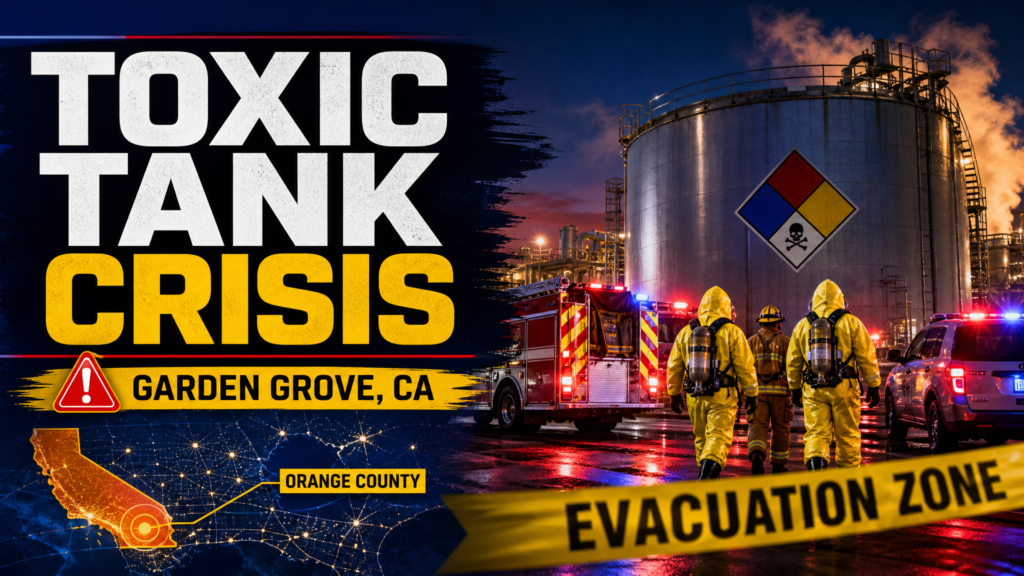
The crisis at GKN Aerospace ended without the catastrophic explosion officials feared, but the evacuation of roughly 50,000 residents exposed serious weaknesses in preparedness, transparency, and public accountability. This is not an argument for bigger bureaucracy. It is an argument for competent government, responsible industry, and a civic culture that puts families first. Source
For days, one overheated chemical tank in a dense part of Orange County turned ordinary life upside down. Parents scrambled to find shelter. Schools closed. Residents packed up pets, medicine, and legal documents with little warning. Officials said the damaged tank at the Garden Grove facility contained 6,000 to 7,000 gallons of methyl methacrylate, a highly flammable chemical that can cause respiratory problems and other health effects if released. Source
Then came the update everyone had been waiting for: on Tuesday night, officials lifted the final evacuation orders for the last 16,000 residents after the tank remained stable without sprinkler intervention. Local reporting also said there was no longer a threat of explosion, fire, or chemical leak, allowing families to begin returning home and Garden Grove Unified schools to reopen Wednesday. Source Source
Support Independent Local Journalism
TheTownHall.News is a non-profit reader-supported journalism. Just $5 helps us hire local reporters, investigate important issues, and hold public officials accountable across Alameda County. If you believe our community deserves strong, independent journalism, please consider donating $5 today to support our work.Why This Issue Matters Now
The immediate emergency may be over, but the public questions are only beginning. AP reported that what started Thursday as an overheating tank escalated into a regional emergency that forced evacuations across Garden Grove and parts of Anaheim, Buena Park, Cypress, Stanton, and Westminster. By the weekend, about 50,000 people had been told to leave because officials feared the tank could fail, spill, or explode. Source Source
That scale matters. This was not a contained industrial inconvenience. It was a public-safety failure with real consequences for working families, small businesses, schools, traffic, shelters, and emergency personnel. When government tells tens of thousands of people to evacuate, it is exercising one of its most serious powers. That power carries an obligation to prepare in advance, communicate clearly, and answer hard questions afterward.
Competence is not optional when families are told to flee.
The right lesson is not panic, and it is not denial. It is seriousness. A self-governing society depends on institutions doing the basics well: enforcing the rules that exist, planning for foreseeable failures, and speaking honestly when the stakes are high. Those are not partisan demands. They are the minimum standard of civic trust.

The Real Cost of Failure Is Paid by Families First
The most revealing fact about the Garden Grove chemical tank emergency is not simply that the danger was severe. It is that the burden fell first on ordinary residents. AP reported no injuries, no confirmed contamination, and no fumes released from the incident, which is fortunate and worth acknowledging. But that good outcome does not erase the disruption or the fear. Source Source
ABC7’s local coverage captured the human reality: evacuees described the ordeal as traumatic, city meetings turned emotional, and residents openly questioned why a military-adjacent aerospace plant handling hazardous material was operating so close to homes and an elementary school. The station also reported complaints that shelter capacity was far below the scale of displacement. Source
That is where this story touches bigger concerns about parental rights and local responsibility. Parents are expected to keep children safe, get them to school, hold jobs, and care for elderly relatives. They cannot do that effectively when emergency systems are improvised in real time. If public officials want trust during a crisis, they must prove they have thought through the basics before the alarms sound.
Public trust collapses when accountability arrives after the sirens.
Accountability Means More Than Another Press Conference
The public deserves a full accounting of what happened, not just reassurance that the worst did not occur. AP reported that the tank overheated after a valve on the cooling system failed, and that a crack that formed in the tank relieved pressure and helped avert a catastrophic explosion. In other words, chance helped rescue a situation that systems were struggling to control. Source
Support Independent Local Journalism
TheTownHall.News is a non-profit reader-supported journalism. Just $5 helps us hire local reporters, investigate important issues, and hold public officials accountable across Alameda County. If you believe our community deserves strong, independent journalism, please consider donating $5 today to support our work.That should unsettle anyone who values law and order. Rules are not meaningful if enforcement is weak, emergency coordination is improvised, or hazardous operations in dense neighborhoods proceed without strong contingency planning. AP also noted that GKN Aerospace agreed in 2025 to pay more than $900,000 to settle violations involving recordkeeping, permitting issues, and nitrogen oxide emissions. That does not prove those earlier issues caused this emergency, but it strengthens the case for aggressive oversight, transparent reporting, and consequences when standards are not met. Source
Fiscal accountability matters here too. Emergency evacuations, police response, hazmat operations, shelter costs, school disruption, and possible cleanup do not happen for free. ABC7 reported that federal emergency assistance was approved to support response and cleanup efforts. Taxpayers have every right to ask who will ultimately bear those costs, and whether public agencies will seek reimbursement where appropriate. Source
A serious government does not merely absorb preventable costs. It traces them, documents them, and pursues accountability.
What Critics Get Wrong About the Policy Debate
Some will argue the Garden Grove chemical tank emergency proves America needs a larger regulatory state. That response is emotionally understandable, but it misses the deeper point. The public does not need more red tape for its own sake. It needs existing laws enforced with clarity, urgency, and local transparency.
Bigger government is not the same as better government. If anything, this crisis shows why limited government must still be capable government. Hazardous-material oversight, emergency notification, evacuation planning, and public communication are core functions. When government performs those functions well, people notice stability. When it performs them badly, families notice chaos.
There is also a free-speech dimension that should not be ignored. Residents who packed council meetings and demanded answers were not obstructing public safety. They were practicing citizenship. Communities have a right to ask what happened, why it happened, and whether officials or corporations failed to act responsibly. Open scrutiny is not a nuisance. It is how self-government works.
Key Takeaway: Preparedness Beats Panic
Here is the clearest takeaway from the Garden Grove chemical tank emergency: communities should not have to rely on luck to avoid catastrophe. AP reported that officials eventually lifted all evacuation orders after the tank’s temperature stayed stable and health authorities said no contamination or vapor release had been detected. That is excellent news. It is not a substitute for preparation. Source
A responsible path forward would include a transparent public timeline, independent review of the facility’s safety practices, a full cost assessment, and stronger local emergency planning for schools, families, and vulnerable residents. Air and drainage monitoring should continue exactly as officials said it would. So should public scrutiny. Source
The lesson for other communities is straightforward: industrial activity can coexist with neighborhoods only when safety standards are real, emergency plans are credible, and leaders remember whom they serve.
How This Affects Families and Communities Beyond Garden Grove
This story resonates beyond Orange County because it speaks to a broader national frustration. Americans are tired of hearing that systems worked when what they actually saw was disruption, fear, and confusion narrowly avoided. They want order, candor, and competence.
They also want neighborhoods where home, school, church, and small business life are not treated as collateral damage. Traditional civic values begin with the understanding that communities are not abstractions. They are real places where children sleep, grandparents need medication, and working adults cannot afford days of disorder.
That is why this emergency should remain a major public story even after the television trucks leave. The final evacuation order may be gone, but the duty to learn from the event has just begun. If officials and industry leaders handle that duty seriously, public trust can be rebuilt. If they default to jargon, delay, and finger-pointing, they will confirm every fear this crisis stirred.
Conclusion
The Garden Grove chemical tank emergency was a high-stakes public warning. It ended better than it might have, and responders deserve credit for preventing a worse outcome. But success in the final chapter does not erase the failures, risks, and burdens that came before it.
A free and responsible society should demand more than relief after danger passes. It should demand accountability before the next crisis begins. That means honest answers from public officials, rigorous responsibility from private operators, and a renewed commitment to the families who pay the highest price when either side falls short.
Stay informed. Share this article with neighbors and community leaders. Support independent journalism that asks difficult questions after the headlines fade, and stay engaged in local civic life—because the strongest communities are not the ones that never face danger, but the ones that insist on learning from it.