Anti-Boycott Israel Laws Now Govern Tens of Thousands of U.S. Business Contracts — Here’s What Every Taxpayer Should Know
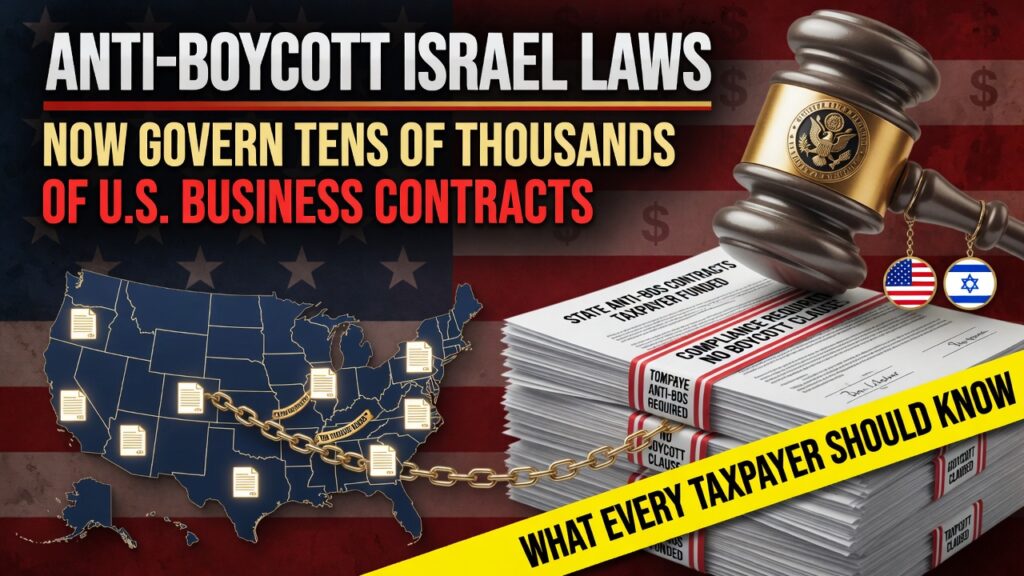
Over 35 states and the federal government are moving to ensure that your tax dollars don’t fund companies with political agendas targeting America’s closest Middle East ally. The push is growing, the legal battles are real, and the stakes for free enterprise and fiscal accountability are higher than most Americans realize.
Imagine bidding on a government contract worth $250,000 — and losing it not because your price was too high or your work substandard, but because your company signed a petition boycotting a foreign nation. That is no longer a hypothetical. For any business with more than 10 full-time employees seeking a state or federal contract over $100,000, anti-boycott Israel certification requirements are now a legally binding condition in more than 35 U.S. states.
This is one of the most consequential — and least discussed — shifts in American contracting law in a generation. Whether you view it through the lens of fiscal responsibility, foreign policy, free speech, or national security, the expansion of these laws deserves your full attention.
Support Independent Local Journalism
TheTownHall.News is a non-profit reader-supported journalism. Just $5 helps us hire local reporters, investigate important issues, and hold public officials accountable across Alameda County. If you believe our community deserves strong, independent journalism, please consider donating $5 today to support our work.The Law in Plain English: What Businesses Are Now Required to Sign
The mechanism is straightforward. Before a company can enter into a covered government contract, it must certify in writing that it does not boycott Israel and will not do so for the duration of the agreement. This language appears either as a standalone pledge or as an embedded clause within the contract itself.
The 10-employee, $100,000 threshold is not arbitrary. After early legal challenges highlighted First Amendment concerns about burdening small businesses and sole proprietors, many states deliberately narrowed their laws to focus on entities substantial enough to have genuine commercial impact. Texas, Arizona, Alaska, and dozens of other states now apply these thresholds consistently — and courts in several jurisdictions have upheld them.
Alaska became the 38th state to act in early 2024, when Governor Mike Dunleavy issued an administrative order requiring all future state contracts to include a clause stating that support for or participation in a boycott of Israel is grounds for contract termination. The state had approximately 1,400 active contracts worth at least $100,000 at the time — all of which now fall under these provisions.
Why Taxpayers Have a Legitimate Stake in This
This is fundamentally a question about how public funds are spent — and that makes it every taxpayer’s business.

The BDS (Boycott, Divestment, and Sanctions) movement is not merely a political opinion. It is an organized economic campaign designed to isolate and damage a specific nation-state. When a company that actively participates in that campaign receives a government contract, taxpayers are, in effect, subsidizing that political activity. Anti-BDS certification laws simply say: if you want public money, don’t use your business operations as a tool of economic warfare against an American ally.
Fiscal accountability is not a partisan value — it’s a civic one. Taxpayers deserve to know that government contracts go to companies that conduct business, not boycotts.
That principle applies regardless of which nation is targeted. States have begun applying the same contracting logic to companies that boycott the fossil fuel industry and the firearms sector, demonstrating that the underlying framework is content-neutral in its application even when individual laws target specific boycotts.
The Federal Push: Congress and the Pentagon Move In
The pressure to extend these protections to federal contracts is intensifying on multiple fronts.
In April 2025, Representatives Claudia Tenney (R-NY) and Jared Moskowitz (D-FL) reintroduced the Countering Hate Against Israel by Federal Contractors Act — a bipartisan bill that would ban the federal government from contracting with any entity that engages in the BDS movement. The legislation targets contracts worth more than $100,000 and carries the same 10-employee threshold found in state laws. Under the bill, a contractor found in violation would have 30 days to take corrective action before its contract is terminated.
Support Independent Local Journalism
TheTownHall.News is a non-profit reader-supported journalism. Just $5 helps us hire local reporters, investigate important issues, and hold public officials accountable across Alameda County. If you believe our community deserves strong, independent journalism, please consider donating $5 today to support our work.The bill is not alone. In September 2025, the House passed a major defense authorization bill that included an amendment barring companies engaged in “politically motivated” boycotts of Israel from receiving Pentagon contracts. Since more than half of the $755 billion the U.S. government spent on contracts in the prior fiscal year flowed through the Defense Department, the practical reach of that provision — if it becomes law — would be enormous.
Thirty-eight states have already acted. The question now is whether Congress will align federal procurement policy with the majority of state governments that have done so.
What Critics Get Wrong About the First Amendment Argument
Opponents of these laws frequently invoke the First Amendment, arguing that requiring companies to certify they won’t boycott Israel amounts to government-compelled speech. It is a serious argument — and it deserves a serious answer.
The Supreme Court has long recognized that the government may impose conditions on those who choose to enter into contracts with it, a doctrine known as the unconstitutional conditions doctrine, which has limits but does not prohibit all contracting requirements. In 2023, the U.S. Supreme Court declined to hear the Arkansas Times appeal, leaving in place an Arkansas law penalizing state contractors who boycott Israel. That decision did not settle the constitutional question nationally, but it allowed the Eighth Circuit’s ruling to stand — and the laws remain fully enforceable in at least seven states under that circuit.
Crucially, these laws do not restrict what any private citizen or business does with its own money. No law prevents you from refusing to buy Israeli products. No law prevents a company from expressing political opinions. The restriction applies only when a company seeks public funds through a government contract. That is a distinction courts have consistently found meaningful.
No one is compelled to apply for a government contract. The First Amendment does not guarantee the right to public funding.
How This Affects American Businesses and Communities
For the vast majority of contractors — including construction firms, technology vendors, staffing agencies, and professional services companies — these certifications present no practical burden whatsoever. They do not boycott Israel. They sign the clause, move on, and do the work.
The laws have their greatest impact on a narrow class of businesses: those whose leadership has made active participation in BDS a corporate policy or public commitment. For those companies, the laws create a meaningful choice: continue receiving taxpayer-funded contracts, or continue the boycott. The government is not preventing them from boycotting. It is simply declining to pay them while they do.
For local communities that depend on efficient, accountable government procurement — whether for road construction, school technology, or municipal services — these requirements serve an important filtering function. Governments should contract with companies focused on delivering value, not using contract revenue to advance political agendas their constituents did not choose.
The Counterargument: Are These Laws Effective Policy?
Skeptics — including some on the limited-government right — raise a fair point: isn’t it government overreach to condition economic participation on political certification? Libertarian-leaning critics argue that the government should stay out of business decisions entirely and let the market sort out political disagreements.
It is a coherent position. But it confuses two different things: a government regulating private commerce, and a government setting terms for its own spending. The government has wide latitude to decide how it spends public money, and has always attached conditions to contracts — from labor standards to cybersecurity requirements to domestic sourcing preferences. Anti-BDS certification is an extension of that same authority. It does not regulate what companies do in the open market; it defines what taxpayers are willing to underwrite.
The real test of consistency is whether the same framework would be applied to boycotts of other American allies — and the evidence suggests it is increasingly being used as a broader template for responsible contracting.
Key Takeaway
The anti-boycott Israel certification framework is not a niche legal development. It is a rapidly expanding feature of American contracting law that now touches hundreds of thousands of businesses across the country. It reflects a clear democratic consensus in over 35 states — and growing federal momentum — that public funds should not flow to companies using their economic operations to target U.S. allies.
For taxpayers who believe in fiscal responsibility, government accountability, and a principled foreign policy, these laws represent exactly the kind of common-sense governance that too rarely makes headlines. The legal framework is sound, the democratic mandate is broad, and the stakes — for how America spends its contracting dollars and signals its values — are real.
Stay informed. Share this article. And when your representatives debate these laws in your state legislature or in Congress, make sure they hear from citizens who understand what’s at stake.
Support Independent Journalism
If you found this reporting valuable, share it with your network — on social media, in your community groups, and with anyone who cares about how government contracts are awarded and what our tax dollars fund. Civic engagement starts with staying informed, and it grows when informed citizens speak up.
Sources: Congress.gov (H.R.3050, 119th Congress); Alaska Beacon; KCUR; JustVision Anti-Boycott Legislation Tracker; The Intercept; Jewish Insider; LegalClarity.org