Idaho Firing Squad Death Penalty for Child Rapists Takes Effect July 1 — Here’s What You Need to Know
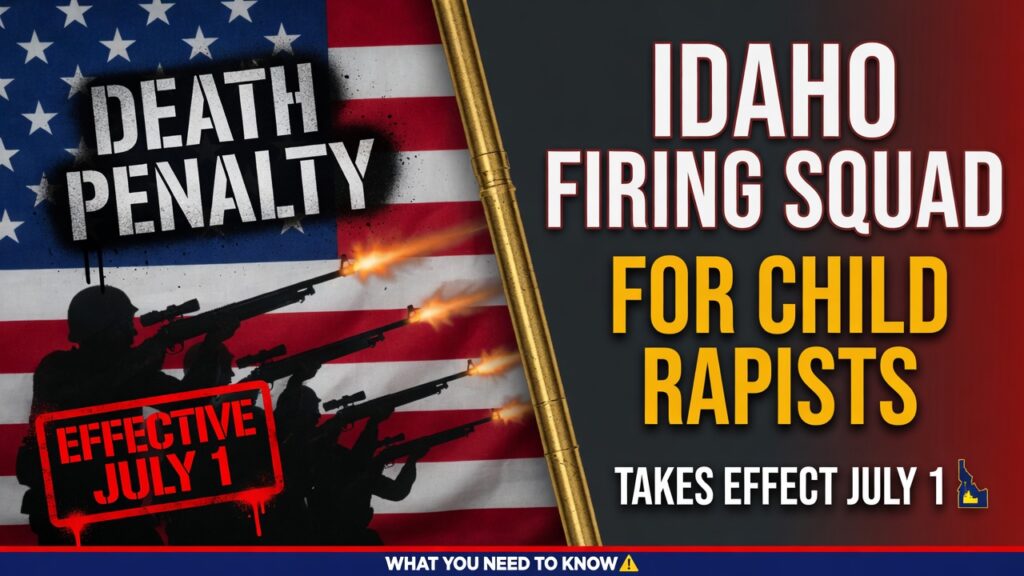
A landmark Idaho law will authorize the death penalty — by firing squad — for convicted child sex abusers. Here’s why this moment could reshape justice in America, and why the critics are missing the point entirely.
On July 1, 2026, Idaho will become the most consequential state in America for child protection law. Starting that day, individuals convicted of aggravated sexual abuse of children under the age of 12 will be eligible for the death penalty — carried out by firing squad. It is a law that has rattled civil liberties organizations, sparked heated national debate, and drawn a sharp line between two very different visions of justice in this country.
For millions of Americans who believe in law and order, parental rights, and the protection of the innocent, this moment has been a long time coming.
Support Independent Local Journalism
TheTownHall.News is a non-profit reader-supported journalism. Just $5 helps us hire local reporters, investigate important issues, and hold public officials accountable across Alameda County. If you believe our community deserves strong, independent journalism, please consider donating $5 today to support our work.What Idaho’s Law Actually Does
Governor Brad Little signed House Bill 380 into law in the spring of 2025. The legislation, which takes effect July 1, 2026, makes aggravated lewd conduct with a child under 12 a capital offense in Idaho — meaning prosecutors can seek the death penalty.
But the law is not a blanket execution order. It is carefully constructed. To face capital punishment, a defendant must meet three of 17 specific aggravating factors laid out in the statute. These include committing three or more incidents of lewd conduct against a minor, using physical force, or transmitting a sexually transmitted disease to a child. This is targeted, deliberate legislation — not a blunt instrument.
Separately, Governor Little also signed legislation making Idaho the only state in the nation to designate the firing squad as its primary method of execution. Previously used as a backup method in a handful of states, the firing squad will now be Idaho’s default — applied to all capital cases, including those involving child sex abuse.
Idaho has one of the most tragic gaps in its legal history on this issue. As bill sponsor Rep. Bruce Skaug (R-Nampa) pointed out to lawmakers, unlike most states, Idaho had previously lacked mandatory minimum sentences for child rape — meaning judges could, in some cases, place the worst offenders on probation. That era is now over.

Why This Issue Matters Right Now
Idaho’s law does not exist in a vacuum. It is the third state — after Florida and Tennessee — to pass legislation authorizing the death penalty for child sex crimes since the U.S. Supreme Court’s 2008 ruling in Kennedy v. Louisiana, which blocked such punishments at the time in a narrow 5-4 decision.
That ruling, written by Justice Anthony Kennedy, found that execution for child rape without a killing was disproportionate under the Eighth Amendment. But the Court that issued that ruling no longer exists. Three of the four dissenting justices — Samuel Alito, John Roberts, and Clarence Thomas — remain on the bench, joined by conservative justices Amy Coney Barrett, Brett Kavanaugh, and Neil Gorsuch.
Legal scholars and lawmakers across the country now believe a challenge to Idaho’s law will force the Supreme Court to revisit Kennedy v. Louisiana — and that this time, the outcome may be different.
The legal landscape has shifted. The moral urgency has not.
The Real Stakes for Families and Communities
This debate is not abstract. According to data from child advocacy organizations, the long-term psychological harm inflicted on child sexual abuse survivors is severe, often lifelong, and frequently irreversible. These are not victimless crimes absorbed quietly by society. They destroy childhoods, fracture families, and impose generational trauma on victims who had no say in what was done to them.
Support Independent Local Journalism
TheTownHall.News is a non-profit reader-supported journalism. Just $5 helps us hire local reporters, investigate important issues, and hold public officials accountable across Alameda County. If you believe our community deserves strong, independent journalism, please consider donating $5 today to support our work.Senate Majority Leader Lori Den Hartog (R-Meridian), who supported the bill, put it plainly during the Senate floor debate: “When I think about the irreparable and irreversible damage done to a child who then has to live with the consequences of these actions upon them for the rest of their lives — I think this is about accountability and about how we value life.”
This is exactly right. A society that takes the sanctity of childhood seriously must be willing to impose consequences proportional to the crime. Idaho has made that choice. Parents across the country are watching.
If a government’s first obligation is to protect its most vulnerable citizens, then Idaho just did its job.
What Critics Get Wrong
Opponents of the law, including the ACLU of Idaho, have branded it “barbaric” and constitutionally dubious. These arguments deserve a fair hearing — and a firm response.
The “barbaric” charge is worth examining carefully. Is execution by firing squad more or less humane than the slow psychological destruction of a child subjected to repeated sexual violence? Critics who use the word “barbaric” to describe state-sanctioned execution rarely apply the same standard to the crimes that prompted the law. Selectivity of outrage is not a moral argument.
On the constitutional question: the critics are correct that Kennedy v. Louisiana currently stands as legal precedent. But precedent is not permanent — the Supreme Court has reversed itself before on major constitutional questions. Bill sponsor Skaug, an attorney, argued publicly that today’s Court would not reach the same conclusion as its 2008 predecessor. Florida, Tennessee, and now Idaho have staked their legislation on that same legal judgment.
Sen. Dan Foreman (R-Moscow), a combat veteran and retired police officer who voted against the bill, raised a more substantive concern: that society risks “equating revenge with justice.” That is a reasonable philosophical distinction — and one worth debating. However, the criminal justice system has always balanced retribution, deterrence, and protection of the public. For crimes of this severity, against victims of this vulnerability, placing execution within the available range of consequences is a defensible position grounded in long-standing legal tradition.
The critics have a platform. The children who survive these crimes often do not.
A National Movement Taking Shape
Idaho’s law reflects a growing national appetite for stronger consequences for child sex crimes. In February 2026, Congresswoman Nancy Mace (R-SC) introduced the Death Penalty for Child Rapists Act at the federal level, which would authorize capital punishment for individuals convicted of aggravated sexual abuse of a child under federal law and the Uniform Code of Military Justice.
Other states, including South Dakota and Missouri, have reportedly considered similar legislation. The movement is bipartisan in its emotional underpinnings — few issues cross party lines more reliably than the protection of children — even if the legislative coalitions have skewed conservative.
What Idaho has done is give the national debate a concrete legal test case. When its law faces an inevitable court challenge, the outcome will not only determine Idaho’s statute. It will determine whether the rest of America can follow.
What Comes Next
Idaho currently has nine people on death row — eight men and one woman — and has carried out only three executions in the past 50 years. The practical near-term impact of the new law on executions may be limited. Capital cases take years to litigate, and any prosecution under the new child abuse provision will almost certainly be tied up in federal court challenges for years before a sentence is ever carried out.
But the law’s symbolic and legal significance is immediate and profound. It signals that Idaho’s voters, through their elected representatives, have concluded that some crimes are so monstrous, their harm to innocent victims so irreversible, that the state must have the ultimate sanction available.
Whether or not every American agrees with that conclusion, it is a position rooted in democratic accountability, parental concern, and an unyielding commitment to protecting children.
Conclusion: A Line in the Sand
Idaho has drawn a line. On one side: a permissive legal framework that allowed judges to place convicted child sex abusers on probation, left survivors without proportional justice, and deferred to a 17-year-old Supreme Court ruling from a very different judicial era.
On the other side: a clear, firm message that the sexual abuse of children will carry the gravest possible consequences the law allows.
Reasonable people can debate the mechanics of capital punishment. They can debate the firing squad. They can debate the constitutional questions that will play out in federal courts over the coming years.
But the underlying principle — that the state has both the authority and the obligation to protect its children with every legal tool available — should not be controversial at all.
Idaho has acted. The rest of the country is watching.
Key Takeaway
Idaho’s new law — taking effect July 1, 2026 — makes the state the only one in the nation to use the firing squad as its primary execution method, and one of only three states to authorize the death penalty for child sex crimes. It is legally bold, politically consequential, and almost certain to reach the U.S. Supreme Court.
Stay informed. Share this article. Engage in the civic conversations that shape the laws protecting your children and your community. Independent journalism depends on readers like you.