Kars4Kids California Ruling: Judge Bans Jingle Ads After Finding Donors Were Systematically Misled
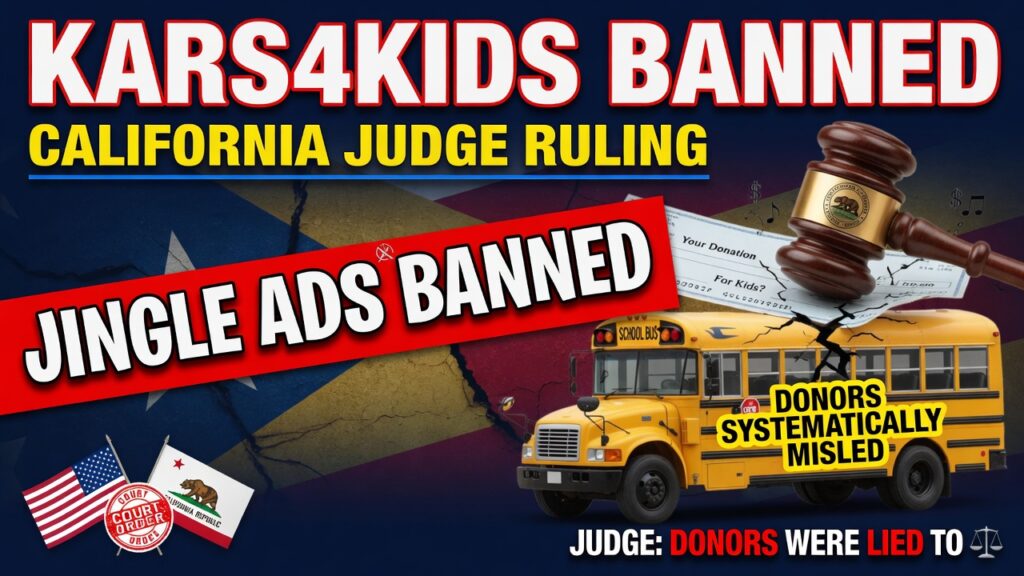
A California judge has banned the infamous Kars4Kids jingle from state airwaves after ruling the charity systematically misled donors. This case isn’t just about one nonprofit — it’s a warning about accountability, transparency, and the trust that makes civic giving possible.
For thirty years, the Kars4Kids jingle burrowed into the brains of radio listeners from coast to coast. “1-877-Kars-4-Kids, K-A-R-S, Kars for Kids.” It was inescapable. It was annoying. And according to an Orange County Superior Court judge, it was deceptive.
On May 8, 2026, Judge Gassia Apkarian ruled that Kars4Kids violated California’s False Advertising Law and Unfair Competition Law — and banned the organization from running its signature jingle ads in the state unless they clearly disclose where donation money actually goes. The ruling, five years in the making, is a significant moment of accountability in an era when charitable institutions too often operate in the dark.
Support Independent Local Journalism
TheTownHall.News is a non-profit reader-supported journalism. Just $5 helps us hire local reporters, investigate important issues, and hold public officials accountable across Alameda County. If you believe our community deserves strong, independent journalism, please consider donating $5 today to support our work.What the Court Found — and Why It Matters
The lawsuit was brought by Bruce Puterbaugh, a Newport Beach man who donated a 2001 Volvo to Kars4Kids in 2021 after hearing the jingle repeatedly. Like most donors, he assumed his car would help disadvantaged children in his community. He later discovered the truth was far more complicated.
The court found that over 60% of Kars4Kids’ funds flow to Oorah Inc., a Lakewood, New Jersey-based Jewish outreach organization whose programs include matchmaking services for young adults and subsidized gap-year trips to Israel for 17- and 18-year-olds — programs serving approximately 250 participants annually. None of this was disclosed in the advertising.
Judge Apkarian was blunt in her eight-page ruling. The Kars4Kids name, “when coupled with an advertisement that does not mention anything about its specific mission,” is likely to deceive the public. The ads, she wrote, “improperly narrow the perceived beneficiary class to ‘kids’ to elicit emotional and financial responses, while diverting funds to a much broader religious and familial social-service network.”
When a charity exploits your goodwill to fund something you never agreed to support, that’s not just misleading — it’s a betrayal of civic trust.

The Testimony That Sealed the Case
Cases are made or broken on testimony, and Kars4Kids’ own chief operating officer delivered damning admissions from the stand.
COO Esti Landau explicitly testified that the organization’s primary purpose is not to help economically disadvantaged children. She confirmed the word “Jewish” appears nowhere in the advertisement. She acknowledged Oorah’s programs encompass matchmaking and Israel travel — programs squarely targeted at a specific religious community, not the broad population of children in need that donors reasonably imagined when they heard the jingle.
Judge Apkarian directly rejected Kars4Kids’ defense that donors should have researched the charity online before giving. “Consumers act reasonably by calling that number rather than cross-referencing a website,” she wrote. The jingle, she concluded, relied on “false assumptions created by the Defendant’s calculated silence.”
That phrase — calculated silence — deserves to sit with readers for a moment. This was not an oversight. It was a deliberate strategic choice to say as little as possible and let donors fill the gap with their own assumptions.
A Pattern of Deception, Not a One-Off Mistake
This ruling did not emerge from a vacuum. Since 2009, three separate state government investigations found that Kars4Kids had not properly informed would-be donors that they were contributing to a religious organization. Three investigations over seventeen years, and the advertising practices barely changed.
Support Independent Local Journalism
TheTownHall.News is a non-profit reader-supported journalism. Just $5 helps us hire local reporters, investigate important issues, and hold public officials accountable across Alameda County. If you believe our community deserves strong, independent journalism, please consider donating $5 today to support our work.A separate investigative press analysis found that less than half of the revenue Kars4Kids received since 2008 went to Oorah — its stated primary charity. The remainder was spent on overhead, advertising, and more than 150 employees, including eight who each earn over $100,000 annually. An expert in nonprofit operations flagged the excessive non-program spending as a red flag.
This is precisely the kind of institutional inertia that erodes public confidence in charitable giving. When a handful of bad actors exploit donor generosity, they make everyone more skeptical — damaging the legitimate nonprofits doing genuine work in communities across the country.
The Legal Consequences Are Just Beginning
Judge Apkarian’s ruling carries teeth beyond the ad ban. She ordered Kars4Kids to reimburse Puterbaugh the market value of his donated vehicle — $250. That may sound modest, but the implications are not. Legal experts say the ruling could force Kars4Kids to reimburse thousands of past donors who can demonstrate they were misled. The attorney who brought the case, Tony Graham, put it plainly: “I hope it will be nationwide.”
Kars4Kids has 30 days from the May 8 ruling — by June 2026 — to bring its California advertising into compliance or pull it entirely. The organization has stated it will appeal, calling the decision “deeply flawed” and saying it “ignores the facts.”
Meanwhile, a separate federal class-action lawsuit filed in November 2025 in the U.S. District Court for Northern California is quietly gaining momentum. That case — Pavel Savva et al. v. Kars4Kids Inc. and Oorah Inc. — includes federal RICO claims, alleging a pattern of organized fraud. Under RICO, if proven, defendants can face treble damages — three times the actual losses of aggrieved parties. That is an entirely different order of legal and financial magnitude.
What Critics of the Ruling Get Wrong
Some have framed this case as government overreach into religious organizations — a free speech or religious liberty issue. That framing misses the point entirely.
No court has told Kars4Kids it cannot support Jewish causes, Orthodox outreach, or trips to Israel. The ruling says nothing about the legitimacy of those missions. The only thing the court has required is honesty. If your charity primarily serves a specific religious community, tell donors that. The First Amendment does not protect the right to mislead consumers into thinking their money will help local disadvantaged children when it will largely fund religious programming for a narrow demographic.
Transparency is not a burden on free speech — it is its foundation. An informed donor is a free donor. A donor operating on manufactured assumptions is a mark.
How This Affects Every American Donor
The broader lesson here extends well beyond one charity and one jingle. Americans give generously. According to Giving USA, charitable donations in the United States total hundreds of billions of dollars annually. That generosity depends on a foundational assumption: that organizations will tell you, honestly, what they do with your money.
When that assumption is violated at scale — through calculated advertising designed to trigger emotional responses while withholding material facts — the damage radiates outward. Donor confidence erodes. Genuine nonprofits working with limited resources suffer. Communities that depend on charitable support lose out.
Accountability in charitable giving isn’t a liberal or conservative issue. It’s a civic one. Donors deserve to know exactly where their money goes — every time.
This ruling is a reassertion of a basic principle: you have the right to make informed choices about your own money. Personal responsibility requires personal information. You cannot be responsible for a decision you were manipulated into making.
Key Takeaway
A California court has affirmed what common sense already knew: telling donors their money helps “kids” while quietly funding religious travel programs and matchmaking services is not transparency — it is fraud by omission. Kars4Kids now faces an advertising ban, potential mass donor reimbursements, and a federal RICO lawsuit. The appeal may delay consequences, but the record is clear. Donors were deceived, systematically, for years.
What You Can Do
Civic life depends on informed citizens. Before donating to any charity, verify its mission and financials through independent watchdogs like Charity Navigator or GuideStar. Look at what percentage of funds go directly to programs versus administrative overhead.
If this story concerns you, share it. Accountability journalism only works when it reaches the people it serves. Forward this article to anyone who has ever donated a car, dropped money in a bucket, or responded to a radio jingle in good faith.
Stay informed. Support independent reporting. And hold institutions — charitable or otherwise — to the standard of honesty that civic life requires.
This article is based on court documents, testimony reported in the proceedings of Orange County Superior Court Case before Judge Gassia Apkarian, and reporting from multiple credentialed news outlets including the Asbury Park Press, KRON4, CBC News, and court filings in the U.S. District Court for the Northern District of California.