California’s $189 Million Prison Tablet Program Is Letting Inmates Groom Children — And Officials Can’t Stop It
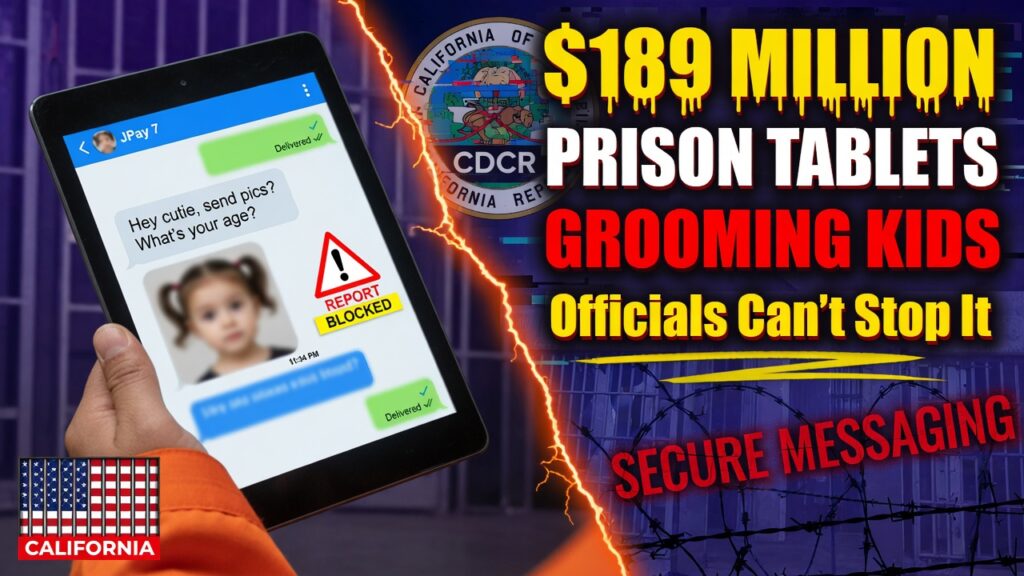
A bombshell investigation reveals that California’s taxpayer-funded tablet program has handed convicted killers, rapists, and child predators an unchecked digital lifeline — and state officials knew the risks.
Every once in a while, a government program comes along so profoundly disconnected from common sense that it demands more than a news brief. It demands accountability. This is one of those moments.
On May 13, 2026, City Journal published an explosive investigation revealing that California’s $189 million prison tablet program — pitched to taxpayers as a noble rehabilitation initiative — has instead become a taxpayer-funded pipeline for pornography, sexual exploitation, and the alleged grooming of children. The report, based on interviews with dozens of death-row inmates and a former senior California Department of Corrections and Rehabilitation (CDCR) official, lays out a pattern of abuse so systematic and foreseeable that it raises a single unavoidable question: Who approved this, and why is no one being held accountable?
Support Independent Local Journalism
TheTownHall.News is a non-profit reader-supported journalism. Just $5 helps us hire local reporters, investigate important issues, and hold public officials accountable across Alameda County. If you believe our community deserves strong, independent journalism, please consider donating $5 today to support our work.How $189 Million in Taxpayer Money Funded a Predator’s Toolkit
The program began as a pilot in 2018 under Governor Gavin Newsom’s administration, expanding until nearly all of California’s approximately 90,000 state prisoners had received a digital tablet by 2023. In February 2025, the state doubled down, awarding Securus Technologies a new four-year, $189 million contract to replace the previous vendor. With optional extensions built into the deal, the total bill to taxpayers could climb to approximately $315 million.
The devices were framed as instruments of “digital equity” for “justice-impacted individuals” — the administration’s preferred language for convicted felons. The stated goals were reasonable enough on the surface: family communication, access to educational content, legal resources, and job-readiness tools. Newsom promoted the effort as part of his broader vision to transform California’s prisons into Nordic-style rehabilitation centers.
What the administration apparently failed to plan for — or chose to ignore — was what happens when you hand internet-connected devices to people convicted of rape, murder, and child molestation without meaningful, scalable oversight.
The Investigation the State Didn’t Want You to Read
The City Journal exposé is not a collection of anonymous tips or partisan speculation. It is built on direct communication with death-row inmates, who described in their own words how the tablets are used: streaming pornographic content, engaging in explicit sexual conversations, and receiving sexually graphic images — all in apparent violation of CDCR’s own stated policies.

More alarming still is what a former senior CDCR official told investigators. Monitoring 90,000 tablets simultaneously is, in that official’s assessment, effectively impossible. And the consequences of that failure are not theoretical. In at least one documented federal case, a convicted child predator allegedly used a state-issued tablet to sexually exploit a 12-year-old victim — re-victimizing a child from behind bars, on the public’s dime.
“There are probably several thousand children that are currently being groomed,” the former official warned.
That sentence should stop every California taxpayer cold.
No Safeguards. No Exceptions. No Accountability.
Perhaps the most indefensible aspect of this program is its complete indifference to the nature of the crimes committed by those receiving the devices. According to investigators, CDCR regulations place no restrictions on tablet access based on offense type. A first-time, non-violent offender receives the same unrestricted device as a serial killer or a convicted child sex offender. No age verification is applied to incoming communications.
This is not an oversight. This is a policy choice.
Support Independent Local Journalism
TheTownHall.News is a non-profit reader-supported journalism. Just $5 helps us hire local reporters, investigate important issues, and hold public officials accountable across Alameda County. If you believe our community deserves strong, independent journalism, please consider donating $5 today to support our work.Parental rights advocates have long argued that government institutions bear a special duty to protect children from predators — not empower them. When the state hands a convicted child predator an internet-connected device with no meaningful age verification on incoming messages, it has not merely failed in its duty. It has actively created the conditions for additional victims.
When your “digital equity” program gives a child predator direct access to new victims, the failure isn’t a glitch. It’s the program.
What the State Is Saying — and Why It Falls Short
To its credit, the CDCR did not stay silent. A department spokesperson issued a pointed rebuttal, calling the City Journal investigation “a sensationalized mashup of falsehoods, speculation, and quotes from convicted murderers presented as fact.” Officials described the tablets as “secure, monitored rehabilitation tools with no open internet access,” adding that the devices provide access to the Bible, educational programming, and reentry resources.
The spokesperson also suggested that if the investigators had credible evidence of criminal activity, they were obligated to report it to law enforcement rather than publish it.
These are not unreasonable points. Inmate testimony is, by nature, a compromised source. And responsible journalism does require reporting credible criminal evidence to authorities.
But here’s where the state’s defense collapses: a former senior CDCR official — someone inside the system, not a partisan journalist — confirmed that meaningful monitoring of 90,000 devices is not operationally realistic. And the Diaz case, in which federal charges allege a convicted predator used a state tablet to exploit a child, is not a quote from an inmate. It is a federal criminal proceeding.
When the official response to documented abuse is dismissal and deflection, taxpayers are right to ask harder questions.
The Real Cost: Fiscal Recklessness Meets Real-World Harm
Fiscal conservatives have raised alarms about this program since its inception, and those concerns have now been vindicated in the most tragic way possible. This is not merely a matter of government waste — though $189 million for prison tablets, in a state grappling with homelessness, crumbling infrastructure, and failing public schools, is a remarkable allocation of priorities.
The deeper cost is human. When government programs are designed without adequate safeguards, real people bear the consequences. In this case, those people include children who were allegedly contacted, groomed, or exploited by individuals the state put behind bars precisely because they were deemed too dangerous to remain in society.
Fiscal accountability is not a talking point. It is a moral imperative. Spending public money without accountability structures isn’t progressive. It’s negligent.
What Needs to Happen Now
This story demands more than outrage. It demands action. Several concrete steps should follow immediately.
California’s legislature must launch a full, independent audit of the tablet program — its costs, its content moderation practices, and the documented incidents of misuse. The CDCR’s claim that tablets are “tightly monitored” must be stress-tested against the reality confirmed by its own former official.
Device access must be tiered by offense type. There is no credible rehabilitation argument for providing unrestricted digital communication to convicted child sex offenders. Age verification for all incoming communications should be a baseline requirement, not an afterthought.
And if the Securus contract does not include enforceable monitoring standards with financial penalties for compliance failures, it should be renegotiated or terminated.
Accountability starts with transparency. Taxpayers deserve a public accounting of exactly how these devices are being used, what content filters are in place, how many violations have been flagged, and what happened next.
Key Takeaway
California spent $189 million to provide tablets to roughly 90,000 inmates — including those on death row and convicted child predators — with no offense-based restrictions on access and monitoring systems its own officials describe as inadequate. At least one federal case documents a child being allegedly exploited through a state-issued device. Officials have dismissed the investigation. No one, as of publication, has faced consequences.
This is a story about government accountability, parental rights, fiscal responsibility, and the protection of children. It deserves your attention — and your voice.
Stay Informed. Stay Engaged.
If this story troubles you, you’re not alone — and you don’t have to stay silent. Share this article with your community. Contact your state representative and ask what oversight mechanisms exist for the CDCR tablet program. Support independent journalism that holds government institutions accountable regardless of political convenience.
Democracy functions when citizens are informed and engaged. The best thing you can do right now is both.