Stacie Laughton Guilty Plea: What the Child Exploitation Case Reveals About Failed Oversight and Broken Accountability
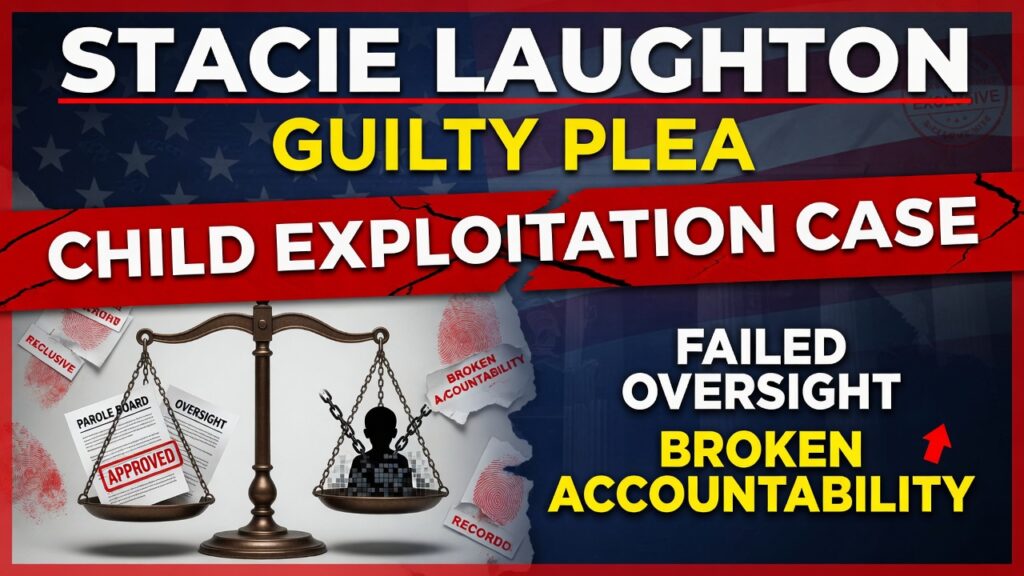
A former New Hampshire lawmaker once celebrated as a transgender trailblazer has pleaded guilty to federal child exploitation charges — and the institutions that enabled her political career owe the public a serious reckoning.
The guilty plea came quietly, buried beneath the daily churn of political news. But for the parents of children enrolled at Creative Minds Early Learning Center in Tyngsborough, Massachusetts, there is nothing quiet about it. Former New Hampshire State Representative Stacie Marie Laughton, 41 — once heralded by national media as the first openly transgender person elected to a U.S. state legislature — pleaded guilty on November 3, 2025, in federal court in Boston to three counts of sexual exploitation of children.
This is not a story about politics or identity. This is a story about children who were failed — by a daycare that employed the wrong person, by a system that repeatedly returned a troubled individual to public office, and by a media culture so eager to celebrate a narrative that it neglected the most basic due diligence. When institutions fail to ask hard questions, children pay the price.
Support Independent Local Journalism
TheTownHall.News is a non-profit reader-supported journalism. Just $5 helps us hire local reporters, investigate important issues, and hold public officials accountable across Alameda County. If you believe our community deserves strong, independent journalism, please consider donating $5 today to support our work.What the Federal Case Actually Revealed
The facts, as laid out in federal charging documents, are deeply disturbing. Laughton’s then-partner, Lindsay Groves, 40, worked at Creative Minds Early Learning Center. Between May 2022 and June 2023 — while Laughton was still serving as a sitting state representative — Groves photographed nude images of children aged three to five during bathroom breaks and routine diaper changes. She then sent those images to Laughton.
Forensic examination of both women’s cellphones revealed more than 10,000 text messages exchanged over approximately one month in 2023. Those messages included explicit discussions about the children and the transfer of the abuse images. Investigators documented that Laughton actively requested more access to the children.
Groves pleaded guilty on October 14, 2025, to three counts of sexual exploitation of children and one count of distributing child pornography. Both women were scheduled for sentencing in February 2026. Each count of sexual exploitation carries a mandatory minimum of 15 years and up to 30 years in federal prison, a fine of up to $250,000, and a lifetime of supervised release. All identified child victims and their families were contacted by law enforcement.
When a sitting lawmaker is receiving child sexual abuse material from a daycare employee, something has gone catastrophically wrong — not just with two individuals, but with every layer of oversight that should have caught it sooner.

A Record of Red Flags No One Acted On
What makes this case particularly troubling is how avoidable it should have been. Laughton’s record of legal and ethical failures stretches back more than a decade — and was publicly available at every step of her political career.
When Laughton was first elected to the New Hampshire House of Representatives in 2012, media coverage was overwhelmingly celebratory. Within weeks, however, it emerged that Laughton had in 2008 been convicted of conspiracy to commit credit card fraud and falsifying physical evidence, receiving a sentence that, under New Hampshire law, rendered her ineligible to hold public office. She resigned before taking her seat.
In 2015, Laughton was sentenced to a suspended six-month jail term for phoning in a false bomb threat to a local hospital. She voluntarily entered a mental health and addiction treatment facility afterward.
By 2020, she was back on the ballot — and won. She was reelected in 2022. That same year, she was arrested on stalking charges related to Groves, the same partner who would later photograph children in a daycare bathroom and send those images to her. Laughton resigned from the House in December 2022. Seven months later, she was arrested on federal child exploitation charges.
This is not a record that emerged from nowhere. Every data point was public. The question that demands an answer is: who was paying attention?
Support Independent Local Journalism
TheTownHall.News is a non-profit reader-supported journalism. Just $5 helps us hire local reporters, investigate important issues, and hold public officials accountable across Alameda County. If you believe our community deserves strong, independent journalism, please consider donating $5 today to support our work.The Daycare Oversight Gap Parents Deserve to Know About
The role of Creative Minds Early Learning Center cannot be overlooked. Groves was employed there from May 2022 until her arrest in June 2023 — more than a full year during which the abuse occurred. The exploitation took place during what prosecutors described as “routine” moments: bathroom breaks, diaper changes before naptime. These were not exceptional circumstances. They were the ordinary backdrop of a working day at a licensed childcare facility.
Parents entrust daycare workers with something irreplaceable. That trust creates a legal, moral, and institutional obligation — one that extends from individual employees all the way up to the licensing bodies that certify facilities and the state agencies that oversee them.
The case raises pointed questions about background check protocols, employee monitoring, and the warning signs that may have been missed or ignored. Families who placed their children in that center deserve transparency, not platitudes.
This is precisely the kind of institutional accountability that government at the state and local level must be willing to provide — and that parents have every right to demand.
What Critics of This Coverage Get Wrong
Some will argue that focusing on Laughton’s political identity or the media’s past celebration of her career is an attempt to score political points at the expense of a serious criminal matter. That argument gets things exactly backwards.
The media’s enthusiastic and largely uncritical coverage of Laughton’s political “firsts” was not journalism — it was advocacy. Advocacy that, in this case, appears to have crowded out the basic journalistic function of scrutinizing a candidate’s background. A Google search in 2020 would have surfaced Laughton’s fraud conviction, her bomb threat charge, her history of legal instability. Voters deserved that context before, not after.
Raising these questions is not about exploiting tragedy. It is about demanding that the same rigorous standard be applied to every public figure — regardless of their demographic identity or the political narrative their candidacy serves. Equal scrutiny is not prejudice. It is the baseline requirement of a functioning press.
The Parental Rights Dimension
At the center of this case are children who had no voice and no choice. Their parents sent them to a licensed childcare facility and trusted that the people responsible for their care had been properly vetted and were being appropriately supervised. That trust was catastrophically violated.
The parental rights movement has long argued that parents — not institutions, not ideological frameworks, not political narratives — must be the first and last line of defense for their children. This case illustrates why that principle matters in the most concrete terms imaginable. When parents are not equipped with accurate, transparent information about the people and institutions caring for their children, they cannot fulfill that protective role.
Childcare licensing reform, stronger background check requirements, and mandatory reporting improvements are not partisan issues. They are child safety issues. And they are exactly the kind of common-sense, accountability-driven policy responses that legislators at every level should be advancing right now.
Children cannot protect themselves. That responsibility falls on parents, on institutions, and on a press willing to ask hard questions before the damage is done.
Accountability Must Not Stop at the Courthouse Door
The federal guilty pleas are a measure of justice — but justice for the victims requires more than prison sentences, as warranted as those are. It requires a systemic examination of how this was allowed to happen.
New Hampshire’s election oversight framework needs to grapple with how a candidate with Laughton’s documented criminal history could return to the ballot and win, twice. Massachusetts childcare regulators must account for what safeguards failed at Creative Minds. And the national media organizations that built a celebratory narrative around Laughton without adequate scrutiny of her background owe their audiences a transparent accounting of that editorial failure.
Accountability is not a partisan value — or it should not be. It is the foundation of every functioning democratic institution. When accountability collapses across multiple systems simultaneously, children are photographed in daycare bathrooms and the images are sent to their elected representatives. That is not a hypothetical. It happened.
Key Takeaway
This case is not an outlier or an anomaly. It is the foreseeable result of institutions — political, journalistic, and regulatory — prioritizing narrative over scrutiny. The children harmed in this case deserved better from every one of those institutions. So do all the children currently in the care of systems that have not yet asked the hard questions this case demands.
Stay Informed. Stay Engaged. Make Your Voice Count.
Stories like this one depend on independent journalists willing to follow facts wherever they lead — not where a preferred narrative points. If this reporting matters to you, share it with your network, engage with your local elected officials on childcare safety reform, and support outlets committed to accountability journalism without fear or favor.
Your engagement is not passive. In civic life, attention is action. Use it.
All facts in this article are drawn from federal court documents, official statements from the U.S. Attorney’s Office for the District of Massachusetts, and verified reporting from the Boston Globe, Union Leader, and Associated Press.