Coca-Cola California Facility Closure Exposes the State’s Growing Business Crisis
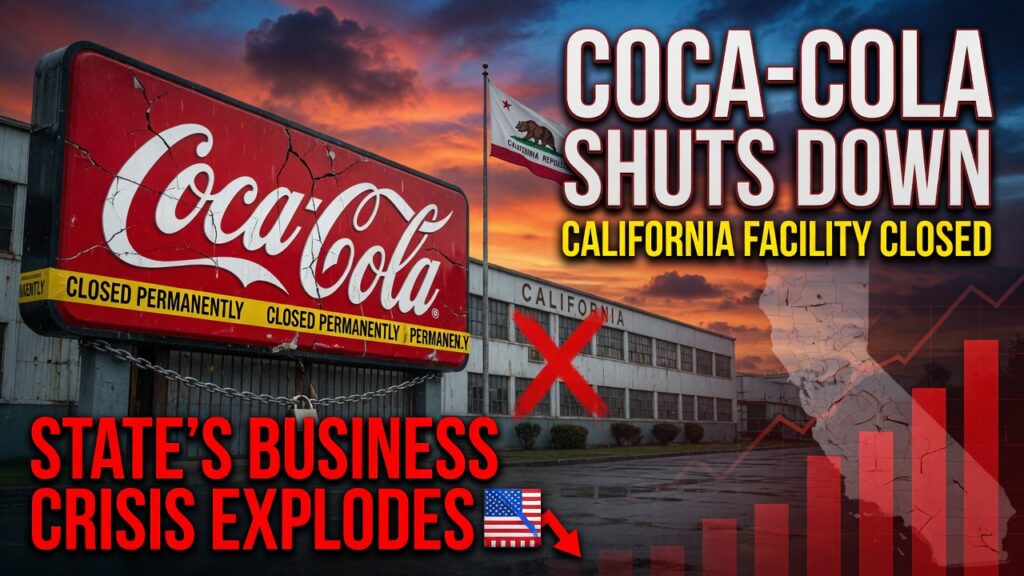
After more than a century of operations in the Golden State, one of the world’s most iconic brands is pulling up stakes. The Coca-Cola exodus from California isn’t just a corporate footnote — it’s a warning sign every voter and taxpayer should read carefully.
The news landed quietly, as it often does when major companies make hard choices. Reyes Coca-Cola Bottling announced that its Ventura distribution center — a facility with more than a century of history in the community — will permanently close its doors on July 10. Eighty-five employees will be affected. Drivers, fleet mechanics, merchandisers, customer growth representatives: real people, real livelihoods, real families.
It would be easy to dismiss this as a routine business decision. It is anything but. The Ventura closure is not an isolated event. It is the latest chapter in a quiet, steady retreat of major industry from a state that has spent decades making it harder — and more expensive — to do business. When a brand as durable as Coca-Cola starts walking away, California’s leaders would do well to ask why.
Support Independent Local Journalism
TheTownHall.News is a non-profit reader-supported journalism. Just $5 helps us hire local reporters, investigate important issues, and hold public officials accountable across Alameda County. If you believe our community deserves strong, independent journalism, please consider donating $5 today to support our work.A Pattern, Not an Incident
The Ventura closure follows a string of similar decisions that together form an unmistakable pattern. In June 2025, Coca-Cola shuttered its American Canyon bottling plant in Napa County — a facility that had been operational since 1994, producing Powerade and Minute Maid products for the region. That closure put 135 workers out of jobs and was described by the company as part of its “asset right” strategy, which prioritizes brand management over direct production ownership.
That same period saw Reyes Coca-Cola Bottling close its Salinas plant after more than seven decades of operation. And before that, the company’s Modesto facility was shuttered, eliminating 101 positions.
Four California facilities. Hundreds of jobs. Each announced with the polished language of corporate strategy — but each representing a community that will now be without an employer it counted on for generations.
When a company that has survived two World Wars, the Great Depression, and a global pandemic decides California isn’t worth the trouble, that is not a company problem. That is a California problem.

The Real Cost of an Inhospitable Business Environment
It is worth being precise here. Coca-Cola is not going out of business. The company is restructuring its operations and shifting production responsibilities to co-packers — third-party manufacturers who will absorb the volume. The brand will survive. The jobs, the local tax base, and the community relationships built over more than a century in places like Ventura will not.
This distinction matters. California is not losing Coca-Cola the product. It is losing Coca-Cola the employer — and the economic multiplier effect that comes with it. Every distribution job supports additional spending in local restaurants, shops, and services. Every shuttered facility is a property that stops generating commercial activity for the surrounding neighborhood.
California’s regulatory and tax environment has for years ranked among the most burdensome in the nation for businesses of all sizes. The state imposes one of the highest corporate tax rates in the country, combined with strict environmental regulations, escalating minimum wage mandates, and complex compliance requirements that disproportionately impact manufacturing and logistics operations. For a distribution-heavy business like bottling, those costs compound quickly.
What Critics Get Wrong
Some will argue that corporate restructuring is simply the natural evolution of capitalism — that blaming California’s policy environment is too convenient, too political. That argument deserves a fair hearing.
It is true that Coca-Cola’s “asset right” strategy reflects a global trend toward leaner, brand-focused operations. The company has pursued similar consolidations in other states and countries. No single regulatory framework is responsible for every business decision a multinational corporation makes.
Support Independent Local Journalism
TheTownHall.News is a non-profit reader-supported journalism. Just $5 helps us hire local reporters, investigate important issues, and hold public officials accountable across Alameda County. If you believe our community deserves strong, independent journalism, please consider donating $5 today to support our work.But that framing misses the larger point. The question is not whether Coca-Cola would have restructured some operations regardless of location. The question is: why does restructuring so consistently mean exiting California? Why does the math keep working out the same way — that the Golden State is where the costs are too high, the margins too thin, and the regulatory burden too heavy to justify staying?
The data tells a consistent story. California has seen a sustained outflow of businesses and residents over the past several years, with companies citing taxes, regulations, and cost of living as primary drivers. Coca-Cola’s departures fit squarely within that documented trend.
How This Affects Families and Communities
Behind every closure notice is a human story that rarely makes the headline.
Of the 85 Ventura employees impacted, Reyes Coca-Cola Bottling says 78 will be reassigned to other company facilities. That sounds encouraging — until you consider what relocation means for a fleet mechanic or delivery driver with a mortgage, children in school, and roots in the community. “You can transfer to another facility” is not the same as job security for workers who have built their lives in a specific city.
The workers who do not transfer face a job market in a state where the cost of living is among the highest in the nation. A distribution job that provides a middle-class income in Ventura does not go as far when you’re starting over. Personal responsibility matters — but so does the environment in which individuals and families try to exercise it. A state that drives away employers is not making it easier for working people to succeed. It is making it harder.
That is the civic cost of poor economic policy, and it is borne not by the executives who sign the closure paperwork, but by the workers who show up every day, by the local businesses that depended on them, and by the communities that now have one fewer employer and one more empty commercial property.
The Accountability Question Politicians Would Rather Avoid
California’s elected leadership rarely frames business departures as a failure of governance. The preferred narrative is that corporations are simply chasing lower wages or evading their responsibilities. That narrative is flattering to those in power and deeply unfair to the truth.
The companies leaving California are not fleeing their obligations. They are responding rationally to an environment that has made operating here increasingly untenable. Blaming the companies that leave — rather than examining the policies that push them out — is a form of willful economic illiteracy.
Fiscal accountability begins with asking hard questions: If California’s business tax revenues are to remain robust, it needs businesses to stay and grow. If workers are to have good, stable employment options, it needs employers who find the state worth the investment. Every facility that closes, every headquarters that relocates, and every job that moves to a more hospitable state is a direct consequence of policy choices made in Sacramento.
The Coca-Cola story is not about a soda company. It is about whether California’s leaders are willing to be honest about what their choices cost.
Key Takeaway
Coca-Cola’s withdrawal from California — four facilities, hundreds of jobs, more than a century of community history erased — is a concrete, documented consequence of a business environment that has prioritized regulatory ambition over economic sustainability. The workers who lose jobs, the communities that lose employers, and the taxpayers who lose the economic activity generated by those facilities deserve better than talking points. They deserve leadership willing to look at the results of its own policies and change course.
What You Can Do
This story matters — and it will keep mattering, because the forces driving it have not changed. Stay informed about how your state and local representatives vote on business regulations, tax policy, and labor law. Engage in local civic life. Ask your elected officials what they are doing to keep employers in your community. And if this article gave you something to think about, share it. The conversation California needs to have about its economic future starts with citizens who are paying attention.
Support independent journalism that holds power accountable. Share this article with someone who needs to read it.