California’s $7,500 EV Replacement Incentive: Who Really Pays the Bill?
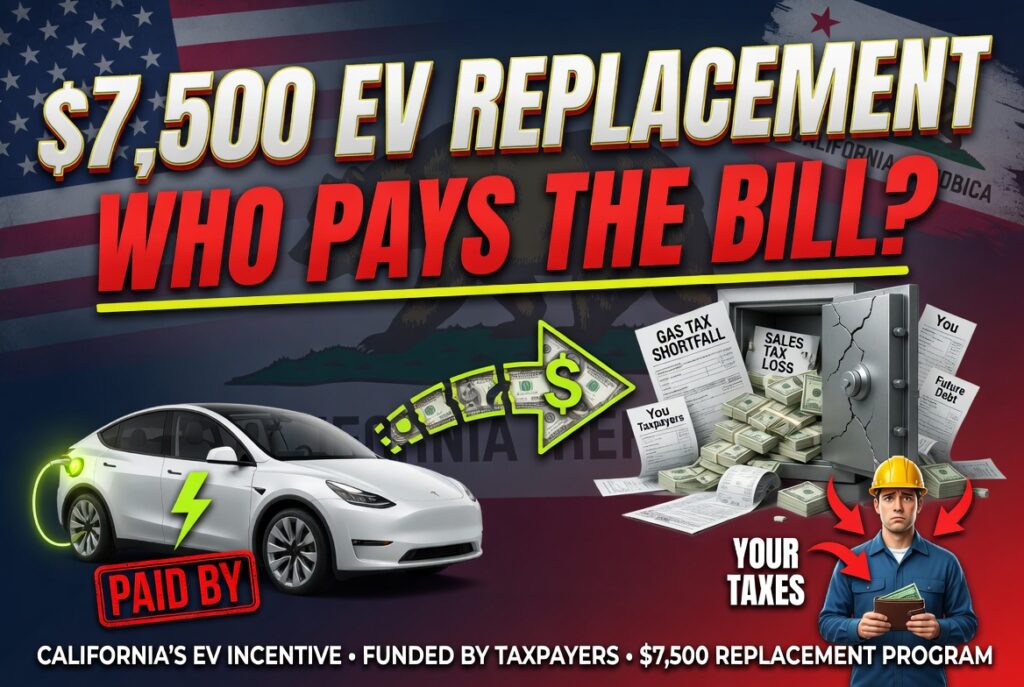
The Golden State is dangling thousands of dollars to push drivers into electric vehicles, but as federal credits expire and the state’s own programs get more complicated, the question lawmakers aren’t answering is: at what cost to the taxpayer?
If you live in California and drive an older gasoline-powered car, the state has a pitch for you: turn it in, pick up an electric vehicle, and collect a check worth thousands of dollars. Programs like Clean Cars 4 All and the Driving Clean Assistance Program promise grants of up to $12,000 or more for qualifying households — figures that, on paper, seem like a genuine windfall for working families.
But strip away the marketing language, and a harder set of questions emerges. Who qualifies for these grants? Who funds them? And as the federal government simultaneously pulls back its own EV tax credits — the $7,500 new-vehicle and $4,000 used-vehicle credits expired on September 30, 2025 — is California doubling down on a subsidy model that is sustainable, or simply shifting the bill from Washington to Sacramento, and ultimately to every California taxpayer?
Support Independent Local Journalism
TheTownHall.News is a non-profit reader-supported journalism. Just $5 helps us hire local reporters, investigate important issues, and hold public officials accountable across Alameda County. If you believe our community deserves strong, independent journalism, please consider donating $5 today to support our work.The Incentive Landscape After the Federal Exit
The collapse of the federal clean vehicle tax credit has reshaped California’s EV market dramatically. Gone is the simple, universal $7,500 deduction that millions of middle-class buyers could claim at the point of sale regardless of income. What replaced it is a patchwork of income-restricted, regionally administered grant programs that require drivers to navigate bureaucratic applications, eligibility windows, and rapidly shifting funding pools.
The state’s primary vehicle-replacement initiative — Clean Cars 4 All, administered by the California Air Resources Board and regional air districts — offers grants of up to $12,000 for lower-income households that retire an older, higher-polluting vehicle and replace it with a cleaner alternative. An additional $2,000 is available for home EV charging installation. Those who do not trade in an older vehicle can access up to $7,500 in purchase grants through related programs.
It sounds generous. The fine print, however, is where things get complicated.
$200 Million — Governor Newsom’s proposed new state EV rebate program, pending legislative approval, aimed at filling the gap left by expired federal credits. That’s $200 million of California taxpayer money, with eligibility details yet to be finalized.
Who Actually Qualifies — and Who Gets Left Out
Here is the reality that glossy state press releases rarely lead with: the vast majority of California’s working middle class no longer qualifies for the headline-grabbing incentives. The most generous grants are income-restricted to households at or below specified multiples of the area median income or federal poverty level. If you earn a moderate salary in San Jose or Los Angeles — where the cost of living consistently ranks among the highest in the nation — you may earn too much to qualify for the largest incentives, yet still struggle to absorb the higher upfront cost of an EV without assistance.

Meanwhile, the funding itself is neither guaranteed nor stable. Regional programs open and close in waves as budgets are exhausted. One major program paused new applications entirely due to overwhelming demand and insufficient funding — a pattern that rewards those who are first in line, not necessarily those most in need.
📣 Social share: “The state can call it an incentive, but when funding runs out mid-year and only specific zip codes qualify, it is something closer to a lottery.”
The Fiscal Accountability Question Sacramento Won’t Directly Answer
Governor Newsom’s 2026–2027 budget proposal includes a new $200 million state-funded EV rebate program, designed to pick up where federal incentives left off. The program, which would provide up-front discounts at dealerships administered through the California Air Resources Board, is framed as a bold climate response. What it actually represents is a significant new government expenditure at a moment when California is simultaneously navigating budget pressures across healthcare, education, wildfire resilience, and infrastructure.
The critical details — grant amounts per vehicle, precise income caps, eligible vehicle categories — have not yet been finalized. The legislature has not approved the measure. In other words, California may be committing $200 million of public money to a program whose fundamental parameters remain unresolved. That is not responsible fiscal management. That is improvised policymaking dressed up as climate leadership.
The question fiscal conservatives and independent-minded voters should be asking is straightforward: if electric vehicles are genuinely the superior, cost-effective choice — as the state insists — why do they require perpetual, escalating government subsidization to persuade consumers to purchase them?
How This Affects Ordinary Families and Communities
The human cost of poorly designed incentive policy is real and measurable. Working families who do not meet the income threshold for Clean Cars 4 All, and who live outside the service areas of the most generous utility rebate programs, face an EV market where the headline prices have not come down fast enough to offset the vanishing subsidies. Many are now caught between state mandates pushing toward zero-emission vehicles and an incentive system that does not realistically serve them.
Support Independent Local Journalism
TheTownHall.News is a non-profit reader-supported journalism. Just $5 helps us hire local reporters, investigate important issues, and hold public officials accountable across Alameda County. If you believe our community deserves strong, independent journalism, please consider donating $5 today to support our work.California’s own rules set a 35 percent zero-emission vehicle sales target for model year 2026 light-duty vehicles — an aggressive regulatory target that presumes market readiness and consumer affordability that the data does not uniformly support. The state cannot simultaneously mandate a transition, cut off federal subsidy pipelines, replace them with income-restricted grants, and then claim it is acting in the interest of all Californians.
Personal responsibility and informed consumer choice should be the engine of this transition, not a revolving door of government incentives that shift based on election cycles, budget negotiations, and bureaucratic availability.
What Critics of This Analysis Get Wrong
Defenders of California’s approach will argue, not without merit, that income-based targeting is a smarter, more equitable use of public funds than the old universal rebate. They have a point. The prior Clean Vehicle Rebate Project, which ran from 2010 to 2023 and distributed nearly $1.5 billion in incentives supporting more than 586,000 vehicles, was criticized precisely because wealthier buyers disproportionately captured its benefits. Redirecting grants toward lower-income households who genuinely cannot absorb higher vehicle costs without help is a defensible policy goal.
But acknowledging that equity-focused targeting is conceptually sound is not the same as endorsing California’s current implementation. A well-designed program defines its eligibility criteria before announcing its funding, maintains stable application windows, and does not leave middle-income families in a policy no man’s land. California’s current patchwork does none of those things consistently.
Fiscal accountability and environmental progress are not mutually exclusive — but they require discipline that Sacramento has yet to demonstrate.
📣 Social share: “Fiscal accountability and environmental progress are not mutually exclusive — but they require discipline that Sacramento has yet to demonstrate.”
The Bottom Line
California’s EV replacement incentive program is not a bad idea wrapped in a good headline. Parts of it — particularly the focus on retiring genuinely high-polluting older vehicles and providing targeted support for lower-income households — reflect sound priorities. But the broader execution is a lesson in how government programs can obscure their true cost, exclude the very middle-class families they claim to serve, and substitute bureaucratic complexity for transparent policy.
Before California commits another $200 million of taxpayer money to a new rebate structure, its lawmakers owe voters a clear accounting: how much per vehicle, who qualifies, how long will funding last, and what happens to the working families who fall through the income eligibility gap? Those are not hostile questions. They are the basic demands of civic accountability.
Informed citizens who care about how public money is spent, who believe in personal economic freedom, and who want environmental policy that actually delivers results rather than headlines should be following this story closely — and demanding better answers from Sacramento.
Key Takeaways
- The federal $7,500 new EV and $4,000 used EV tax credits expired September 30, 2025 — gone for all 2026 purchases.
- California’s replacement incentives are income-restricted, regionally administered, and subject to funding shortfalls.
- Governor Newsom has proposed a new $200 million state rebate program — but eligibility details and legislative approval are still pending.
- Middle-income California families often earn too much to qualify for the largest grants, yet too little to easily absorb EV sticker prices without help.
- California’s 35% ZEV sales mandate for 2026 model-year vehicles exists alongside an incentive system that is neither universal nor reliably funded.
- Responsible policy requires stable rules, transparent costs, and programs that serve all taxpayers — not just those who apply first.
Policy decisions like this one are made in budget rooms and legislative chambers — far from public view. If this analysis mattered to you, share it with someone who should read it. Stay informed, engage your local representatives, and support independent journalism that follows the money.