California Election Integrity Crisis: What’s Really at Stake in the June 2026 Primary
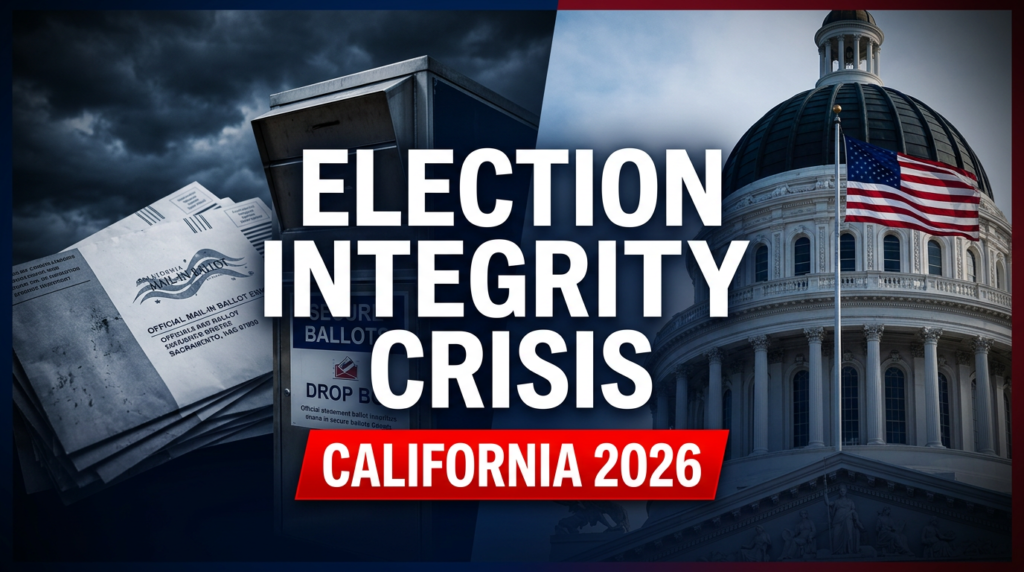
As mail-in ballots flood California homes ahead of the June 2 gubernatorial primary, a perfect storm of legal battles, seized ballots, and a growing trust deficit is raising urgent questions about whether the state’s election system can withstand the scrutiny it now faces.
California didn’t wait for Election Day to start making headlines. With the June 2, 2026, primary now less than a month away, the state’s Secretary of State has confirmed that county election officials have already begun mailing ballots to every active registered voter in the state. In a race this consequential — an open governor’s seat, U.S. House control hanging in the balance, and a deeply divided electorate — how those ballots are handled, verified, and counted matters enormously.
What’s unfolding right now is not a conspiracy theory or a partisan talking point. It is a documented, multi-front crisis that should concern every Californian who believes their vote should count — and only their vote.
Support Independent Local Journalism
TheTownHall.News is a non-profit reader-supported journalism. Just $5 helps us hire local reporters, investigate important issues, and hold public officials accountable across Alameda County. If you believe our community deserves strong, independent journalism, please consider donating $5 today to support our work.The Riverside County Bombshell That Changed Everything
No story better captures the fragile state of California election integrity than what happened in Riverside County. In a stunning move, Riverside County Sheriff Chad Bianco — himself a Republican candidate for governor — ordered the seizure of more than 650,000 ballots from the November 2025 election from the county’s own registrar of voters, citing allegations of fraud.
The move drew immediate legal and political firestorm. Critics called it constitutionally dubious and procedurally alarming. Even some election security advocates who share concerns about ballot integrity questioned the method. But the underlying message — that confidence in California’s ballot chain of custody has broken down badly enough for a sitting county sheriff to take such extraordinary action — cannot simply be dismissed.
Whatever one thinks of Bianco’s tactics, the episode exposed a fundamental truth: when the system fails to earn trust through transparency and rigorous verification, it invites exactly this kind of disruption.
A System Built on Self-Attestation, Not Verification
California’s vote-by-mail infrastructure is vast, ambitious, and largely built on the honor system. Voter registration forms require applicants to attest they are U.S. citizens — under penalty of perjury — but no documentary proof of citizenship is required. No photo ID is needed at the polls. And under current California law, local jurisdictions are severely limited in their ability to implement additional safeguards.

The result is a system that prizes accessibility above verifiability. That is a defensible philosophical choice. But it is not a costless one.
A new survey from the UC Berkeley Institute of Governmental Studies puts a number on the trust deficit it has created. More than two-thirds of California Republicans say they are “not at all satisfied” with the way democracy functions in the state. Just 10% of Democrats feel the same way. That is not a minor gap in perception. It is a chasm — and it does not close itself.
As Kim Alexander, president of the nonpartisan California Voter Foundation, put it plainly at an April election integrity panel: “Election security is about security in reality and also security in perception, and they’re both equally important.”
The Voter ID Debate Reaches a Tipping Point
Republican Assemblymember Carl DeMaio of San Diego has placed a proposed ballot initiative before California voters that would require photo identification to vote — bringing the state in line with a growing number of states that have adopted similar measures.
Initial polling suggests the idea has broader appeal than partisans on either side acknowledge. A UC Berkeley poll found that 56% of survey respondents initially supported the measure when asked without political framing. That majority flipped when respondents were given explicit partisan context from both sides — a finding that illustrates how thoroughly California voters’ views on election reform are now filtered through party loyalty rather than policy substance.
Support Independent Local Journalism
TheTownHall.News is a non-profit reader-supported journalism. Just $5 helps us hire local reporters, investigate important issues, and hold public officials accountable across Alameda County. If you believe our community deserves strong, independent journalism, please consider donating $5 today to support our work.The substantive case for voter ID is not complicated. Every American who boards a plane, opens a bank account, or picks up a prescription must show identification. The argument that requiring the same basic step to vote is uniquely burdensome has always been a stretch. Dozens of democracies worldwide — including Canada, France, Germany, and the United Kingdom — require voters to present identification. They are not considered voter suppression states.
The question is not whether verification matters. The question is why California has decided it doesn’t.
The Supreme Court, Trump’s Order, and a Legal Battle California Can’t Ignore
California’s election infrastructure is simultaneously under pressure from two directions at the federal level.
The U.S. Supreme Court is actively examining the constitutionality of counting mail-in ballots that arrive after Election Day — a practice California has long permitted. A ruling against late-ballot counting could significantly affect how the June 2 results are tabulated, and potentially reshape future elections across the state.
Separately, President Trump signed an executive order aimed at tightening mail-in voting standards nationally. California Attorney General Rob Bonta responded by joining a coalition of 23 state attorneys general in federal court to block the order. The legal fight is ongoing.
Californians can reasonably disagree on the merits of the federal order. But the reflexive rush to preserve every aspect of a system that even its defenders acknowledge is slow, opaque, and increasingly distrusted deserves more scrutiny than it is getting from Sacramento.
The Slow Count Problem Is Not a Minor Inconvenience
California is legendarily slow at counting votes. Under state law, counties have up to 30 days after an election to certify and submit results to the Secretary of State. In competitive federal races, that timeline leaves weeks of uncertainty — and weeks of opportunity for speculation, litigation, and manufactured doubt to take hold.
A CalMatters analysis published in April made the point with unusual candor: California’s slow count is actively fueling mistrust, particularly among Republican voters. Election officials are forcing themselves into a false choice, the analysis argued — treating speed and accuracy as trade-offs when both are, in fact, requirements of a functioning democracy.
When winners aren’t decided for days or weeks, the uncertainty doesn’t just frustrate voters — it becomes a recruiting tool for those who would delegitimize the entire process.
The fix does not require abandoning accuracy. It requires investing in the infrastructure, staffing, and procedures that allow ballots to be verified and counted faster — starting with encouraging voters to return mail ballots early so counties can process them before Election Day.
What Critics Get Wrong About Election Reform
Opponents of voter ID laws and stricter mail-in ballot protocols argue, consistently, that election fraud is rare and that reform efforts are really voter suppression in disguise.
There is legitimate evidence that documented in-person voter fraud is uncommon. That point deserves acknowledgment. But it does not settle the broader debate.
First, the rarity of detected fraud is not the same as the rarity of actual fraud — particularly in a system with limited verification. Second, the argument that any friction in voting constitutes suppression proves too much. Virtually every legitimate security measure involves some friction. Third, and most importantly, public confidence in elections is itself a democratic value. A system that is technically secure but widely distrusted has failed at its core mission.
The goal is not to make voting harder. The goal is to make the result undeniable.
California Voters Deserve Better Than This
The June 2 primary will produce results. Ballots will be counted, candidates will advance, and California will move toward a November election that could reshape the state’s political future. But the process by which those results are reached — and how much of the electorate trusts them — is now a legitimate and urgent public question.
Election integrity is not a fringe issue. It is a foundational one. A democracy that cannot produce results its citizens believe in is not functioning as designed, regardless of what any court certifies.
The conversation California needs to have — about voter verification, about counting speed, about chain-of-custody standards for mail ballots — is not happening at the pace or depth the moment demands. It needs to.
The right to vote is meaningless if the vote itself is meaningless. California voters deserve a system they can trust — and right now, they don’t have one.
Key Takeaway
California’s June 2 primary is arriving against a backdrop of seized ballots, federal legal battles, a Supreme Court challenge, and a historic partisan trust gap. Election reform — including voter ID, faster counting, and stronger mail-in safeguards — is not suppression. It is the minimum standard a functioning democracy owes its citizens.
Stay informed. Share this article. And make your voice heard on June 2.
Independent journalism depends on readers like you. If this reporting matters to you, share it with someone who needs to read it.