$166 Billion Tariff Refund: What the Supreme Court Ruling Really Costs American Taxpayers
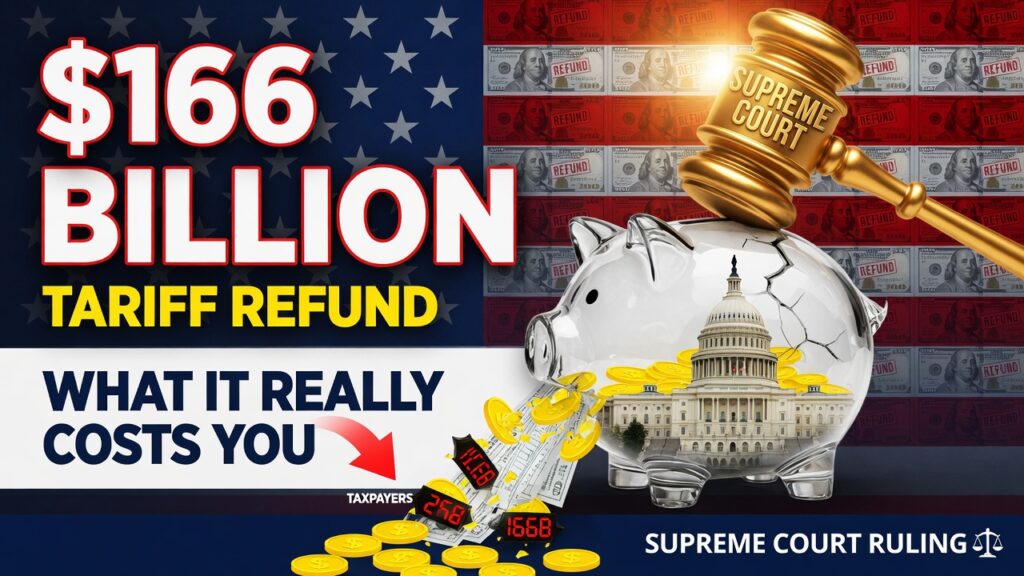
The federal government is now writing refund checks for over $166 billion in tariffs it was never legally authorized to collect — and American businesses and taxpayers are still picking up the tab.
When the Supreme Court struck down President Trump’s most sweeping tariffs in February 2026, the headlines focused on the legal victory. But buried beneath the constitutional drama is a fiscal reality that every taxpayer — regardless of party — should be paying close attention to: the U.S. Treasury is now on the hook for one of the largest government refund operations in modern American history.
This is not a partisan talking point. It is a direct consequence of what happens when executive power is stretched beyond its constitutional limits, and when Congress fails to hold the line on who gets to control the nation’s fiscal levers. The bill, as always, comes due eventually. And this time, it comes due all at once.
Support Independent Local Journalism
TheTownHall.News is a non-profit reader-supported journalism. Just $5 helps us hire local reporters, investigate important issues, and hold public officials accountable across Alameda County. If you believe our community deserves strong, independent journalism, please consider donating $5 today to support our work.What the Supreme Court Actually Ruled — and What It Didn’t
In February 2026, the Supreme Court ruled 6–3 that the Trump administration had overstepped its authority by imposing sweeping tariffs under the International Emergency Economic Powers Act, known as IEEPA. The decision was clear: those tariffs were unconstitutional.
What the Court did not do, however, was order an automatic refund. In a notable dissent, Justice Brett Kavanaugh flagged the practical earthquake the ruling would trigger, writing that “refunds of billions of dollars would have significant consequences for the U.S. Treasury” and that the Court had said nothing about “whether, and if so how, the Government should go about returning the billions of dollars it has collected.”
That ambiguity matters. It left the refund process to the executive branch — the very branch responsible for collecting those funds in the first place.
How $166 Billion Disappears From the Treasury
Two months after the ruling, U.S. Customs and Border Protection launched an online portal allowing American importers to apply for reimbursement. The total liability: approximately $166 billion, plus interest, according to estimates cited by both CNN and the Tax Foundation.

CBP has indicated refunds will be processed within 60 to 90 days of approval — though complex cases may take considerably longer. That means hundreds of thousands of businesses, from manufacturers to small retailers, are now filing paperwork to recover costs they should never have been forced to pay.
The scale is almost difficult to absorb. According to Penn Wharton budget modeling, more than $175 billion in IEEPA-related tariff revenue had been collected since Trump’s tariff program began in 2025. Tariff receipts surged to $30 billion in January 2026 alone — a 304% increase over the same period the year before.
That revenue was real. It reduced borrowing. It was counted in the budget. Now it must be returned — and the Treasury will need to fill the gap.
The Fiscal Reality No One Wants to Say Out Loud
Here is the uncomfortable truth: when government spends money it doesn’t legally have, someone always pays — and it is never the government.
The refund process will force the Treasury to increase borrowing to cover the $166 billion outflow. That means more debt. More interest payments. More pressure on a federal balance sheet already strained by decade-high deficits. The Committee for a Responsible Federal Budget has estimated Trump’s tariffs raised roughly $300 billion per year — but potential dividend refunds alone could cost double that in a single round.
Support Independent Local Journalism
TheTownHall.News is a non-profit reader-supported journalism. Just $5 helps us hire local reporters, investigate important issues, and hold public officials accountable across Alameda County. If you believe our community deserves strong, independent journalism, please consider donating $5 today to support our work.Meanwhile, the administration has not walked away from tariffs entirely. Following the Supreme Court ruling, a new 10% tariff was imposed under Section 122 of the Trade Act of 1974 — a different legal authority that permits tariffs of up to 15% for 150 days. U.S. Trade Representative Jamieson Greer also placed new Section 301 tariffs under consideration, targeting what the administration describes as “discriminatory” foreign trade practices.
In other words: the tariff strategy continues. Only the legal vehicle has changed.
What Critics Get Wrong — and What They Get Right
Supporters of the original tariffs argue they were necessary to protect American industry, reduce trade deficits, and bring manufacturing back to the United States. That is a legitimate policy debate worth having, and the economic case for strategic trade protection has serious intellectual defenders.
But the core problem was never the policy goal. It was the method. Using an emergency economic powers law to impose a permanent, sweeping tariff regime — without congressional authorization — is precisely the kind of executive overreach that the Founders designed the courts to check. The Supreme Court agreed.
Critics on the left who now celebrate the ruling, however, should take note: the same legal principle that limits presidential tariff authority also limits executive action on issues they may support. Expanding presidential power is a bipartisan temptation. Constraining it requires bipartisan discipline.
The real winners here are not Democrats or Republicans. They are the American businesses that were forced to pay billions in tariffs that no court — and no Congress — had formally authorized. A small business importing bicycle components reported net losses exceeding $200,000 in 2025 due to tariff costs. Multiply that story by hundreds of thousands of companies and the human cost becomes undeniable.
Congress Was Asleep at the Wheel — Again
There is another dimension to this story that deserves far more attention than it is receiving: Congress’s near-total abdication of its constitutional role on trade.
The Constitution grants Congress — not the president — the power to regulate commerce with foreign nations and to lay and collect duties. Over decades, Congress gradually delegated that authority to the executive branch through legislation like IEEPA. The Supreme Court’s ruling is, in part, a signal that those delegations have limits.
Proposed legislation, including the RELIEF Act introduced in the House, would require CBP to automatically refund all IEEPA tariffs collected since January 2025 — eliminating the need for individual business applications. Whether that bill advances is uncertain. But its very existence highlights how Congress is now scrambling to manage the consequences of powers it should never have ceded.
Fiscal accountability begins with institutional accountability. If Congress wants to control how tariff revenue is collected and spent, it must reclaim the authority it has spent decades giving away.
Key Takeaway
The $166 billion tariff refund is not just a legal story. It is a lesson in the cost of unchecked executive power, fiscal recklessness, and a Congress that prefers to let presidents lead — until they lead somewhere unpopular. American businesses paid the price in real time. The Treasury will pay the price in borrowed money. And American taxpayers will pay the price in interest for years to come.
The rule of law is not a partisan convenience. It is the foundation on which every dollar of government revenue must stand.
What You Can Do Right Now
This story is bigger than tariffs. It is about who controls your money, who authorizes the government to take it, and what happens when no one is minding the constitutional guardrails.
Stay informed. Share this article with friends and family who care about fiscal responsibility and limited government. Contact your congressional representative and ask what they are doing to reclaim Congress’s constitutional role on trade authority. And support independent journalism that follows the money — not the narrative.
Democracy requires an informed citizenry. That starts with you.