Trump Rejects Iran War Proposal as “Totally Unacceptable” — What’s Really at Stake
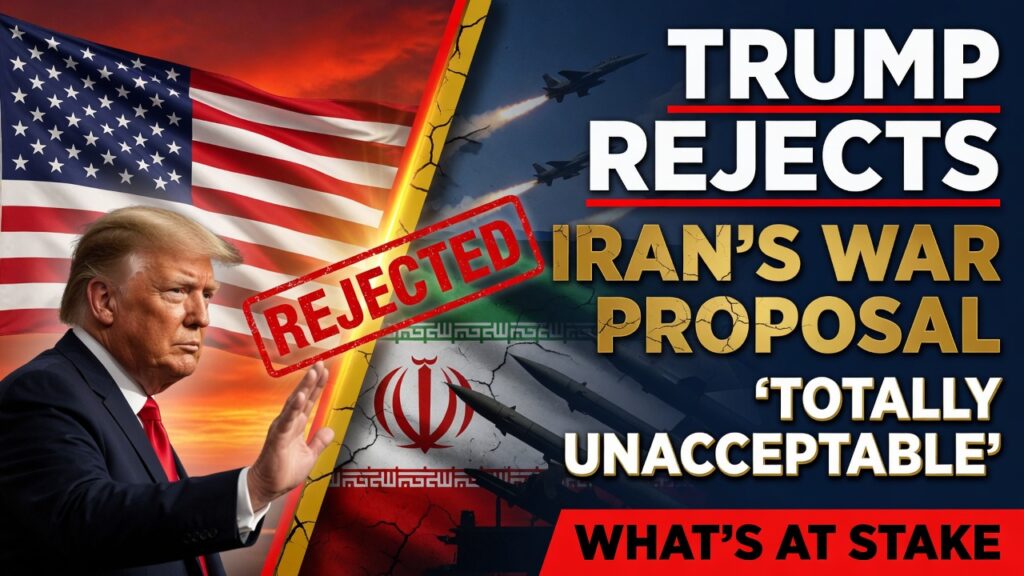
Tehran’s counter-proposal dodged the nuclear question entirely, demanded sanctions relief up front, and claimed sovereignty over one of the world’s most critical waterways. President Trump didn’t flinch — and for good reason.
The message was blunt, characteristically Trump, and strategically sound: “I have just read the response from Iran’s so-called ‘Representatives.’ I don’t like it — TOTALLY UNACCEPTABLE!”
Posted Sunday on Truth Social, those words landed hours after Tehran submitted its counter-proposal to the latest U.S. plan to end a war now in its tenth week — a war that has blockaded the Strait of Hormuz, sent global oil prices soaring nearly 45%, and rattled energy markets from London to Singapore. Whatever one thinks of the style, the substance behind Trump’s rejection deserves serious attention. Because Iran’s proposal was not a good-faith path to peace. It was a demand list dressed up as diplomacy.
Support Independent Local Journalism
TheTownHall.News is a non-profit reader-supported journalism. Just $5 helps us hire local reporters, investigate important issues, and hold public officials accountable across Alameda County. If you believe our community deserves strong, independent journalism, please consider donating $5 today to support our work.What Iran Actually Proposed — And What It Conspicuously Left Out
Iran’s counter-proposal, transmitted through Pakistani mediators and reported by multiple state media outlets, included a sweeping set of preconditions: an immediate end to the U.S. naval blockade upon signing any initial agreement, the lifting of all U.S. sanctions on Iranian oil sales during a 30-day negotiating window, the release of frozen Iranian assets, and — most remarkably — formal recognition of Tehran’s sovereignty over the Strait of Hormuz, the narrow chokepoint through which roughly one-fifth of the world’s oil and natural gas supply ordinarily flows.
What the proposal did not include is equally telling: any mention of Iran’s nuclear program. Not a word.
This is not an oversight. Since the war began on February 28 — launched with joint U.S.-Israeli strikes targeting Iranian military, government, and infrastructure sites — the United States has consistently identified Iran’s nuclear ambitions as a central justification for military action. Trump’s team drew what U.S. Ambassador to the United Nations Mike Waltz called a “very clear red line” in its latest proposal. Tehran’s response crossed it by pretending it didn’t exist.
The Strait of Hormuz: Why Iran’s Sovereignty Claim Is a Non-Starter
Tehran’s demand for recognized sovereignty over the Strait of Hormuz is perhaps the most revealing element of its counter-proposal — and the most dangerous concession any U.S. administration could make.

The Strait is not merely an Iranian waterway. It is a global artery. Under international maritime law, the Strait of Hormuz is subject to the right of transit passage, meaning all nations’ vessels — military and civilian alike — are entitled to navigate it freely. Granting Iran the kind of sovereignty Tehran is demanding would effectively hand a hostile regime a permanent veto over global energy flows.
Since Iran closed the Strait at the war’s outset, approximately 10 to 12 million barrels of crude oil per day have been choked off from global markets, according to analysts. Brent crude is trading near $104 per barrel as of this writing — roughly $20 higher than before the conflict began, and U.S. crude is approximately $10 more expensive. American families are feeling this at the pump. Granting the demand that caused this crisis as a condition of ending it would reward aggression with legitimacy. That is not a deal. That is a capitulation.
A nation that closes an international waterway to coerce the world does not deserve sovereignty over it.
Why This Negotiation Is a Test of American Credibility
There is a broader principle at stake that transcends this specific conflict, and it is one Americans who value strength, deterrence, and the rule of law should understand clearly.
For decades, U.S. foreign policy has alternated between muscular deterrence and accommodationist gestures that adversaries have routinely exploited. The 2015 nuclear deal — negotiated under the Obama administration — released billions in frozen assets to Tehran, provided substantial sanctions relief, and in return secured only temporary, reversible limits on Iran’s nuclear program. Iran used that economic breathing room to expand its proxy network across Lebanon, Yemen, Iraq, and Syria.
Support Independent Local Journalism
TheTownHall.News is a non-profit reader-supported journalism. Just $5 helps us hire local reporters, investigate important issues, and hold public officials accountable across Alameda County. If you believe our community deserves strong, independent journalism, please consider donating $5 today to support our work.The Trump administration’s position now is simple: Iran must address its nuclear program, reduce its missile capabilities, and end support for regional proxies. These are not unreasonable demands. They are the foundational conditions for a durable peace — not just for the United States, but for every nation that depends on stable energy markets and a rules-based international order.
Trump himself acknowledged the difficulty plainly in a recent interview: “They make a deal and then they break it. Then they make a deal, they break it. It’s a difficult group.” That is a candid assessment of a negotiating partner with a documented track record of non-compliance. Recognizing that reality is not hawkishness. It is clarity.
What Critics Get Wrong About Diplomatic Pressure
Critics of the administration’s hard line will argue that rejecting Iran’s counter-proposal risks escalation — that diplomacy requires compromise, and that walking away from the table is reckless.
It is a fair concern, and one worth engaging honestly. No reasonable person wants a prolonged military conflict in the Middle East. The economic consequences alone — elevated fuel prices, disrupted shipping lanes, strained allied relationships — are significant and real.
But there is a critical distinction between principled negotiation and appeasement. Accepting Iran’s proposal as submitted — lifting sanctions before any nuclear concessions, handing over frozen assets at signing, and recognizing Iranian control of the Strait — would not end the threat. It would finance it. History offers an uncomfortable lesson here: rewarding a regime for defiance does not moderate its behavior. It validates the strategy.
Qatar, Saudi Arabia, Egypt, and Pakistan are all engaged in active diplomatic outreach, suggesting that regional partners understand the urgency of a negotiated resolution. That diplomatic infrastructure remains intact. The door to talks is not closed. What Trump has refused is a bad deal — and refusing a bad deal is not the same as refusing peace.
The Economic Pressure Is Working — Don’t Abandon It Now
One underreported dimension of this standoff is the degree to which the U.S. blockade is imposing genuine economic pain on Iran’s leadership. With Iranian-flagged vessels being redirected — U.S. Central Command confirmed 61 such vessels as of Sunday — and Iranian ports cut off from global trade, the regime faces compounding fiscal pressure.
The U.S. military, meanwhile, has significantly degraded Iran’s military infrastructure. Trump noted that Iran’s nuclear capabilities have been severely weakened, adding that it would take Iran “20 years to rebuild” from a military standpoint if the U.S. were to disengage today.
That is leverage. Walking it back in exchange for a proposal that sidesteps the nuclear question would squander the most significant strategic position the U.S. has held over Iran in decades. From the perspective of fiscal accountability — ensuring that American military investment produces tangible, lasting security outcomes — abandoning that leverage now would be a costly mistake.
Key Takeaway
Iran’s counter-proposal was not a compromise. It was a maximalist opening bid designed to extract economic relief while avoiding the central issue the United States went to war over: Tehran’s nuclear program. President Trump was right to reject it. The question now is whether Iran’s leadership is willing to negotiate in good faith — or whether the ceasefire remains a tactical pause while the regime recalibrates.
The Strait of Hormuz will not reopen, oil prices will not normalize, and American families will not stop paying elevated fuel costs until a deal addresses the root causes of this conflict — not just its symptoms.
What Happens Next
Regional diplomacy continues. Qatar’s Prime Minister Mohammed Al-Thani has held calls with the foreign ministers of Saudi Arabia, Egypt, and Iran, and met personally with Vice President Vance, Secretary of State Marco Rubio, and Trump’s envoy Steve Witkoff in Washington last Friday. Pakistan, which served as the channel for Iran’s counter-proposal, remains an active mediator.
The ceasefire, though fragile, has largely held since it was agreed last month — despite a shadow drone war continuing in the background, with incidents involving vessels near Kuwait and the United Arab Emirates. There is still a path to a deal. But it runs through Tehran’s willingness to put its nuclear program on the table — not around it.
President Trump has made clear he is willing to negotiate. He has also made clear he will not accept a deal that leaves the core threat unresolved. That is not intransigence. That is leadership.
Stay informed on this rapidly developing story. If you found this analysis valuable, share it with someone who cares about American foreign policy, energy security, and the cost of getting diplomacy right. Independent, fact-based reporting depends on engaged readers — bookmark this page and follow our coverage as negotiations continue.