Hantavirus Cruise Ship Outbreak: Who’s Accountable for 3 Deaths and the Taxpayer Evacuation Bill?
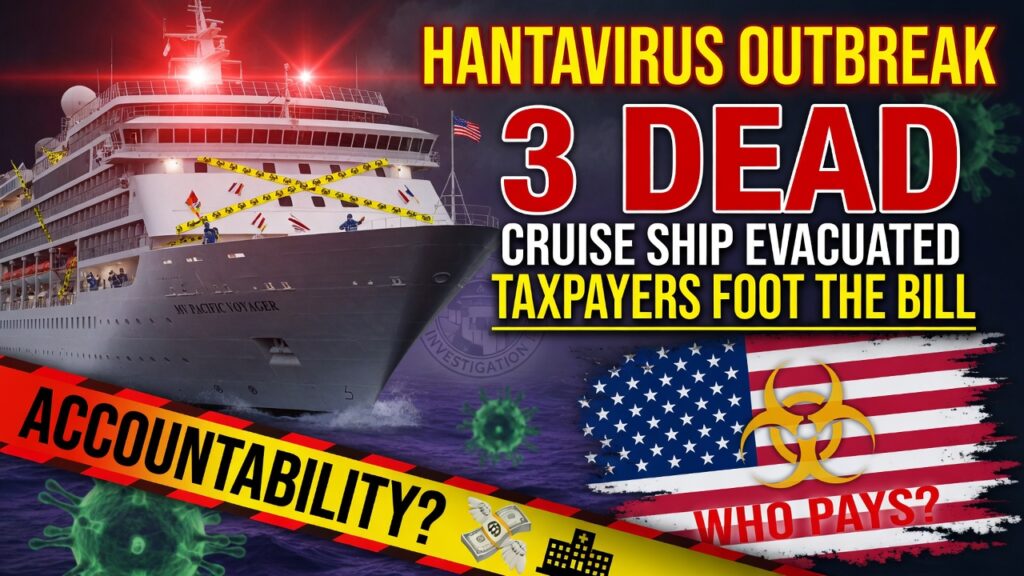
When a $20,000-a-berth cruise ship becomes a floating biohazard zone and American taxpayers are left footing the emergency evacuation bill, it’s time to ask hard questions about who is responsible — and who is being honest with the public.
The images are striking: passengers in blue hazmat suits boarding small boats off the coast of Tenerife, Spain, ferried ashore from a ship that had become one of the most alarming public health stories of 2026. The MV Hondius, a Dutch expedition cruise vessel operated by Oceanwide Expeditions, departed Ushuaia, Argentina on April 1 carrying roughly 150 passengers and crew. By the time it docked in the Canary Islands on May 10, three people were dead, at least eight were confirmed infected with the Andes strain of hantavirus, and governments across the globe were scrambling to manage a situation that should never have reached this scale.
A Santa Clara County, California resident who was aboard the ship is now under monitoring by the California Department of Public Health and the Centers for Disease Control and Prevention. The Santa Clara Public Health Department has stated there is no known risk to the general public. That may be reassuring — but the broader story demands more than reassurance. It demands accountability.
Support Independent Local Journalism
TheTownHall.News is a non-profit reader-supported journalism. Just $5 helps us hire local reporters, investigate important issues, and hold public officials accountable across Alameda County. If you believe our community deserves strong, independent journalism, please consider donating $5 today to support our work.A Rare and Deadly Virus — and a Slow Response That Cost Lives
Hantavirus is not a new threat. The Andes strain, confirmed as the cause of this outbreak, is particularly alarming because it is the only known hantavirus capable of spreading directly between humans — a rare but documented trait that makes containment far more complex than typical rodent-to-human transmission events. The virus typically begins with flu-like symptoms: fever, muscle aches, fatigue. It can then progress rapidly to severe respiratory failure. There is no cure. Doctors can only provide supportive care — oxygen, hydration, ventilators. The Andes virus kills in roughly 40% of confirmed cases.
The first passenger died on April 11, ten days into the voyage. His wife, who went ashore at the island of Saint Helena on April 24 with gastrointestinal symptoms, died in a Johannesburg hospital two days later. A third passenger died on board. The World Health Organization was not formally notified until May 2 — weeks after the first death. By the time the WHO confirmed the outbreak on May 4, the ship had already been at sea for over a month, and passengers who had disembarked in late April had scattered to their home countries.
That delay is a problem. And it is precisely the kind of institutional failure that should command far more public scrutiny than it has received.
Who Pays When a Cruise Line’s Crisis Becomes a Government Emergency?
Here is a fact that deserves emphasis: berths on the MV Hondius for this voyage were priced between €14,000 and €22,000 per person. This was not a budget holiday. Oceanwide Expeditions is a private commercial enterprise that collected premium prices from customers for an Antarctic expedition. Those customers contracted with a private company, not a government.

And yet, when the crisis became unmanageable, it was governments — and by extension, taxpayers — who mobilized. The CDC deployed multiple teams of epidemiologists and medical professionals to the Canary Islands. The U.S. Department of State led diplomatic coordination across multiple countries. Seventeen American passengers are being transported to Offutt Air Force Base in Nebraska before transfer to the National Quarantine Unit at the University of Nebraska Medical Center — a federally funded facility built and maintained at public expense.
The question of financial accountability is entirely legitimate: what obligation does Oceanwide Expeditions bear for the cost of this response? If a private business creates conditions — or fails to prevent conditions — that trigger a multinational government emergency, the assumption that public funds simply absorb the cost deserves challenge. Passengers and their families deserve to know what legal recourse they have. Taxpayers deserve to know what the bill is.
The Canary Islands Were Right to Ask Hard Questions
When the ship needed to dock somewhere for evacuation, the president of the Canary Islands, Fernando Clavijo, initially refused entry. He cited concern for his residents — people who, like many communities across Southern Europe, still carry vivid memories of the COVID-19 pandemic and the institutional failures that accompanied it.
He was criticized for it. The cruise company’s statement that “Spain has a moral and legal obligation to assist these people” was widely amplified. Spain’s national government overruled the regional president and approved the docking.
But Clavijo’s instinct — to ask hard questions before opening his region’s ports to a vessel carrying a potentially transmissible hemorrhagic virus — was not unreasonable. It reflects exactly the kind of local accountability and community-first thinking that centralized bureaucracies tend to dismiss. Communities have the right to weigh risks to their own people. That is not xenophobia. That is governance.
Support Independent Local Journalism
TheTownHall.News is a non-profit reader-supported journalism. Just $5 helps us hire local reporters, investigate important issues, and hold public officials accountable across Alameda County. If you believe our community deserves strong, independent journalism, please consider donating $5 today to support our work.Local leaders who ask hard questions before accepting risks onto their communities are not obstructionists. They are doing their jobs.
Spain ultimately managed the disembarkation carefully, and the May 10 operation — 94 passengers of 19 nationalities disembarked on the first day — was described by Spain’s Health Minister as going “according to plan.” But one French passenger showed symptoms during the evacuation flight home, triggering isolation protocols for the entire flight. The situation remains fluid.
What Critics Get Wrong About Public Health and Individual Responsibility
Some commentators have suggested this outbreak is a reason to expand standing international health surveillance authority — essentially, to give bodies like the WHO more power to intervene in private commercial travel. That argument moves in the wrong direction.
The failure here was not a lack of WHO authority. It was a failure of basic reporting and transparency at the point of origin. The index case — a Dutch citizen who spent four months traveling through Chile, Uruguay, and Argentina before boarding — brought the virus with him. Argentina’s health ministry, to its credit, published a detailed timeline of his movements after the fact. But that kind of epidemiological transparency should have been activated far earlier, and more urgently, once the first death occurred on April 11.
The solution is not more centralized international power. It is stronger accountability at every level of the chain: cruise operators who must have clear outbreak protocols and legal obligations to report, governments that must enforce those obligations, and travelers who must take seriously their responsibility to monitor their own health — and disclose relevant exposures — when re-entering their home countries.
The Santa Clara County resident now being monitored is, by all accounts, cooperating with health authorities. That is exactly what personal responsibility looks like in practice. It works. It does not require a new bureaucracy.
What Families and Communities Should Know Right Now
The CDC has confirmed that the risk to the American public remains extremely low. The Andes virus does not spread casually. Transmission requires prolonged, close contact with an infected individual. This is not airborne in the conventional sense.
That said, because the virus has an incubation period of one to eight weeks, additional cases among those who were aboard the ship — or in close contact with passengers who disembarked before the outbreak was declared — may still emerge. Health officials around the world are actively monitoring. The CDC has provided guidance to state and local health departments, and passengers have been given individualized risk assessments.
Parents and families with loved ones who traveled aboard the Hondius, or who may have had contact with passengers at any point during the voyage, should consult their local or state health department for current guidance. Do not wait for symptoms. Report your travel history proactively.
The best public health system in the world is one in which informed citizens act responsibly before they are told to.
The Takeaway: Accountability Before Bureaucracy
Three people are dead. Families have been shattered by a preventable — or at minimum, manageable — outbreak that spiraled because of delayed reporting, inadequate onboard medical capacity, and a cascade of institutional decisions that prioritized optics over urgency.
The MV Hondius story is not finished. As the repatriated passengers disperse to their home countries and the incubation window plays out over the coming weeks, public health officials will be watching closely. So should the public — and so should elected representatives who have the power to demand answers from both the private entities and government agencies involved.
Accountability, transparency, and personal responsibility are not abstract values. In a crisis like this, they are the difference between a contained incident and a global emergency.
Stay informed. Share this story. And when your government spends your money managing a private company’s crisis, ask why — and demand an answer.
If you found this reporting valuable, share it with your network and subscribe to stay ahead of the stories that matter. Independent journalism depends on engaged readers.