Alabama Redistricting 2026: Supreme Court’s 6-3 Ruling Restores Legislative Authority Over Congressional Maps
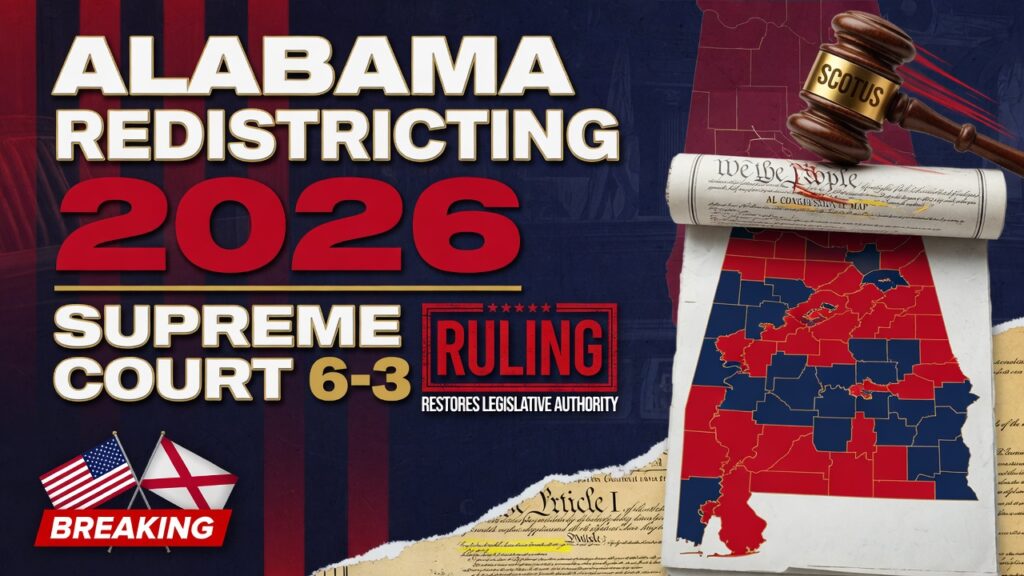
The Supreme Court’s 6-3 decision clears the way for Alabama to redraw its congressional map ahead of the 2026 midterms. Here’s why this ruling is a victory for the rule of law — and why the backlash from the left misses the point entirely.
In a nation built on the principle that elected representatives — not unelected courts — draw the lines of governance, Monday’s Supreme Court ruling on Alabama’s congressional maps lands like a thunderclap. On May 11, 2026, the Court’s conservative majority voted 6-3 to vacate lower court rulings that had blocked Alabama from using a Republican-drawn congressional map. The state can now move forward with redistricting ahead of the November midterm elections.
This is not a story about suppression. It is a story about the restoration of constitutional order — and the left’s desperate attempt to use the courts to engineer electoral outcomes they cannot achieve at the ballot box.
Support Independent Local Journalism
TheTownHall.News is a non-profit reader-supported journalism. Just $5 helps us hire local reporters, investigate important issues, and hold public officials accountable across Alameda County. If you believe our community deserves strong, independent journalism, please consider donating $5 today to support our work.Why This Ruling Matters Beyond Alabama
The Alabama redistricting saga has been grinding through the federal court system for the better part of five years. At its core, the dispute centers on how many majority-Black congressional districts the state must draw — and who gets to make that call.
Under a remedial map imposed by a three-judge district court panel, Alabama was required to maintain two majority-Black districts out of seven total. That map was used in the 2024 elections and produced a congressional delegation of five Republicans and two Democrats. Alabama’s Republican-controlled legislature, however, had drawn a 2023 map with one majority-Black district — and consistently fought to use it.
What changed the equation entirely was the Supreme Court’s April 29, 2026, ruling in a Louisiana redistricting case that significantly curtailed the scope of Section 2 of the Voting Rights Act of 1965. That ruling made it substantially harder to challenge maps on the basis of racially discriminatory effect alone. Armed with that precedent, Alabama moved quickly. The Supreme Court agreed — sending the lower court cases back for reconsideration in light of the new legal standard.
The message from the Court’s majority is clear: the era of courts substituting their judgment for that of elected legislators is coming to an end.

What Critics Get Wrong About Voting Rights
Critics of the ruling have reached for the most incendiary language available. Democratic Rep. Shomari Figures, who holds one of Alabama’s two majority-Black districts, declared the decision “sets the stage for Alabama to go back to the 1950s and 60s in terms of Black political representation.” NAACP President Derrick Johnson went further, calling it “a return to Jim Crow.”
These comparisons are not only historically irresponsible — they obscure the actual legal question at hand.
The Voting Rights Act of 1965 was a landmark achievement designed to end the systematic, state-enforced disenfranchisement of Black Americans. Nobody is arguing that era should return. The question before the Court was narrower and more technical: does Section 2 of that law require states to draw majority-minority districts based on race, even when doing so creates maps that are themselves racially motivated?
The Court’s answer, consistent across both the Louisiana and Alabama rulings, is that racial gerrymandering — even when dressed up as minority protection — carries its own constitutional problems. Drawing a district primarily on the basis of race is not automatically virtuous just because the beneficiary is a minority community. That principle cuts both ways, and it is one that civil rights law has long recognized.
The Real Cost of Judicial Overreach
For years, federal courts have operated as a backstop for Democrats seeking to preserve electoral maps that couldn’t survive the democratic process. Alabama is a conservative state. Its legislature is Republican. Its voters have consistently elected Republican majorities.
Support Independent Local Journalism
TheTownHall.News is a non-profit reader-supported journalism. Just $5 helps us hire local reporters, investigate important issues, and hold public officials accountable across Alameda County. If you believe our community deserves strong, independent journalism, please consider donating $5 today to support our work.Yet through a succession of legal challenges, the state was forced — by a court-appointed panel, not its own elected representatives — to use congressional boundaries that its legislature had explicitly rejected. That is not democracy. That is rule by judicial committee.
Alabama Gov. Kay Ivey recognized the stakes. Before the Supreme Court had even ruled, she signed legislation allowing for new U.S. House primaries in districts whose boundaries might change — a responsible, forward-looking move that kept the state’s democratic machinery operational. That is exactly the kind of proactive governance voters expect from their elected officials.
When courts draw the maps and legislatures are sidelined, accountability disappears. Monday’s ruling puts it back where it belongs.
A Broader Redistricting War With National Implications
Alabama is not an isolated case. It is a front in a nationwide battle over congressional maps — one with direct implications for control of the U.S. House in November.
Republican governors in Tennessee and Alabama have both announced special legislative sessions to redraw congressional maps in the wake of the Supreme Court’s Voting Rights Act ruling. In South Carolina, several gubernatorial candidates have called on the Republican-controlled legislature to revisit its map. Virginia is tangled in its own redistricting litigation.
According to prediction markets tracked during the May 11 news cycle, Democratic odds of retaking the House have dropped measurably since the redistricting wave began. Democrats currently hold a strong tailwind heading into the midterms — but the structural advantages they had built through court-ordered maps are eroding.
Republicans, meanwhile, have surged ahead in states like Texas and Florida, where their own maps have withstood legal scrutiny. The playing field is leveling, and Democrats — accustomed to winning redistricting battles in the courts — are scrambling to adapt.
Acknowledging the Counterargument — and Why It Falls Short
Opponents of the ruling make one argument that deserves a fair hearing: that without court enforcement of minority representation, states with histories of racial discrimination will simply revert to marginalizing Black voters.
It is a serious concern, and it should not be dismissed outright. Alabama does have a documented history of voter suppression. The Voting Rights Act was a necessary and constitutional response to that history.
But the appropriate remedy for past discrimination cannot be the permanent entrenchment of race-based mapping enforced by unelected judges. The Supreme Court has now made clear that intentional discrimination remains illegal and actionable — the standard has been raised, not eliminated. Civil rights plaintiffs can still challenge maps that are deliberately designed to disenfranchise voters. What they can no longer do is demand race-conscious districts based on statistical disparities alone, without proving discriminatory intent.
That is not a rollback of civil rights. It is an application of equal protection principles that apply to every American, regardless of race.
What Comes Next for Alabama
With the Supreme Court’s green light secured, Alabama’s Republican-led legislature is now positioned to finalize a new congressional map. Attorney General Steve Marshall has been unambiguous about the goal: a map that reflects the state’s political composition and withstands constitutional scrutiny.
The state’s primary elections, originally scheduled for May 19, have been pushed back to accommodate the new map. The Alabama Legislature has already held a special session passing legislation to allow for revised U.S. House primaries — a move Gov. Ivey signed into law in anticipation of exactly this outcome.
Whatever map ultimately emerges will face scrutiny. Intentional racial discrimination remains prohibited, and civil rights groups will be watching closely. But the power to make that initial determination now rests where the Constitution intended: with Alabama’s elected representatives, accountable to the people of that state.
The Rule of Law Won on Monday
The Supreme Court did not hand Republicans a political gift on May 11. It handed the American system of self-governance a necessary correction.
For too long, congressional maps in states across the South have been drawn or redrawn by courts operating under an expansive — and now constitutionally questionable — reading of the Voting Rights Act. The result was a form of judicial democracy: electoral outcomes shaped not by voters, but by litigation.
That era appears to be closing. Whether one agrees with the political implications or not, the underlying principle is sound. Elected legislatures draw maps. Courts enforce the Constitution’s guarantees. The two roles are not interchangeable — and confusing them has produced a decade of legal chaos that serves no one’s long-term interests.
Alabama is moving forward. The rule of law is intact. And the voters of that state will have their say in November.
Key Takeaway: The Supreme Court’s 6-3 ruling restoring Alabama’s authority over its own congressional maps is a win for constitutional governance — not a threat to it. The battle over who draws America’s electoral lines is far from over, but the legal framework has fundamentally shifted.
Stay informed on redistricting battles shaping the 2026 midterms. Share this article to keep the conversation going — and support independent journalism that covers the stories the mainstream media buries.