China Executes Child Rapists: What the West Can Learn About Protecting Children
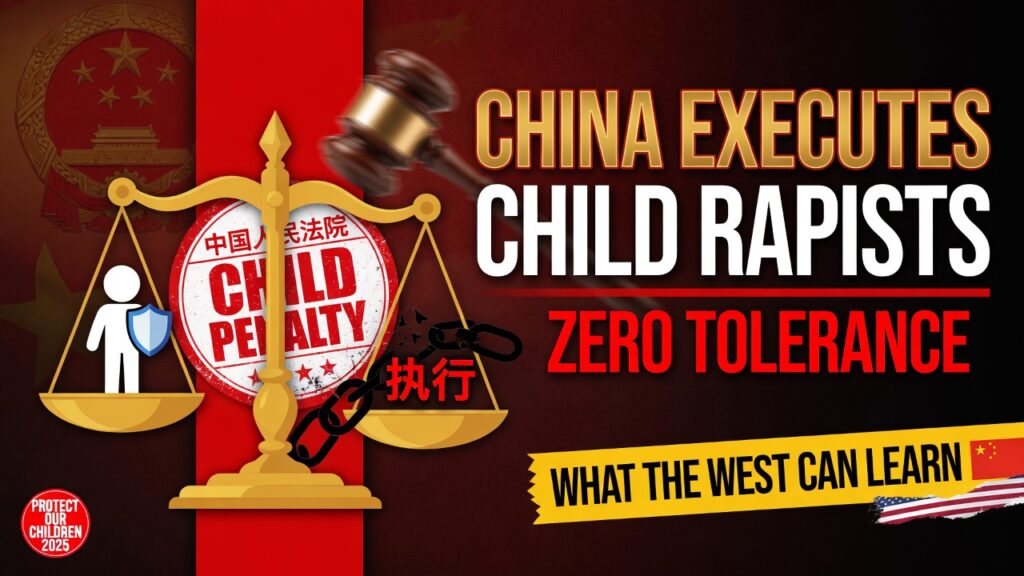
When a nation puts the safety of its children above political optics, the results speak for themselves. China’s repeated executions of convicted child sex offenders are forcing a global conversation that too many Western governments have been unwilling to have.
The image is stark: three men, convicted of some of the most depraved crimes imaginable against children — rape, coercion, repeated abuse of girls as young as 11 — executed after China’s Supreme People’s Court approved each death sentence. No ambiguity. No decade-long appeals theatre. No early release for good behavior.
In May 2025, China carried out exactly that. The Supreme People’s Court confirmed the executions of three child sex offenders, citing the country’s unwavering “zero tolerance” policy toward those who harm minors. It was not the first time. A near-identical set of executions had been carried out in November 2024. And in February 2026, Chinese authorities announced further legislative reinforcement: child rape will be met with the strongest possible legal force, including capital punishment in the most severe cases. While debates rage in Western capitals about sentencing reform, rehabilitation, and criminal leniency, Beijing is answering a far simpler question — what does a society owe its children?
Support Independent Local Journalism
TheTownHall.News is a non-profit reader-supported journalism. Just $5 helps us hire local reporters, investigate important issues, and hold public officials accountable across Alameda County. If you believe our community deserves strong, independent journalism, please consider donating $5 today to support our work.The Cases That Cannot Be Minimized
Details matter here, because sanitizing these crimes does a disservice to the victims and to the public’s right to understand what justice is actually responding to.
In the May 2025 executions, one perpetrator — identified as Zhao — ran an illegal educational institution and used his position of authority to imprison, beat, and repeatedly rape eight underage girls, including three under the age of 14. He forced victims to take contraceptives over extended periods, causing lasting gynecological harm.
A second man, Wang, exploited social media and online platforms to coerce underage girls into sending explicit images, then used that material as blackmail to rape them repeatedly. Among his victims was a girl with an intellectual disability. A third, Chen, posed as a peer in student chat groups on WeChat and QQ to lure victims, raping three girls under 14 multiple times and filming the abuse to extort further compliance — driving at least one victim to self-harm and another to attempt suicide.
These were not crimes of passion or momentary failures of judgment. These were predatory, sustained, calculated campaigns against the most vulnerable members of society. China’s courts called them exactly that — and acted accordingly.

Zero Tolerance Is Not a Slogan — It’s a Policy
“Zero tolerance” only means something when the justice system is willing to follow through.”
China’s Supreme People’s Court has been explicit in its messaging. These executions are designed to send a signal: those who prey on children will face the full weight of the state. The court noted that child sexual abuse crimes are becoming “more concealed and varied,” with perpetrators increasingly exploiting online platforms, positions of trust, and the vulnerabilities of children from low-supervision households — including rural children whose parents work away from home, and children with disabilities.
In response, Chinese judicial authorities issued new guidelines requiring individuals and institutions to report suspected child abuse immediately, regardless of whether it falls within their formal jurisdiction. Educational institutions were ordered to tighten employee vetting. Internet service providers were directed to proactively remove material that could facilitate child exploitation. Parents and guardians were put on notice: failure to protect children in your care is a criminal matter.
This is what a comprehensive child protection framework looks like when a government treats the issue with the gravity it deserves — not as a talking point, but as a mandate.
What Critics Get Wrong
Human rights organizations have raised concerns about China’s use of capital punishment, and those concerns are not without legitimate grounding. The death penalty is irreversible. Wrongful convictions, though rare in cases with this level of documented evidence, carry consequences that cannot be undone. These are serious considerations that any functioning justice system must weigh carefully.
Support Independent Local Journalism
TheTownHall.News is a non-profit reader-supported journalism. Just $5 helps us hire local reporters, investigate important issues, and hold public officials accountable across Alameda County. If you believe our community deserves strong, independent journalism, please consider donating $5 today to support our work.But the critique often stops there — and in doing so, it sidesteps the harder question: what is the acceptable cost of under-punishment? When a system prioritizes the rights of the convicted over the safety of future victims, it makes a moral choice. It chooses leniency for perpetrators over deterrence for predators. The children who were raped repeatedly over years, by men in positions of trust, were failed by institutions long before the courts got involved. The question of whether execution is appropriate is legitimate. The question of whether the alternative — short sentences, early release, minimal deterrence — has been working for children is equally legitimate, and Western critics rarely answer it.
How This Affects the Conversation at Home
This isn’t just a story about China. It’s a mirror held up to every country that claims child protection as a priority.
In the United States, the United Kingdom, and across Europe, advocates for victims of child sexual abuse have long argued that sentences are too short, that parole is granted too readily, and that repeat offenders cycle through a system that fails to stop them. Registration lists exist but are imperfectly enforced. Online platforms remain vectors for predatory contact despite years of regulatory pressure. Schools and institutions have, in documented cases across multiple countries, failed to report abuse when doing so was inconvenient.
“The measure of a civilization is how it protects its weakest members. By that standard, many societies have room for urgent improvement.”
Parental rights advocates, in particular, should pay attention. China’s new judicial guidelines specifically call out parents and teachers as the first line of defense — and hold them accountable when they fail in that duty. That is a conservative, responsibility-centered principle: the family and the community are the first protectors of children, with the state as a backstop when those systems fail. The debate isn’t simply about execution versus incarceration. It is about whether any given society has the political will to treat crimes against children with the seriousness they demand.
The Deterrence Question
Does the death penalty deter crime? The academic literature is genuinely mixed, and intellectual honesty requires acknowledging that. Studies on deterrence effects of capital punishment have reached conflicting conclusions, and context — cultural, institutional, economic — matters enormously.
What is less contested is this: a system that consistently imposes severe consequences for severe crimes communicates societal values clearly. It tells would-be offenders that the state is serious. It tells victims and their families that the law reflects the weight of what was done to them. And it removes, permanently, the possibility of reoffending by those convicted.
China’s courts have also been careful to pair punishment with prevention. Alongside the executions, judicial authorities have called for stronger family education, improved school protocols, tighter online platform oversight, and broader community awareness. Deterrence through punishment and deterrence through prevention are not mutually exclusive — and Beijing is pursuing both simultaneously.
Key Takeaway
China’s repeated executions of convicted child sex offenders — backed by the Supreme People’s Court and reinforced by new legislative guidance in 2026 — represent a clear-eyed, unapologetic commitment to protecting children. Whether one agrees with capital punishment or not, the underlying principle is worth examining: when a society decides that certain crimes against children are intolerable, its legal and institutional responses must match that conviction. The conversation about how to best protect children is one every society needs to have honestly — and urgently.
The Bottom Line: Children Deserve a System That Takes Them Seriously
Justice deferred is justice denied — and for the youngest, most vulnerable members of any society, deferred justice often means more victims.
China’s approach is not without legitimate criticism. But the instinct driving it — that children deserve the full protective force of the law, and that those who systematically prey on them should face severe, certain consequences — is one that crosses political and cultural lines. Every parent, every community leader, every elected official who claims to prioritize child safety should be willing to ask whether their own systems are living up to that promise.
The executions in Beijing make that question impossible to ignore.
Stay informed. Share this article with someone who cares about child safety and justice. Support journalism that asks the hard questions. Engage with your elected representatives about the strength of child protection laws in your community — because these conversations only happen when citizens demand them.