House Passes the Deporting Fraudsters Act: A Major Win for Taxpayers and the Rule of Law
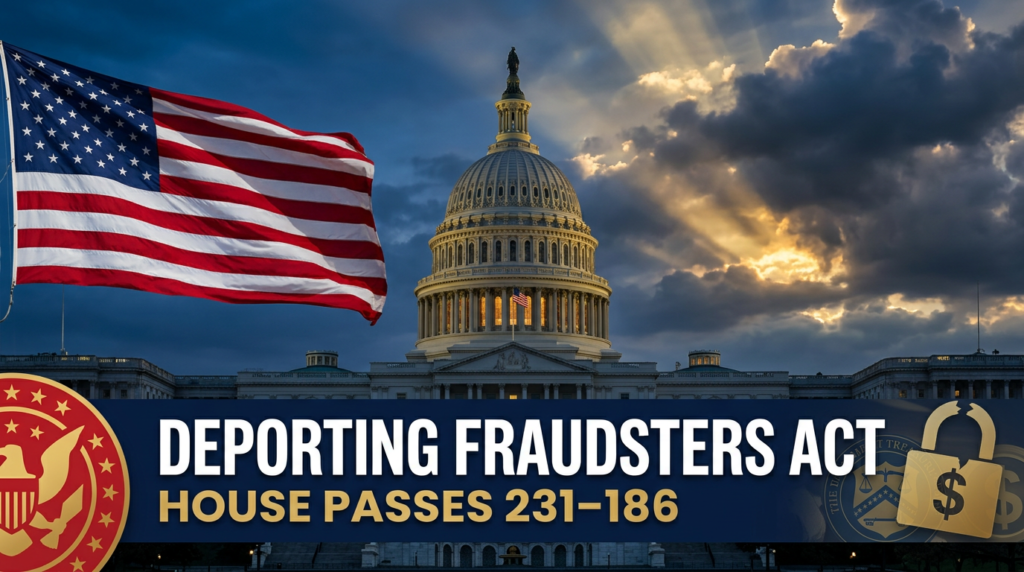
The U.S. House just voted 231–186 to make welfare fraud a deportable offense for non-citizens. It’s a commonsense measure long overdue — and a powerful signal that Washington is finally getting serious about protecting the public treasury.
Every year, hundreds of billions of dollars — money collected from working Americans to fund programs meant for the most vulnerable — vanish into the hands of fraudsters. Not all of them are foreign nationals, but a significant and documented portion are non-citizens exploiting a long-standing legal gray area: until now, defrauding the U.S. government was not explicitly listed as a deportable offense under immigration law.
That loophole just got closed.
Support Independent Local Journalism
TheTownHall.News is a non-profit reader-supported journalism. Just $5 helps us hire local reporters, investigate important issues, and hold public officials accountable across Alameda County. If you believe our community deserves strong, independent journalism, please consider donating $5 today to support our work.On March 18, 2026, the U.S. House of Representatives passed H.R. 1958, the Deporting Fraudsters Act of 2026, by a vote of 231 to 186. Sponsored by Rep. Dave Taylor (R-OH), the bill makes it a deportable — and inadmissible — offense for any non-citizen convicted of defrauding the federal government or stealing taxpayer-funded benefits. For millions of Americans who have watched their tax dollars disappear into a broken system, this is long-overdue accountability.
What the Deporting Fraudsters Act Actually Does
The legislation is targeted and deliberately narrow. Under H.R. 1958, any non-citizen convicted of federal document fraud — including producing counterfeit government seals, using false identification documents, or possessing document-making equipment to access public benefits — becomes deportable. The bill also applies to those who admit to having committed such offenses, closing a second avenue of evasion.
Beyond deportation, it permanently bars fraudsters from re-entering the United States and strips them of eligibility for any future federal benefits. This isn’t a broad immigration sweep — it is a surgical strike at a specific category of criminal conduct that has cost American taxpayers staggering sums for decades.
The White House reinforced the message on the exact same day the vote was held. President Trump signed an executive order establishing the Task Force to Eliminate Fraud, directing a government-wide effort to combat waste and abuse in federal benefit programs. The legislative and executive branches moved in lockstep — a deliberate and powerful signal of unified intent.

The Staggering Scale of the Problem
To understand why this bill matters, consider the numbers. The White House Office of Management and Budget estimates that between $233 billion and $521 billion is lost to federal fraud every single year. Total federal welfare and social service spending exceeds $1 trillion annually — meaning fraud could consume up to half of it.
The problem isn’t abstract. In Minnesota, investigators found that more than half of the state’s $18 billion federal social services allocation — including Medicaid funds — had been stolen. In California, $181 million was lost to EBT fraud. In New York, a $120 million Medicare and Medicaid fraud scheme was uncovered. These are not rounding errors. They represent real money, drained from programs designed to serve American seniors, veterans, disabled citizens, and low-income families.
The bill’s backers estimate that non-citizens receive approximately $42 billion in public benefits annually — a portion of which flows to individuals who entered illegally or exploited documentation loopholes to access programs never intended for them.
Why This Issue Matters Right Now
The timing of this vote is no accident. The Trump administration has made immigration enforcement and government accountability two of its defining priorities. The Deporting Fraudsters Act is part of a broader legislative campaign that includes bills to increase penalties for illegal reentry, restrict immigration relief for convicted criminals, and crack down on Social Security fraud across the board.
For American families, this is personal. Every dollar stolen through fraud is a dollar that doesn’t reach a struggling family, a sick child, or an elderly veteran. The social safety net was designed as a lifeline for citizens and legal residents who have contributed to — and depend on — it. It was never meant to be an open account for exploitation.
Support Independent Local Journalism
TheTownHall.News is a non-profit reader-supported journalism. Just $5 helps us hire local reporters, investigate important issues, and hold public officials accountable across Alameda County. If you believe our community deserves strong, independent journalism, please consider donating $5 today to support our work.Fiscal accountability isn’t a partisan value. It’s a civic one. Protecting the integrity of public programs is precisely how you ensure those programs survive for the people who genuinely need them.
“If you come into our country illegally and steal from American taxpayers, you should not be allowed to stay here.” — Rep. Anna Paulina Luna (R-FL), cosponsor, H.R. 1958
Bipartisan Support — And What It Signals
One of the most telling features of the March 18 vote was its bipartisan dimension. All 211 Republican members present voted yes — not a single defection. But equally significant: 20 Democrats crossed the aisle to support the bill. Most represent competitive swing districts, a clear indicator that their constituents — regardless of party registration — expect their representatives to take welfare fraud seriously.
Senate companion legislation, S. 3113, was introduced on November 7, 2025, by Senators Ted Cruz, John Cornyn (both R-TX), and Mike Lee (R-UT). Senator Cruz put it plainly: “Americans who meet eligibility requirements should be the only ones to receive taxpayer-funded benefits. This bill will stem that abuse.” Senator Cornyn added that the legislation “rightfully puts Americans first.”
The Senate is the next battleground. Its dynamics are different, and passage is not guaranteed — but political pressure on senators from competitive states will be difficult to ignore.
What Critics Get Wrong
Opposition to the bill has not been quiet. Democrats including Rep. Zoe Lofgren (D-CA), Rep. Pramila Jayapal (D-WA), and Rep. Jerrold Nadler (D-NY) raised concerns in committee, arguing the bill could ensnare vulnerable immigrants convicted of minor offenses and that it limits the discretion of immigration judges to weigh individual circumstances.
These procedural concerns deserve a fair hearing. They don’t, however, survive scrutiny.
The bill is narrowly written to target federal document fraud convictions — not petty infractions. More fundamentally, the argument that immigration judges should retain broad discretion to decide whether to deport someone who deliberately defrauded American taxpayers collapses under its own logic. Accountability cannot hinge on how sympathetically a fraud case is framed before a judge. The law should be clear, and the consequences should be predictable.
What critics also consistently fail to address is the cost of inaction. When fraud goes unpunished and deportation remains off the table, the message sent — to every potential fraudster — is unmistakable: there are no real consequences. That is not a compassionate immigration policy. That is a broken one.
The Rule of Law Is Not Optional
At its core, the Deporting Fraudsters Act affirms something larger than immigration enforcement or budget discipline. It affirms that law means something — that access to the resources of the American public carries responsibilities, and that violating the social contract has real consequences.
Americans who work hard, pay their taxes, and operate within the rules have every right to expect a government that defends the systems their contributions fund. They deserve to know that the programs designed to help their most vulnerable neighbors aren’t being systematically drained by fraud.
This bill enshrines a simple, powerful idea: if you defraud the American people, you don’t get to stay in America.
That is not an extreme position. It is the foundation of any functioning civic society.
Conclusion: A Step Forward — But the Work Isn’t Over
The House passage of the Deporting Fraudsters Act is a meaningful victory for fiscal accountability, the rule of law, and the millions of Americans whose tax dollars fund the programs at stake. It closes a real loophole, sends a clear deterrent message, and reflects a Congress willing to take the fraud crisis seriously.
But the work isn’t finished. Senate bill S. 3113 now awaits debate, and Americans who care about protecting the public treasury — and the integrity of social programs that serve genuine need — should be watching closely. As the 2026 midterm season takes shape, how senators vote on this legislation will reveal, in plain terms, whose interests they actually represent.
Key Takeaway: The Deporting Fraudsters Act passed the House 231–186 on March 18, 2026. It makes document and welfare fraud a deportable offense for non-citizens, closes a long-standing legal loophole, and shields hundreds of billions in taxpayer-funded programs. The Senate is next. The clock is ticking.
If this article informed you, share it — on social media, with colleagues, and across communities where accountability and civic integrity still mean something. Independent journalism depends on readers who are engaged enough to stay informed. Subscribe to follow the Senate vote as it develops.