DOJ Memo Threatens 27 Years of Disability Rights — Could States Force Institutionalization?
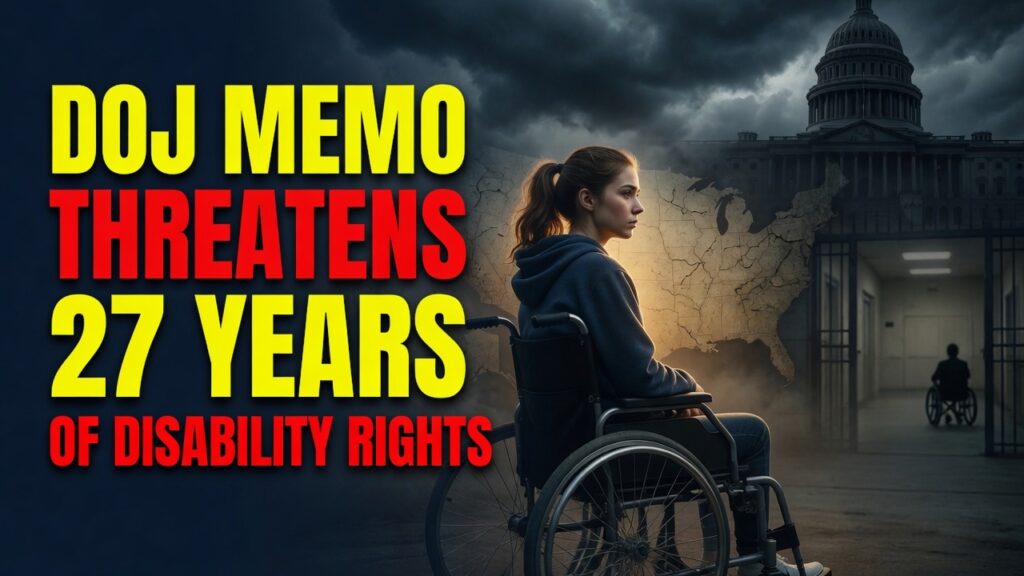
A new Justice Department memo argues states have no legal obligation to keep disabled Americans in their communities. Critics say it’s a green light to bring back the institutions America spent decades dismantling.
The Justice Department released a 39-page legal opinion on June 18, 2026 — four days before the 27th anniversary of the Supreme Court ruling it was written to undercut — arguing that federal law does not require states to provide disabled Americans with home- or community-based care. The memo, if acted upon, could affect more than 8 million Americans currently receiving Medicaid-funded community services and reverse nearly three decades of bipartisan disability rights enforcement.
The opinion came from the Office of Legal Counsel (OLC), authored by Principal Deputy Assistant Attorney General Lanora Pettit, and targets Olmstead v. L.C. — the 1999 Supreme Court decision that has served as the legal backbone of disability integration in the United States for a generation.
Support Independent Local Journalism
TheTownHall.News is a non-profit reader-supported journalism. Just $5 helps us hire local reporters, investigate important issues, and hold public officials accountable across Alameda County. If you believe our community deserves strong, independent journalism, please consider donating $5 today to support our work.What Did the Olmstead Decision Actually Say — and Why Is It Under Attack Now?
In 1999, two women with mental disabilities sued Georgia, arguing the state had failed its obligation to return them to their communities after professionals determined they were capable of community living. The Supreme Court agreed, ruling that states have a legal responsibility to provide support that integrates disabled Americans into their communities. Courts across the country embraced that interpretation for nearly three decades. By 2023, 8.4 million Americans were receiving home- and community-based services through Medicaid. NPRNPR
The new OLC memo doesn’t just challenge the policy — it challenges the legal foundation itself. The opinion reinterprets Olmstead as having a narrower scope, arguing the ruling held only that “unjustified institutional isolation of persons with disabilities is a form of discrimination” — not that states must actively provide integrated community services. CBS News
This is not a fringe legal theory — it is now the official position of the United States Justice Department.
Professor Alison Barkoff, who led Olmstead enforcement efforts in the Obama Justice Department, noted that the U.S. government has taken the position since 1977 that federal law includes an integration mandate. For decades, both Republican and Democratic administrations — including Trump’s first term — proactively enforced that standard and brought actions against states that over-relied on segregated institutional care. South Carolina Public Radio

What the Memo Actually Does — and Doesn’t Do
It is important to be precise about the scope of this opinion. The OLC opinion is not a court decision. It doesn’t erase Olmstead or change Supreme Court precedent. It also doesn’t eliminate the ADA, Section 504 of the Rehabilitation Act, or the regulations that protect community living. The Arc
What it does do is potentially more consequential in practice. The opinion could fundamentally change the way both the Justice Department and the Department of Health and Human Services enforce allegations of discrimination by patients who receive state-funded care. Rights mean less when the federal government refuses to enforce them. CBS NewsThe Arc
The memo itself acknowledges it is “out of step” with longstanding and consistent federal court interpretation of the ADA and Section 504 of the Rehabilitation Act. That admission is in the document itself — the DOJ is not claiming courts have agreed with this reading. It is asserting a new executive-branch position regardless. American Civil Liberties Union
The Bigger Picture: Medicaid Cuts + Institutional Push = A Policy Convergence
The memo does not exist in isolation. It lands at the intersection of two converging policy moves that disability advocates say amount to a coordinated squeeze.
Legal experts note that in response to last year’s One Big Beautiful Bill Act, states must now make deep cuts to services previously funded by Medicaid. The OLC memo essentially gives states permission to cut those community-based supports and instead rely on institutionalization — even though research shows institutionalization is considerably more expensive for states to provide. NPR
Support Independent Local Journalism
TheTownHall.News is a non-profit reader-supported journalism. Just $5 helps us hire local reporters, investigate important issues, and hold public officials accountable across Alameda County. If you believe our community deserves strong, independent journalism, please consider donating $5 today to support our work.In other words: states are losing the money to fund community care, and now the federal government is telling them they don’t have to provide it.
The homelessness dimension adds another layer. The memo is the latest move in a broader effort that began with a July 2025 executive order intended to make it easier for state and local governments to police homelessness, which calls for “shifting homeless individuals into long-term institutional settings for humane treatment through the appropriate use of civil commitment.” A footnote in the OLC memo suggests disability integration law has contributed to the rise in chronic homelessness — a framing advocates forcefully reject. NPR
The push for institutionalization faces a significant practical obstacle: an acute shortage of beds at specialized facilities. The federal government has not announced plans to fund new capacity. NPR
What Critics Are Saying
Pushback was swift and bipartisan in tone, with disability organizations across the political spectrum weighing in.
The American Association of People with Disabilities warned the memo threatens to drag the nation back to a “dark and shameful era of ignorance and cruelty” and would open doors for states to warehouse disabled people in institutions “out of sight and out of mind.” WSIU Public Broadcasting
Advocates specifically referenced Willowbrook, the infamous New York school where disabled individuals were subjected to filthy and overcrowded conditions, forced sterilizations, and eugenic experiments — institutions that began being phased out in the 1970s precisely because of the documented harm they caused. AAPD
The ACLU was direct in its legal assessment: Trump’s Justice Department cannot erase federal laws and decades of legal precedent with a single opinion, calling the memo a “blatant attempt to undermine the rights of disabled people.” American Civil Liberties Union
The Administration’s Argument
The administration has not elaborated publicly beyond the OLC memo itself. The underlying policy rationale traces to public order concerns around homelessness and what the executive order framed as a mental health crisis in American cities.
In a 2023 campaign video, President Trump stated his position plainly: those who are severely mentally ill and deeply disturbed should be returned to mental institutions. The OLC memo provides the legal infrastructure to pursue that goal by removing the primary legal obstacle — the Olmstead integration mandate — that had stood in the way for nearly three decades.
Supporters of the broader policy argue that community-based care, while preferable in theory, has failed to adequately address severe mental illness and that voluntary systems have left a significant population without appropriate supervision or treatment.
Key Questions
Will DOJ actually stop enforcing Olmstead? The memo signals intent to pull back federal enforcement, but legal experts note individuals can still bring private ADA lawsuits. The practical impact depends on how aggressively states act on the new federal posture.
Which states are most at risk? States with large Medicaid populations, significant homelessness crises, and conservative legislatures — Texas, Florida, and Arizona — are most likely to test the new limits.
Can Congress block this? Disability advocates are calling for legislation to codify Olmstead into statute. With the current congressional makeup, that path is narrow.
What happens to the 8.4 million Americans currently on community-based Medicaid services? Nothing immediately — but if states begin cutting those programs under fiscal pressure from One Big Beautiful Bill, these individuals will have less federal protection to challenge the cuts.
The bottom line: The DOJ’s memo is not a death sentence for Olmstead — courts still control legal precedent — but it signals that the federal government will no longer be the enforcement engine behind 27 years of disability integration law. Combined with Medicaid cuts from the One Big Beautiful Bill and a White House executive order pushing institutionalization as a homelessness solution, disabled Americans are facing a policy environment where their right to community living is less protected than at any point since 1999.