ICE Is Giving Local Police a Face-Scanning App & American citizens will be scanned too — No Warrant, No Consent, 15-Year Storage
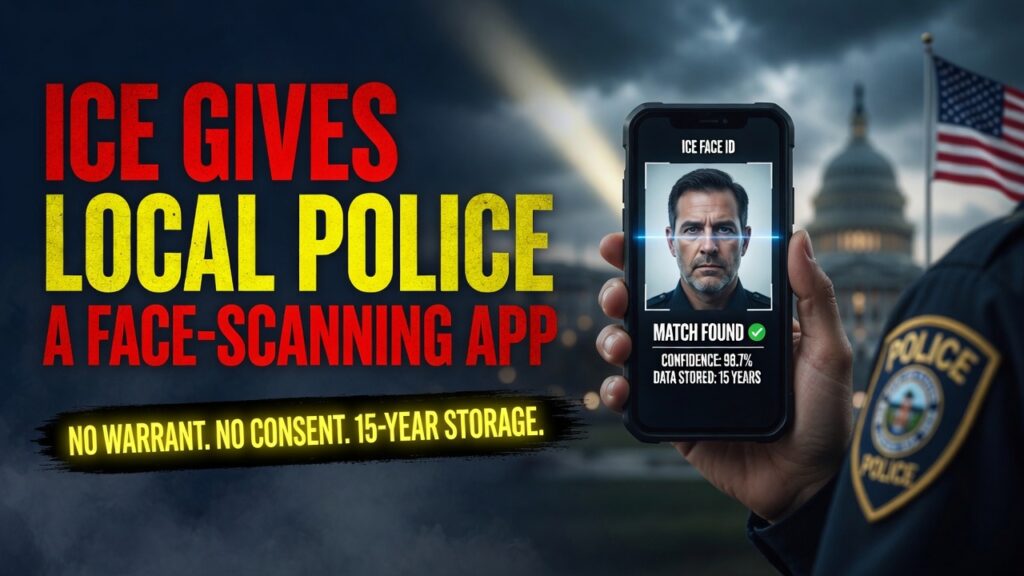
A leaked DHS document reveals that over 1,200 local police departments across 32 states are set to receive ICE’s facial recognition technology. No warrant. No consent. No notice. And the government admits American citizens will get caught in the scans.
A newly disclosed Department of Homeland Security document has confirmed what civil liberties advocates have warned about for months: ICE is actively distributing a mobile facial recognition app to local police departments nationwide, dramatically expanding the reach of immigration surveillance beyond federal agents and into routine street-level policing across America.
The app has already been used more than 100,000 times in the field. It scans faces against a database of 250 million government records. And every photo it captures — including photos of American citizens — is stored for 15 years.
Support Independent Local Journalism
TheTownHall.News is a non-profit reader-supported journalism. Just $5 helps us hire local reporters, investigate important issues, and hold public officials accountable across Alameda County. If you believe our community deserves strong, independent journalism, please consider donating $5 today to support our work.What Is the ICE Task Force Module — and Who Already Has It?
The document, first reported by tech news outlet 404 Media, is a Privacy Threshold Analysis — a federal report assessing whether the privacy implications of a tool warrant further government study. The tool in question is a mobile app called the ICE Task Force Module, which allows local police to scan the faces of people they stop in their communities. WFSU News
The app runs scanned faces against more than 250 million government records — including State Department visa records and the database TSA uses at airports — and tells officers whether the person can be detained for an immigration violation. NPR
Internal government documents reveal ICE plans to distribute the app to over 1,200 local police departments across 32 states. The technology requires no warrant, consent, or notice from the person being scanned. Raw Story
The app is not new — it launched in September 2025, which means local police have already been using it for months before the public learned of its existence. According to a lawsuit filed by the State of Illinois and the City of Chicago in January 2026, ICE has utilized its facial recognition technology in the field more than 100,000 times — a major expansion from its previous limited use at ports of entry and in child exploitation investigations. Vanderbilt University

Who Are These Local Police Officers, and What Authority Do They Have?
The local officers are called “ICE non-federal law enforcement officers” in the DHS document and are likely participants in the federal 287(g) program. A subset of that program — the Task Force Model — gives local police the authority to arrest immigrants on ICE’s behalf during their routine police duties. There are approximately 1,300 police agencies participating in the Task Force Model nationwide. NPR
This is the critical accountability detail most coverage buries: these are not specially trained federal immigration agents operating in controlled settings. These are local patrol officers — conducting everyday traffic stops, responding to 911 calls, working neighborhood beats — who now have the ability to scan anyone’s face for immigration status in real time, without the person’s knowledge or consent.
The line between local policing and federal immigration enforcement has effectively been erased.
Will American Citizens Get Caught in This?
Yes — and the government acknowledges it in its own document.
The DHS document itself states: “It is conceivable that a photo taken by an ICE non-federal law enforcement officer using the TFM mobile application could be that of someone other than a removable individual, including U.S. citizens.” Because every photo taken through the app is kept for 15 years, that suggests a long-term government record of citizens and immigrants alike. NPR
Support Independent Local Journalism
TheTownHall.News is a non-profit reader-supported journalism. Just $5 helps us hire local reporters, investigate important issues, and hold public officials accountable across Alameda County. If you believe our community deserves strong, independent journalism, please consider donating $5 today to support our work.Patrick Eddington of the libertarian Cato Institute flagged the scale of the risk: when technology that can impact individual rights is scaled, “it can have potentially very, very large effects, affecting lots and lots of people.” NPR
The accuracy problem compounds the citizen-capture concern. The government databases the app searches against are described by ACLU experts as “notoriously error-filled,” and the technology is “being used on the street in ways that are dangerous, totally unprecedented in this country, and frankly, blatantly illegal.” Democracy Now!
The Protest Surveillance Dimension
The implications extend well beyond immigration enforcement. Privacy experts warned the app could chill freedom of speech — people might worry they’ll be identified at a protest and end up on a watch list. NPR
That concern is not theoretical. At a congressional hearing, Secretary of Homeland Security Markwayne Mullin confirmed that DHS used facial recognition technology on people gathered outside of Delaney Hall, an immigration detention center in New Jersey that has been the site of recent protests. ICE has repeatedly denied maintaining a formal database of protesters, but a letter from former acting ICE Director Todd Lyons to members of Congress indicated the agency gives itself wide latitude to collect information on people — and the new DHS document confirms that photos end up in an internal DHS system and are stored there for 15 years. NPRNPR
A DHS memo sent to some federal immigration agents temporarily assigned to Minneapolis instructed them to collect personal information about protesters and agitators, including license plates, identifications, and images. A number of observers who monitored ICE operations have also reported having their Global Entry status revoked afterward. NPR
What DHS Says
The administration has been direct about the intent of the program, even as it deflects on specifics. DHS declined to provide further detail about how the app is used, but stated: ICE is committed to ensuring that the local police who partner with them have the tools needed to support ICE’s mass deportation mission, and that those tools are constitutional and respect civil liberties and privacy interests. NPR
The Case For the Program
Supporters of the 287(g) expansion and the broader facial recognition deployment argue the tools are a straightforward force multiplier for a legitimate law enforcement mission. The administration’s position is that effective mass deportation — a stated campaign promise — requires more than federal manpower alone, and that local police with proper training and technology can identify deportable individuals who would otherwise slip through. Proponents also note that the database cross-referencing runs against existing government records, not a new surveillance apparatus, and that immigration law enforcement is a constitutionally authorized federal function.
The Counterarguments and Legal Challenges
Civil liberties organizations across the ideological spectrum — from the ACLU to the libertarian Cato Institute — have raised objections on both constitutional and practical grounds.
The State of Illinois and City of Chicago have sued DHS, arguing the technology’s deployment violates constitutional protections. Legal scholars at Vanderbilt have noted that DHS is effectively circumventing Fourth Amendment warrant requirements by deploying surveillance at a scale that would normally trigger judicial oversight. Vanderbilt University
Clare Garvie, deputy director of the Technology Law and Policy Program at NYU School of Law’s Policing Project, offered a measured but pointed assessment: the DHS analysis raises more questions than it answers. NPR
The “papers, please” framing has emerged from multiple legal analysts. One privacy expert put it plainly: “It makes this sort of face surveillance ubiquitous on American streets. Americans should not tolerate law enforcement being able to scan anyone’s face at any time for any reason to try to determine their identity. This is the new form of ‘papers, please.'” NPR
Key Questions
Can you refuse to be scanned? No. A separate DHS document from October 2025, also reported by 404 Media, stated explicitly that individuals cannot refuse to be scanned by the ICE facial recognition app.
Are there any judicial guardrails? Currently, no warrant is required. The legal challenge in Illinois v. DHS is the primary active check — with no ruling yet.
What happens if the app misidentifies you as a citizen? The DHS document does not specify a correction or appeals process for misidentified citizens whose photos are stored.
What stops local police from using this on non-immigration stops? The DHS document provides no apparent technical restriction on when or why a scan can be initiated during any police encounter.
Which states are affected? The app is being deployed across 32 states with approximately 1,200 participating departments, though DHS has not published a list of which agencies.
The bottom line: The ICE Task Force Module represents the largest known expansion of biometric immigration surveillance in U.S. history — and it is already operational. By routing the technology through local police in the 287(g) program, DHS has effectively nationalized street-level face scanning without congressional authorization, judicial oversight, or a public debate. The government’s own document concedes that American citizens will be caught in the surveillance net and that their images will be stored for 15 years. Whether that trade-off is acceptable — in service of the administration’s deportation mission — is a question that courts, Congress, and voters have yet to fully answer.