Great American AI Act Explained: What Federal AI Preemption Means for Your State
A sweeping 269-page bill dropped on June 4, 2026 — and if it passes, Washington could override your state’s AI protections for the next three years. Most Americans haven’t heard a word about it.
Congress just moved quietly — and the stakes could not be higher. While the national conversation remains fixated on inflation, immigration, and elections, a bipartisan coalition of House members released what may be the most consequential technology legislation in American history. It’s called the Great American AI Act. And the question every citizen should be asking right now is: who gave Washington permission to overrule the voters who already protected themselves?
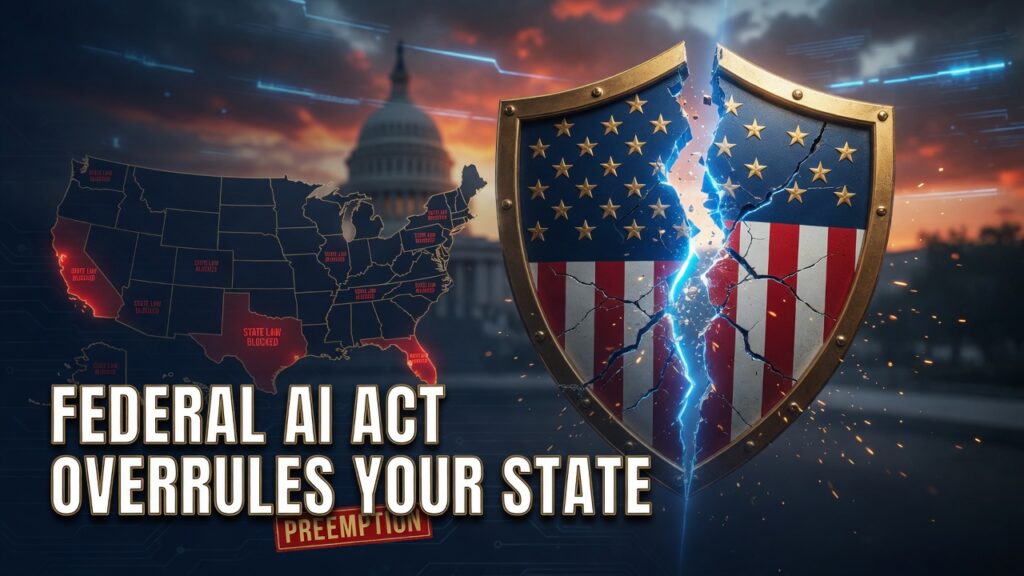
This isn’t a distant regulatory debate. If this bill becomes law, state protections that voters fought for — transparency rules in California, anti-discrimination safeguards in Colorado, biometric privacy laws in Illinois — could be suspended for three full years under a single federal framework directed from Washington. That is not consolidation. That is preemption. And preemption has a cost that ordinary Americans, not lobbyists, end up paying.
Support Independent Local Journalism
TheTownHall.News is a non-profit reader-supported journalism. Just $5 helps us hire local reporters, investigate important issues, and hold public officials accountable across Alameda County. If you believe our community deserves strong, independent journalism, please consider donating $5 today to support our work.What the Great American AI Act Actually Does
The discussion draft, released June 4 by Rep. Jay Obernolte (R-CA) and Rep. Lori Trahan (D-MA), runs nearly 270 pages. At its core, it proposes a federal AI governance framework built around four pillars: frontier AI oversight, workforce protections, cybersecurity, and international research cooperation.
The headline mechanism is the Center for AI Standards and Innovation (CAISI) — the renamed version of Biden’s AI Safety Institute — which would be formally codified in statute and funded at $100 million per year through 2029 [bill draft authorization]. CAISI would license “Independent Verification Organizations” to conduct semi-annual audits of large AI developers. Companies that violate safety requirements face fines of up to $1 million per day.
On paper, these sound like meaningful guardrails. But the provision generating the most alarm is buried in Title I: a three-year federal preemption of state laws specifically regulating AI development. That clause effectively freezes a generation of hard-won state protections — and replaces them with a federal floor that critics say is far lower.
Is This the End of State-Level Accountability?
40 states have already passed or are actively developing their own AI regulations [National Conference of State Legislatures data range, 2025–2026]. Colorado’s anti-discrimination rules for AI in hiring and lending. California’s data transparency mandates. Illinois’s biometric privacy protections. These didn’t emerge from Washington think tanks — they came from state legislators responding directly to constituents experiencing real harms.

Under the GAAIA’s preemption clause, California’s AB 2013 — which requires AI developers to publicly disclose training data summaries — would be suspended. Portions of California’s SB 942 watermarking law would also be preempted. The bill’s own FAQ, released by Rep. Trahan’s office, confirmed these specific casualties.
If your state passed a law to protect you from AI discrimination, and Congress erases it with a three-year moratorium, who exactly is looking out for you?
Brad Carson, president of Americans for Responsible Innovation and a former Democratic congressman, put it directly: “This bill takes the current floor on state AI legislation and turns it into a federal ceiling, preventing state lawmakers from addressing emerging AI harms in an era of fast-moving technology.”
$100 Million a Year. The Question Washington Isn’t Answering: Who Decides How It’s Spent?
$100 million per year. The question fiscal conservatives should be demanding an answer to: what accountability mechanisms ensure that this new federal bureaucracy doesn’t simply grow, entrench, and outlast its three-year mandate?
The bill authorizes CAISI at $100 million annually for 2027, 2028, and 2029 — plus additional revenue from IVO licensing fees. It also authorizes CAISI to hire “critical technical experts at higher pay levels,” bypassing standard federal pay scales. That is a bureaucratic foothold. History tells us these agencies rarely shrink on schedule.
Support Independent Local Journalism
TheTownHall.News is a non-profit reader-supported journalism. Just $5 helps us hire local reporters, investigate important issues, and hold public officials accountable across Alameda County. If you believe our community deserves strong, independent journalism, please consider donating $5 today to support our work.The bill contains a sunset clause — CAISI’s authorities expire after three years “unless reauthorized.” But Congress has reauthorized nearly every temporary agency it has ever created. The sunset provision offers the appearance of fiscal discipline without the substance of it.
“Three-year sunsets sound like accountability — until you remember that Washington hasn’t let a major agency expire in living memory.”
What Do Supporters of This Bill Actually Believe?
This is a legitimate question, and it deserves a fair answer. Supporters make a coherent argument: AI systems are built in one state and deployed in all fifty. A patchwork of fifty different regulatory regimes creates genuine compliance confusion for companies trying to bring AI products to market nationally. Inconsistent rules may actually reduce consumer protection by making it harder to establish clear, enforceable national standards.
Rep. Erin Houchin (R-IN), a co-sponsor, framed it plainly: “America should lead the world in artificial intelligence, not regulate ourselves into falling behind China through a patchwork of fifty different state laws.” The Business Software Alliance and other industry groups echoed this, arguing that national uniformity benefits both innovation and consumers.
These concerns are not invented. The EU’s fragmented early tech regulatory environment is a cautionary tale.
But here’s the critical distinction: consolidating standards upward is not the same as stripping protections downward. The GAAIA, as drafted, doesn’t simply harmonize existing state protections — it suspends many of the strongest ones. A genuine federal floor would match or exceed the most protective state laws. This bill does not do that. The Consumer Federation of America’s Ben Winters called it “a weak and convoluted regulatory state that lets AI companies continue to do whatever they want with impunity.” That is not a fringe view — it is a mainstream consumer protection objection grounded in the bill’s actual text.
Are Our Elected Officials Even Listening to the People Who Sent Them?
The House Democratic Commission on AI came out in formal opposition within hours of the draft’s release. Americans for Responsible Innovation launched an ad campaign in Massachusetts urging Rep. Trahan — a Democrat — to oppose her own bill’s preemption clause. The Alliance for Secure AI, a safety-focused group, praised the bill’s structure but opposed the preemption language directly.
This isn’t partisan gridlock. This is a bill being opposed by members of both parties, consumer advocates, AI safety researchers, and the very constituents whose state laws are being targeted.
The sponsors have invited public feedback at GAAIA@mail.house.gov and have not yet formally introduced the legislation. That means the window to influence this bill is open — but it will not stay open.
Personal responsibility means staying informed before the decisions are made for you. Limited government means questioning whether a new $100-million-a-year federal agency is the right answer to a problem states were already solving. And parental rights mean asking whether the erasure of child safety and biometric protections — written into law by state legislators you actually voted for — serves your family’s interest or the AI industry’s.
What Happens If No One Speaks Up?
Washington moves fastest when it moves quietly. This bill was released on a Thursday, in early June, during a news cycle crowded with other stories. That is not a coincidence. Major legislation rarely announces itself.
The preemption provision sunsets in three years — but by then, the federal framework will be entrenched, CAISI will be staffed, the IVO licensing ecosystem will be operational, and Congress will face enormous pressure to simply reauthorize what already exists. The window for course correction is now, not after the ink dries.
If your state already passed an AI protection law and Congress erases it before you even knew it existed, can we honestly call that representative government?
Key Questions This Article Raises
- Does a three-year federal preemption of state AI laws protect Americans — or protect AI companies from accountability?
- Who ensures that a $100-million-per-year federal AI agency doesn’t outlive its mandate and become permanent?
- If the strongest existing state protections are frozen, what stops the federal “floor” from becoming the permanent ceiling?
The Question You Need to Take With You
The Great American AI Act may well pass. It may even produce some genuine accountability for the most powerful AI systems on earth. But a bill that silences forty states, creates a new federal bureaucracy, and authorizes a hundred million dollars a year — while being released on a Thursday afternoon most Americans never saw — deserves far more scrutiny than it has received.
The real question isn’t whether AI needs federal oversight. It’s whether Americans can afford to let Washington write the rules while the public isn’t watching.
What do you think — is a federal AI framework the protection Americans need, or the override they never asked for? Share this article and start the conversation.
Still have questions? Subscribe for daily coverage of the policies shaping your rights and your future.
Think others need to hear this? Share the article — especially in states with active AI protection laws.
Want to make your voice count? Contact your House representative directly or submit public feedback to the bill’s sponsors at GAAIA@mail.house.gov before the bill is formally introduced.