AI Cancer Treatment: Real Breakthroughs, Real Access Questions
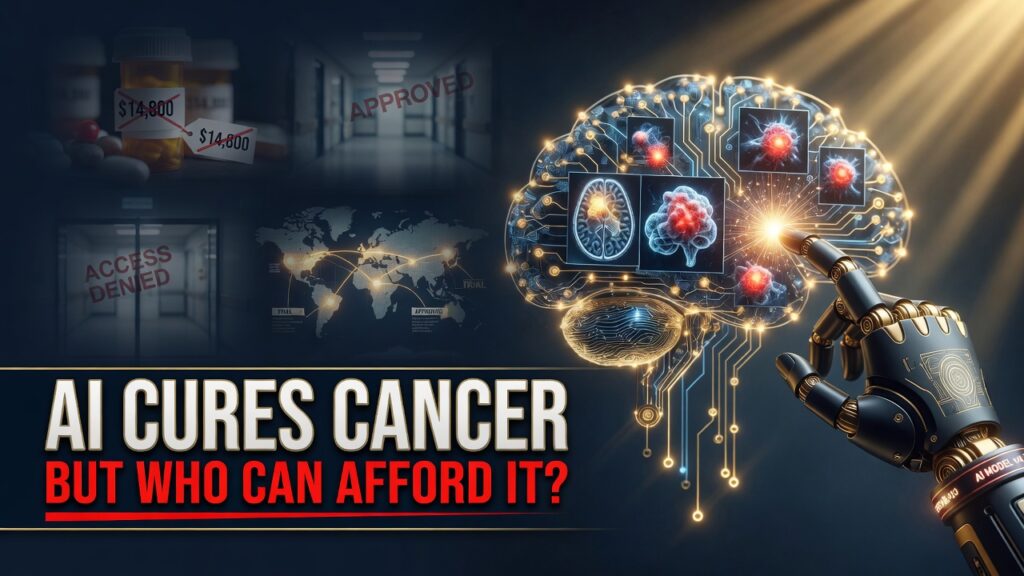
A tech founder used artificial intelligence to escape a death sentence. The science is real, the results are extraordinary — and the question of who gets to benefit next is one America can no longer afford to ignore.
When a billionaire engineers his own cancer cure, the world applauds. But what happens to everyone else?
That question is no longer hypothetical. Sid Sijbrandij, co-founder of GitLab, was diagnosed with osteosarcoma — a rare, aggressive bone cancer — in November 2022. After exhausting every standard treatment, being turned away from clinical trials, and receiving what amounted to a medical shrug from his oncologists, he did what any founder would do: he treated the problem like a broken codebase and started debugging it himself. Today, his cancer is undetectable. The approach he used — combining AI-assisted research, cutting-edge genomic diagnostics, and personalized experimental therapies — is now drawing global attention. The question it raises for the rest of us is urgent, and it deserves a straight answer.
Support Independent Local Journalism
TheTownHall.News is a non-profit reader-supported journalism. Just $5 helps us hire local reporters, investigate important issues, and hold public officials accountable across Alameda County. If you believe our community deserves strong, independent journalism, please consider donating $5 today to support our work.What Sid Sijbrandij Actually Did — and Why It Matters
The viral version of this story has been simplified to the point of distortion. Artificial intelligence did not, by itself, cure Sid’s cancer. What it did was serve as a powerful research and synthesis tool within a much larger, meticulously engineered system of care.
After his cancer returned in 2024, Sid assembled a multidisciplinary team that included concierge oncology services, computational biologists, academic researchers, and genetic sequencing specialists. He maintained a master health document — over 1,000 pages long by 2025 alone — tracking every scan, lab result, and medical meeting. He used ChatGPT and other AI tools to navigate complex medical literature, cross-reference emerging therapies, and identify treatment pathways his standard oncologists had never considered.
The science behind his recovery is extraordinary: single-cell RNA sequencing of his tumor revealed that his cancer cells were over-expressing fibroblast-associated genes — including a protein called FAP — which pointed his team toward an experimental radioligand therapy available in Germany. His tumor responded. The cancer shrank. Surgery became possible again. Post-surgical analysis showed his cancer-fighting T cells had surged from 19% to 89% of infiltrating immune cells — a stunning indicator that the combination of treatments had triggered a powerful immune response.
He has since open-sourced 25 terabytes of his personal medical data at osteosarc.com, making his genomic sequencing results, imaging data, and treatment timeline freely available to researchers worldwide. In March 2026, he presented alongside a geneticist at an OpenAI Forum event titled “From Terminal to Turnaround.” His cancer remains undetectable.
Is This Science Real — Or Silicon Valley Hype?
This is not snake oil. Every component of Sid’s treatment protocol is grounded in legitimate, peer-reviewed science.
Radioligand therapy — the experimental German treatment that helped shrink his tumor — uses the same core mechanism as Pluvicto, an FDA-approved cancer drug. Personalized mRNA neoantigen vaccines, which Sid is now receiving as a maintenance therapy, entered clinical trials for osteosarcoma as recently as May 2026 [clinical research reporting]. Single-cell RNA sequencing, the diagnostic technology that identified his tumor’s vulnerability, is manufactured by 10x Genomics, a publicly traded biotech company whose tools are used in leading research institutions worldwide.
“One patient’s data and methodology, made open, becomes infrastructure for the next hundred.” — Sid Sijbrandij
The broader medical community agrees that AI is transforming oncology. The American Association for Cancer Research’s 2026 expert forecast highlighted AI’s role in drug repurposing, clinical trial matching, and imaging analysis [AACR, January 2026]. Dana-Farber Cancer Institute researchers are actively building AI-assisted oncology tools. City of Hope predicts AI-powered patient-matching tools could improve clinical trial enrollment rates significantly [City of Hope, 2026 forecast].
The science isn’t hype. The access question is where things get complicated — and that’s the conversation no one in Washington is having.
What Do Supporters of This Approach Actually Believe?
Proponents of AI-driven, personalized medicine argue that Sid’s case is an “existence proof” — evidence that better outcomes are possible, and that today’s frontier treatment becomes tomorrow’s standard of care. They point to Magic Johnson’s HIV treatment in the 1990s: at the time, it was an exclusive intervention; today, effective HIV treatment is widely available.
Support Independent Local Journalism
TheTownHall.News is a non-profit reader-supported journalism. Just $5 helps us hire local reporters, investigate important issues, and hold public officials accountable across Alameda County. If you believe our community deserves strong, independent journalism, please consider donating $5 today to support our work.Advocates also argue that open-sourcing medical data — as Sid has done — democratizes knowledge in ways that benefit all patients regardless of income. When one person’s tumor genomics are publicly available to researchers globally, the cost and timeline of developing the next generation of treatments can drop dramatically.
These are valid points. The open-sourcing of 25TB of personal medical data is, by any honest measure, a genuinely revolutionary act. And the historical precedent for frontier treatments eventually reaching broader populations is real.
But the analogy has limits. HIV treatment became accessible through decades of public investment, regulatory pressure, generic manufacturing, and policy reform. None of that happened automatically. It happened because people demanded accountability from institutions that had failed them.
Who Is Really Paying the Price for Our Broken Cancer System?
Here’s what the inspirational narrative leaves out: Sid himself has acknowledged the extraordinary difficulty of accessing his own tissue samples, navigating hospital bureaucracy, and compelling a risk-averse medical establishment to deviate from standard protocols. He needed a dedicated team member functioning essentially as a “forward-deployed tissue extractor” just to obtain his own biopsy samples from hospitals that had no procedures for patient data access.
If a self-made billionaire with a world-class professional network struggled this hard to access cutting-edge care, what does that tell us about the system the rest of us are navigating?25 Terabytes of open-source personal cancer data. The question no one in Washington wants to answer: why does it take a billionaire to make this possible?
This is where personal responsibility and systemic accountability must coexist. Individuals who take agency over their own health — who demand information, push back on passive protocols, and seek second opinions — consistently achieve better outcomes. That principle is not class-dependent. But the structural barriers Sid identified — hospitals that won’t release patient tissue, regulatory frameworks that treat every personalized therapy like a $1 billion Phase III drug trial, and a clinical system optimized for liability over outcomes — are barriers that no amount of individual initiative alone can dismantle.
Sid said it plainly: “It costs $1 billion to get a drug approved. But it costs $1 million to dose a single person with a personalized therapy. That discrepancy is the highest it’s ever been.”
That discrepancy is a policy failure. And policy failures have authors.
What Happens If We Miss This Moment?
The convergence of AI, genomic sequencing, personalized mRNA vaccines, and radioligand therapy represents the most significant shift in cancer treatment in a generation. The tools exist. The science is proven. The open-source data is freely available.
What is missing is the political will to remove the structural barriers that keep these tools out of ordinary patients’ hands — regulatory frameworks built for a one-size-fits-all pharmaceutical model that no longer reflects what’s scientifically possible, hospital systems that prioritize institutional liability over patient data rights, and a clinical trial architecture that excludes the rarest cases most in need of innovation.
Parental rights advocates, patient rights advocates, and fiscal conservatives should all be asking the same question: why is a system consuming trillions of public dollars still forcing patients to become their own doctors to survive?
📌 Key Questions This Story Raises
- If the tools to beat cancer already exist, who is responsible for ensuring they reach patients who can’t afford a personal genomics team?
- Should patients have a legal right to access their own medical tissue and data — and why don’t they already?
- Is the current FDA regulatory framework for personalized therapies protecting patients, or protecting the pharmaceutical industry’s business model?
The Real Question Isn’t Whether AI Can Cure Cancer
Sid Sijbrandij’s story is real, the science is verified, and the inspiration is warranted. But inspiration without accountability is just a feel-good story.
The real question isn’t whether artificial intelligence can help beat cancer. It clearly can, and it already has. The question is whether the institutions entrusted with protecting public health — regulatory agencies, hospital systems, insurance frameworks, and elected officials — will move fast enough to let that capability reach the people who need it before it’s too late.
The future of medicine may be in the terminal, as the viral post suggests. But the fight for access is still in the halls of Congress, the boardrooms of hospital systems, and the ballot box.
What do you think — should patients have an absolute legal right to their own medical data and tissue? Share this article and tell us where you stand.
Still have questions? Subscribe for daily coverage of the issues that matter. Think others need to hear this? Share the article — this conversation is just getting started. Want to make your voice count? Contact your congressional representative and ask where they stand on the FDA’s personalized therapy approval pathway.