Is Iran Using the Strait of Hormuz as a Bargaining Chip While Negotiating in Switzerland?
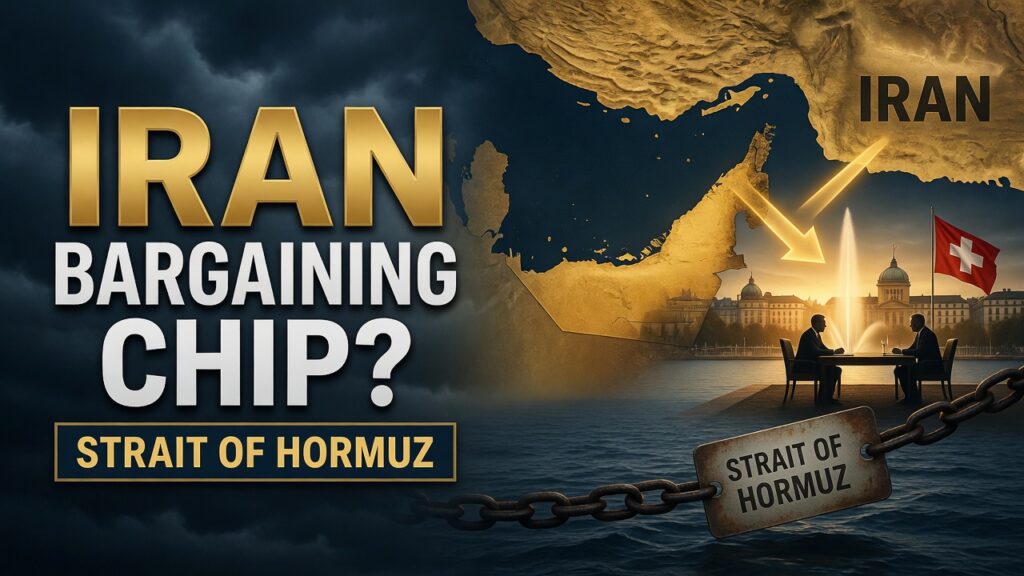
Iran’s military declared the strait closed less than 48 hours after signing a peace framework with the United States — while its own diplomats boarded planes to Switzerland.
The Islamic Revolutionary Guard Corps (IRGC) declared the Strait of Hormuz closed to all vessel traffic on Saturday, June 20, warning ships that their “safety would be at risk” if they approached the waterway. The announcement came less than 48 hours after Iran and the United States signed a Memorandum of Understanding (MOU) on June 18 that was supposed to end nearly four months of open warfare — and it came while Iranian negotiators were simultaneously en route to Switzerland for follow-up talks.
The United States military flatly rejected the closure claim. U.S. forces are on the water, ships are moving, and the world’s energy supply is — for now — intact. But the contradiction between Iran’s IRGC and its own Foreign Ministry, the fragile Lebanon ceasefire, and the on-again, off-again talks in Bürgenstock have cast serious doubt on whether the interim peace deal will survive its first week.
Support Independent Local Journalism
TheTownHall.News is a non-profit reader-supported journalism. Just $5 helps us hire local reporters, investigate important issues, and hold public officials accountable across Alameda County. If you believe our community deserves strong, independent journalism, please consider donating $5 today to support our work.What the MOU Actually Said — and Why Iran Says It’s Already Dead
The Islamabad Memorandum of Understanding, signed electronically by President Donald Trump and Iranian President Masoud Pezeshkian on June 18, was a 14-point preliminary peace framework. Its terms included an immediate ceasefire on all fronts, Israeli withdrawal from southern Lebanon, the lifting of the U.S. naval blockade on Iranian ports, unfreezing of Iranian assets, suspension of oil sanctions, and the full reopening of the Strait of Hormuz without Iranian tolls for at least 60 days.
Iran says Washington breached the first clause within hours. The argument: Clause 1 demands “an end to the war on all fronts, including Lebanon,” and Israel continued striking southern Lebanon targets the same day the deal was signed. Because the U.S. failed to restrain Israel, Tehran’s position is that it is no longer bound by its own commitments under the framework — including keeping the strait open.
Iran’s military framed the closure as the “first step” in its response to what it called “bad faith” and a “blatant breach” of commitments by the U.S. and Israel.
Iran’s Foreign Ministry spokesperson Esmail Baghaei made clear in a Sunday post what Tehran’s conditions are: “The termination of the war on all fronts, including Lebanon” must be addressed before final agreement negotiations can begin. Iran is specifically demanding compliance with clauses 1, 4, 5, 10, and 11 of the MOU before it considers the deal operative.

Iran’s Foreign Ministry Contradicts the IRGC — Again
In a pattern that has repeated itself throughout this crisis, Iran spoke with two voices on Saturday.
The IRGC issued its closure declaration over maritime radio channels, warning all vessels away from the strait and threatening that any ship that “defies this directive will be targeted.” But within hours, Iran’s Foreign Ministry put out a contradictory statement. Spokesman Esmail Baghaei said Iran’s armed forces had “taken the necessary measures to ensure the safe passage of commercial vessels through the Strait of Hormuz, and shipping in this route is currently underway.”
The contradiction is not an accident — it reflects a genuine and well-documented internal division within Tehran between hardliners who see the MOU as a capitulation and pragmatists who see it as an off-ramp from a war Iran was losing.
American and regional sources have cited this internal friction as a major reason negotiations took nearly four months to produce even an interim framework.
The U.S. Says the Strait Is Open — and Has the Numbers to Prove It
U.S. Central Command spokesperson Navy Captain Tim Hawkins was direct: “Iran does not control the Strait of Hormuz. Traffic continues to flow, and U.S. forces are monitoring the situation to ensure this remains the case.”
Support Independent Local Journalism
TheTownHall.News is a non-profit reader-supported journalism. Just $5 helps us hire local reporters, investigate important issues, and hold public officials accountable across Alameda County. If you believe our community deserves strong, independent journalism, please consider donating $5 today to support our work.CENTCOM backed that statement with data. On Saturday, 55 merchant ships transited the strait, moving more than 17 million barrels of oil to global markets. Vice President JD Vance, speaking before departing for Switzerland, added context: following the ceasefire announcement, 16 million barrels of oil transited in a single day — a volume he described as a record exceeding even pre-conflict levels.
The U.S. military knocked out Iranian radar installations and coastal defense capabilities in strikes earlier in the conflict, which analysts say significantly degraded Iran’s ability to physically enforce a closure. As one senior defense official put it: “They can’t. They don’t control it.”
Lebanon Is the Real Flashpoint
The trigger for Iran’s re-closure declaration was Israel’s continued military operations in southern Lebanon.
On Saturday morning — the same day Iran declared the strait closed — Israeli strikes on southern Lebanon killed at least 16 people, including two children, hours after reports of a new Hezbollah ceasefire brokered by the U.S. and Qatar. Seven people were trapped under rubble in the city of Nabatiyeh. Lebanon’s Health Ministry announced the total death toll in the latest Israel-Hezbollah conflict had surpassed 4,000.
A Hezbollah official told the Associated Press that Iran informed the group it would not reopen the strait until Israel publicly committed to a “comprehensive ceasefire” in Lebanon and an end to military operations there.
Israel’s position has been equally unambiguous. Defense Minister Israel Katz confirmed that IDF forces did not plan to leave southern Lebanon. Prime Minister Netanyahu, speaking Sunday at the Jerusalem News Syndicate International Policy Summit, said Israel’s operations had “created conditions for the eventual fall of the Islamic Republic” and urged Iranians to overthrow their government. The IDF published a new map showing an expanded zone of occupation, with troops deployed more than six miles across the Lebanese border, including north of the Litani River.
An Israeli military official said the IDF received “updated directives from the political echelon to cease fire” but characterized operations as “defensive” — including the right to respond to Hezbollah attacks. Hezbollah fired more than 50 projectiles at Israeli forces in southern Lebanon overnight.
Switzerland: Talks That Are On, Off, and On Again
Despite the closure announcement, Iranian negotiators arrived in Bürgenstock, Switzerland, on Sunday. The delegation was led by Parliament Speaker Mohammad Bagher Ghalibaf and included Foreign Minister Abbas Araghchi, as well as senior security and central bank officials.
Vice President Vance arrived in Lucerne just before midnight on Saturday, joined by Trump special envoy Steve Witkoff and Jared Kushner. Pakistan’s Prime Minister Shehbaz Sharif and Chief of Army Staff Field Marshal Asim Munir also traveled to Bürgenstock, as did representatives from Qatar. IAEA Director General Rafael Grossi separately met Swiss Foreign Minister Ignazio Cassis to discuss Iran’s nuclear situation.
The first session lasted roughly 80 minutes before pausing. An Iranian source told Reuters the talks had stopped but had not ended. The disruption was linked to remarks by Trump, who on Sunday warned in a phone interview with Fox News that the Iranian president “should watch what he says” and threatened to “take over the rest of the country” if Iran didn’t comply.
Iran’s lead negotiator Ghalibaf posted on X in response: “Our armed forces are prepared to respond to them in a different manner.”
Iranian state media described the talks as entering a “difficult phase.” A diplomat involved in the discussions disputed reports that Iran’s delegation had walked out entirely, telling Axios: “The Iranians haven’t left and the talks between them and the US are continuing.”
Vance sought to strike a more measured tone publicly. “Can we turn over a new leaf? Can we change relations in the Middle East permanently?” he said. “Or do we go back to doing things the old way — which is not our preference, but is certainly very much something that can happen.”
Trump Threatens to Charge Tolls
President Trump weighed in on the strait standoff via Truth Social, threatening that if the two sides fail to convert the interim agreement into a final deal within 60 days, the United States could begin charging ships to transit the Strait of Hormuz.
“There will be NO TOLLS in the Hormuz Strait for 60 days during the Cease Fire Period,” Trump wrote, “and there will be NO TOLLS after the 60 day period has expired, unless they are imposed by and for the United States of America, should the deal not be completed.”
He characterized any future U.S. toll as payment for “services rendered as the guardian angel to the countries of the Middle East.”
What Iran Actually Controls in the Strait — and What It Doesn’t
“Iran will pay whatever price that comes with that because that gives you leverage.” — Foad Izadi, Professor, University of Tehran, speaking to Al Jazeera
The Strait of Hormuz is 34 kilometers (21 miles) wide at its narrowest point, forming a seaway between Iran and Oman. Through it flows roughly 20 million barrels of oil per day under normal conditions — approximately 20% of global seaborne oil trade. In 2024, an estimated 84% of crude shipments through the strait were destined for Asian markets, with China receiving roughly a third of its oil via this corridor.
Since the war began on February 28, the strait has experienced a dramatic collapse in traffic, with tanker flows dropping 70% within days of the conflict’s outbreak and eventually falling to near zero. The International Maritime Organization reported in April that approximately 20,000 mariners and 2,000 ships were stranded in the Persian Gulf.
In May, the IRGC redefined the strait as a “vast operational area” extending from the Iranian port city of Jask to Siri Island — a broader strategic zone than the traditional narrow maritime corridor. That redefinition matters: Iran doesn’t need facilities adjacent to the Persian Gulf to threaten shipping. It has long-range ballistic missiles and drones.
But physical enforcement is a different matter. With U.S. forces actively escorting traffic and Iranian coastal defense systems degraded, the IRGC’s ability to translate its warnings into a genuine blockade is limited — for now.
The Nuclear Dimension
Underneath the Strait of Hormuz theater, the deeper American objective in Switzerland is Iran’s nuclear program.
Vance stated Sunday that “the ending of the Iranian nuclear program” has “already been accomplished” — a claim that refers to U.S. and Israeli strikes on nuclear infrastructure and the killing of senior Iranian nuclear scientists. The MOU calls for Iran to dilute its stockpile of highly enriched uranium and includes provisions aimed at making it “effectively impossible” for Tehran to rebuild its nuclear program.
Iranian President Pezeshkian pushed back directly. “What is certain is that we will never back down from the right to enrich uranium,” he said Sunday, according to Iranian state media. “The other side is also forced to accept it.”
That fundamental disagreement — over whether Iran retains any enrichment rights — sits at the core of whether a final deal is achievable within the 60-day framework window.